

Recruiter Productivity: How Staffing Agencies Can Increase Efficiency During Hiring
July 31, 2026 13 min readMeasuring or improving recruiter productivity is more difficult than measuring productivity in many other roles because outcomes depend on how candidates respond throughout the hiring process. However, staffing agencies cannot afford to overlook recruiter performance based on this assumption.
Recruiter productivity is not about pushing teams to make more calls or process more résumés. It is the agency’s ability to turn recruiter time and candidate relationships into successful placements and ultimately sustainable revenue.
In my experience of working with recruiting agencies, the best way to assess productivity is through outcomes and the process that produces them, i.e examining where recruiters spend their time and whether performance controls support quality.
The Biggest Recruiter Productivity Takeaways
- Recruitment agencies improve efficiency when they remove avoidable administration and protect time for candidate and client conversations.
- Recruiter productivity should be measured through hiring outcomes, efficiency, quality, and workload – not just calls, emails, or other activity counts.
- Staffing agencies can improve productivity by setting balanced goals, automating repetitive work, standardizing workflows, tracking time, and centralizing recruitment data.
- Clean candidate records, personalized templates, targeted training, and better workload distribution help recruiters spend more time on sourcing, candidate engagement, and client communication.
- Productivity data should be used to identify workflow bottlenecks and operational problems before managers assume that individual recruiters are underperforming.
- Agencies should avoid automating inefficient processes, adding technology without training, and increasing workloads without reviewing recruiter capacity.
- Tools such as LinkedIn Recruiter, TimeBee, and Bullhorn can support sourcing, productivity analysis, and applicant tracking when they are matched to the agency’s actual needs.
- Overall, recruiter productivity improves when agencies combine reliable data, efficient processes, appropriate technology, and a clear focus on high-value recruitment work.
What Is Recruiter Productivity?
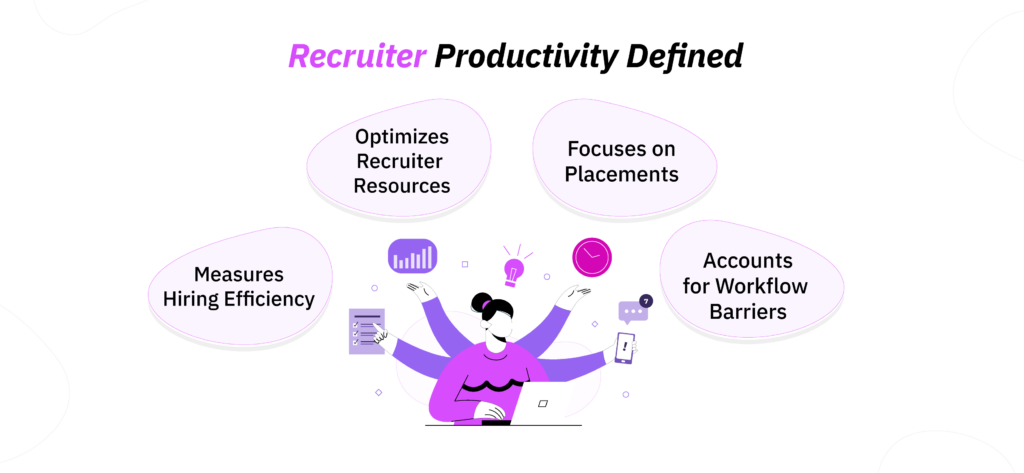
Recruiter productivity measures how effectively an agency converts available resources into hiring outcomes. Those resources include recruiter time and sourcing tools. Other than that, it is how efficiently the recruiter works with Candidate data, client information, management support, and operational capacity.
For this benchmark-based model, productive work includes activities that move a viable candidate or client requirement closer to a placement. Targeted sourcing and the resolution of interview delays all meet this standard.
An important thing here to remember is that while measuring productivity, candidate intake process, poor database hygiene, or delayed client feedback can restrict even an experienced recruiter. Effective measurement must account for these operational conditions before leadership draws conclusions about individual performance.
Recruiter Productivity vs. Recruiter Activity: Understanding the Key Differences
Recruiter activity records what happened, and recruiter productivity shows whether that work created useful progress. Here’s a quick look at the two.
| Aspect | Recruiter Productivity | Recruiter Activity |
| Definition | How effectively a recruiter turns time and effort into meaningful recruiting results | The volume of tasks and actions a recruiter completes |
| Primary focus | Outcomes and efficiency | Activity and workload |
| Primary focus | Placements, qualified candidates, time-to-fill, and hiring outcomes | Calls, emails, interviews, submissions, and follow-ups |
| Key question | “What results did the recruiter generate? | “How much work did the recruiter complete?” |
| Example | Filling 8 roles with 40 qualified candidates | Making 150 candidate calls in a week |
| Why it matters | Shows whether recruiting efforts are producing valuable results | Helps track workload, effort, and day-to-day performance |
| Potential issue | High activity does not always translate into high productivity | High activity can create the appearance of productivity without strong results |
Why Recruiter Productivity Matters for Staffing Agencies
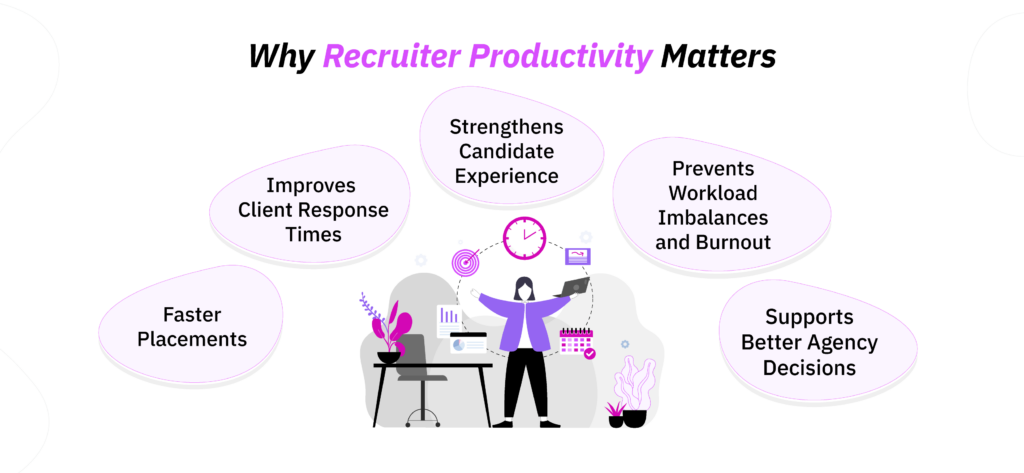
Recruiter productivity matters because it directly affects placement volume and operating costs. Throughout the hiring lifecycle, I recommend measuring these outcomes through a combination of implications of productivity metrics and outcomes
1. Creates More Placement and Revenue Capacity
Productive recruiters spend less time on duplicate data entry and manual updates. This gives them more capacity for candidate conversations and client development.
For recruitment agencies, even modest improvements in time allocation can increase the number of viable searches a team can manage without reducing submission quality.
2. Improves Client Response Times
Clients expect agencies to understand vacancies quickly and present suitable candidates within a reasonable period.
To meet this expectation, agencies need efficient workflows that reduce delays between screening and candidate submission. As a result, faster response times can strengthen client confidence, particularly when the agency also maintains relevance and quality throughout the process.
3. Strengthens the Candidate Experience
Inefficient processes cause delayed updates and inconsistent communication. If this happens, candidates disengage when recruiters cannot explain the next step or provide timely feedback. By contrast, recruitment agencies with organized workflows can deliver clearer communication and build stronger long-term candidate relationships.
4. Prevent Workload Imbalances and Burnout
Productivity data can reveal whether recruiters are managing too many requisitions or spending excessive time on administration. I recommend reviewing these conditions before increasing performance targets. Ultimately, better workload distribution protects employee well-being while helping agencies maintain consistent service levels.
5. Support Better Agency Decisions
Accurate metrics help leaders identify where hiring delays begin. Often, the bottleneck may be within sourcing, screening, client feedback, interview scheduling, or offer management. This way, recruitment agencies can improve workflows and select technology that addresses a verified operational problem.
How to Increase Recruiter Productivity in a Staffing Agency: 10-Step Framework
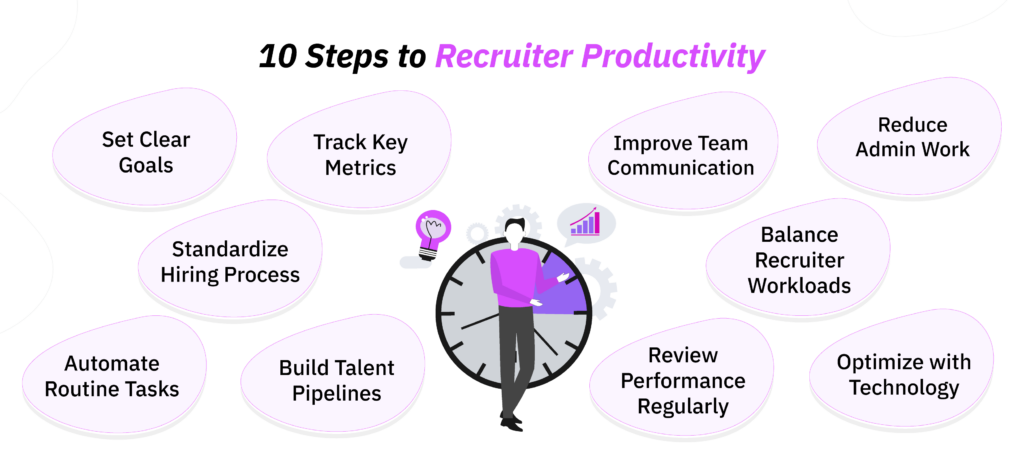
To illustrate how these strategies work together, I created a model for a mid-sized recruiting company with eight recruiters.
At the start of the quarter, each recruiter managed 14 active requisitions, produced six qualified submissions per week, and completed two placements per month. Time to first submission averaged five days, while administrative work consumed 11 hours per recruiter each week.
In the model, the following 10 strategies were introduced. Over the 90-day period, monthly placements increased from 2 to 2.6 per recruiter. Time to first submission decreased from five days to three, while administrative work declined to seven hours per recruiter each week.
Across the eight-person team, quarterly placements increased from 48 to approximately 62. Moreover, candidate response rates rose from 28% to 34%, while the submission-to-interview ratio improved from 25% to 31%.
The following strategies were applied in the model:
1. Set Goals That Balance Hiring Speed and Candidate Quality
Setting goals that balance hiring speed and candidate quality increases recruiter productivity without sacrificing submission quality or candidate experience.
The model replaced general activity targets with five outcome-based measures: qualified submissions, scheduled interviews, monthly placements, client response time, and candidate response rate.
Each recruiter received a target of seven qualified submissions per week, but submissions were also reviewed against interview conversion. This prevented recruiters from increasing volume through poorly matched candidates.
By the end of the quarter, weekly submissions rose from six to seven per recruiter. The submission-to-interview ratio also increased from 25% to 31%. So overall, the agency gained more viable candidates without weakening submission quality or candidate experience.
2. Automate Repetitive Work to Recover Recruiter Time
Knowing how repetitive work can take up most of the time, I mapped the administrative work that consumed recruiter time each week. The review identified repeated data entry throughout the process.
I automated stable tasks but retained human review for screening decisions and candidate communication. From these changes, administrative time subsequently fell from 11 hours to seven hours per recruiter each week. Across eight recruiters, this returned 32 hours of weekly capacity to the agency.
For automation, many recruitment agencies are opting for AI tools as well. Bullhorn’s GRID 2026 Industry Trends research found that agencies using AI in recruitment are 3.5 to 4.5 times more likely to have achieved revenue growth than those that do not. It can be useful; however, doing proper research for tools is highly recommended.
3. Standardize Each Stage of the Recruitment Workflow
Nothing helps recruiters more than a properly laid out workflow that defines things they need to accomplish at every stage of the hiring lifecycle.
I introduced one core workflow with clear stage definitions, ownership rules, and service expectations. Recruiters retained discretion over candidate conversations, but the operational process stayed consistent.
After one quarter, incomplete candidate records fell from 18% to 7%. Average time to first submission also declined from five days to three. Standardization made delays easier to identify and reduced the time managers spent correcting process errors.
4. Measure Productivity Through Reliable Tools and Outcome Metrics
I introduced a productivity tracking tool that generated weekly reports showing how much time recruiters spent on each stage.
We set practical time benchmarks for each recruitment stage and compared them with actual performance. The reports showed that recruiters were losing time on repeated database searches, manual status updates, unnecessary meetings, and tasks that could be automated.
Based on these findings, I adjusted workflows and redirected more time toward candidate and client engagement. By the end of the quarter, the reports showed productivity improvements ranging from 5% to 10% across different activities. Recruiters completed routine work faster and spent more time on placement-focused tasks.
Transform Recruiter Productivity with Actionable TimeBee Insights
Learn More
5. Centralize Recruitment Work in an Applicant Tracking System
Considering the amount of application recruitment agencies get in a day, an ATS is the best decision. I moved everything from candidate records to pipeline stages into one applicant tracking system. Recruiters no longer had to search across spreadsheets before contacting a candidate.
The ATS also supported résumé parsing, candidate search, interview tracking, and workflow reminders. Moreover, the ATS platform centralized candidate information and automated recurring recruitment tasks.
After the first quarter, duplicate data entry fell by 60%. Recruiters saved an estimated 90 minutes each week, while managers gained a consistent view of active roles and pipeline status.
6. Improve the Accuracy of the Candidate Database
Human errors can always happen; however, it does not mean they cannot be prevented with a proper checking system. Especially if a process has so many stages, one has to be much more careful.
I audited the existing talent database before asking recruiters to source more candidates. Almost one in five reviewed records contained outdated availability information or incomplete skill tags.
I introduced monthly data checks and clear rules for candidate status. Recruiters also received responsibility for updating records after meaningful candidate interactions.
Database reuse increased from 22% to 34% of qualified submissions during the quarter. Recruiters spent less time rebuilding searches for roles that the agency had filled before. Additionally, they reduced irrelevant outreach because candidate information was more accurate.
7. Protect Time for High-Value Recruitment Work
Prioritizing your work is the first step to achieving productivity in any role. I divided recruiter responsibilities into work that required professional judgment and work that could be automated or delegated.
The strategy suggested that the candidate relationships, targeted sourcing, client consultation, interviews, and offer discussions would be recruiter-led. And routine scheduling, reminders, document requests, and standard updates moved into automated workflows. Recruiters then reserved two daily blocks for candidate and client conversations.
Following this, candidate conversations increased from an average of 14 to 19 per recruiter each week. Monthly placements rose from two to 2.6 per recruiter. The improvement came from better use of existing hours rather than longer working days.
8. Use Templates Without Making Communication Impersonal
I created approved templates for every email and message that were to be sent to either the interviewer or client. Each template included fields that recruiters had to personalize before sending.
The objective was to remove repeated drafting while preserving context. That’s a given that recruiters still adjusted messages according to the role; however, the effort would be minimal.
Average preparation time for routine messages fell from six minutes to three minutes. Across 40 recurring messages per recruiter each week, this saved approximately two hours. Candidate response rates also rose from 28% to 34% after the agency improved targeting and personalization.
9. Train Recruiters Around Identified Performance Gaps
Targeted training goes a long way in any role. I used workflow data to decide which training topics deserved attention. Low sourcing accuracy led to Boolean search coaching, while weak interview conversion led to sessions on screening quality and candidate presentation.
Recruiters also received practical training on the ATS, AI tools, negotiation, and recruitment analytics. The training used active requisitions rather than generic exercises. After eight weeks, new recruiters reached the team’s minimum submission target in six weeks instead of nine.
10. Balance Workloads According to Requisition Complexity
I reviewed workload beyond the number of open roles. Each weekly review considered pipeline stage and administrative demand.
The initial audit showed that two recruiters managed 19 active requisitions each, while three recruiters managed fewer than 11. I reassigned six roles and introduced a capacity range of 13 to 17 active requisitions per recruiter. The team increased average capacity from 14 to 17 requisitions without additional overtime.
Overview: Recruiter Productivity Before and After 90 Days
| Productivity Metric | Start of Quarter | After 90 Days | Change |
| Monthly placements per recruiter | 2 | 2.6 | 30% increase |
| Quarterly team placements | 48 | Approximately 62 | Approximately 30% increase |
| Qualified submissions per recruiter per week | 6 | 7 | 17% increase |
| Time to first submission | 5 days | 3 days | 40% reduction |
| Administrative work per recruiter | 11 hours/week | 7 hours/week | 36% reduction |
| Candidate response rate | 28% | 34% | 6 percentage-point increase |
| Submission-to-interview ratio | 25% | 31% | 6 percentage-point increase |
| Average active requisition capacity | 14 | 17 | 21% increase |
4 Common Recruiter Productivity Mistakes + How to Avoid Them
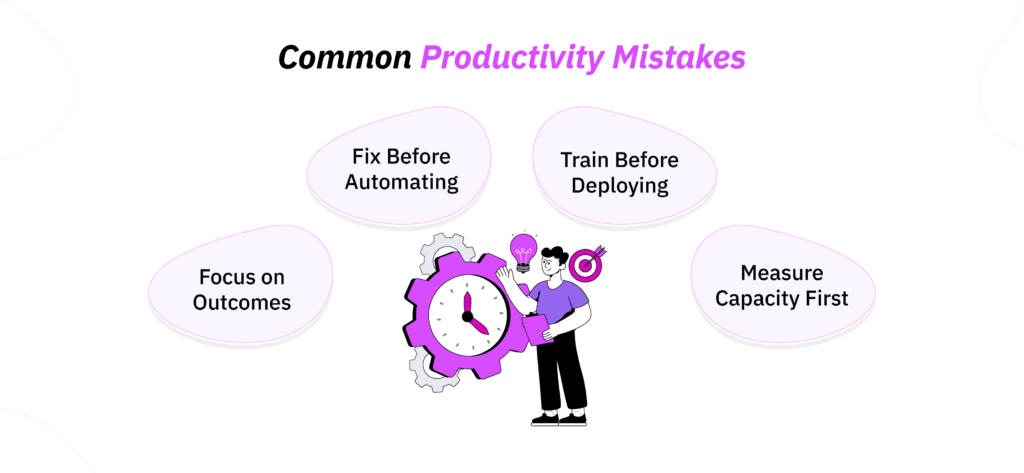
While the above strategies are genuinely effective, many staffing agencies make evaluation mistakes that can distort results and undermine the value of these efforts.
1. Measuring Calls and Emails Instead of Outcomes
Activity counts are easy to collect, but they can reward visible motion rather than placements. Use them to diagnose behavior, then evaluate conversion and commercial results.
2. Automating Inefficient Processes
Automation can accelerate duplication or poor communication. Map the process first, remove unnecessary steps, and automate only after the workflow is stable.
3. Adding Technology Without Training Recruiters
A tool cannot improve productivity when users do not understand the workflow or the expected data. Assign ownership, provide role-based training, and review adoption after launch.
4. Increasing Workloads Without Measuring Capacity
More requisitions do not always create more placements. Recruitment agencies should examine pipeline stage, client responsiveness, recruiter experience, and administrative demand before reallocating work.
Recruiter Productivity Metrics That Actually Matter
A useful scorecard combines six metric groups. No single measure can explain recruiter performance.
| Metric Category | Metrics | Average Impact on Recruiter Productivity |
| Activity Metrics | – Outreach attempts- Screens completed- Candidate profiles reviewed | Low-Medium — tracks effort but not outcomes |
| Efficiency Metrics | – Time to first submission- Time to fill- Recruiter hours per placement | High — directly shortens the hiring cycle and increases placements per recruiter per week |
| Conversion Metrics | – Response rate- Ssubmission-to-interview ratio- Interview-to-offer ratio- Offer-to-placement ratio | High — improves match quality |
| Quality Metrics | – Hiring manager satisfaction- Candidate experience- Retention- Post-hire performance (where the agency can lawfully access that data) | Medium — protects long-term productivity by reducing repeat searches from bad hires |
| Commercial Metrics | – Revenue per recruiter- Gross profit- Placement value- Client retention | Medium — reflects the business outcome of productivity rather than driving it directly |
| Capacity Metrics | – Requisitions per recruiter- Active candidates- Workload by stage- Time spent on administrative work | High — prevents overload and burnout |
These relevance ratings are indicative and may vary according to an agency’s business model, role complexity, technology stack, client responsiveness, and placement type.
I recommend reading these measures together. A fast time to first submission means little when interviews remain low. High placement volume can also conceal poor margins or excessive workload.
3 Most Useful Tools To Increase Recruiter Productivity in a Staffing Agency
While no single platform solves every recruitment challenge, the following three tools consistently helped improve hiring efficiency. I recommend these tools because they can actually help staffing agencies increase productivity.
1. LinkedIn Recruiter For Sourcing

LinkedIn Recruiter is a widely used sourcing platform for staffing agencies that hire across different industries and seniority levels. It helps recruiters identify qualified candidates faster by providing access to talent recommendations and a large network of active and passive professionals.
The platform allows recruiters to filter candidates by skills, experience, location, industry, company, education, and several other criteria to reduce time spent reviewing unsuitable profiles. Moreover, recruiters can save talent pools or organize candidate projects and outreach within the platform.
Another advantage is its ability to engage passive candidates who may not be actively applying for jobs but are open to the right opportunity. This expands the available talent pool and improves sourcing efficiency for difficult-to-fill positions.
While LinkedIn Recruiter significantly improves candidate sourcing, it is not designed to manage the entire recruitment lifecycle. Staffing agencies still need an Applicant Tracking System (ATS) to handle placement management. For agencies focused on finding quality candidates quickly, LinkedIn Recruiter can be a valuable sourcing solution.
2. TimeBee For Recruiter Productivity Tracking
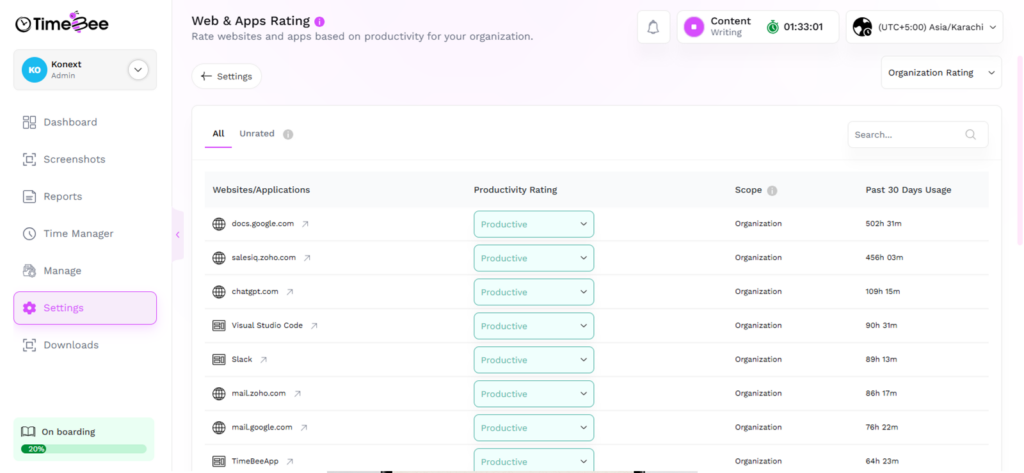
TimeBee is an agency productivity and time tracking tool that provides clear insights at both individual and team levels. It helps staffing agencies understand how recruiters use their working hours and identify practical opportunities to improve efficiency.
Instead of relying only on activity metrics such as calls or emails, TimeBee provides visibility into the time spent on sourcing, candidate communication, administrative work, meetings, interview coordination, and other daily responsibilities.
These insights allow managers to identify operational bottlenecks before assuming that productivity issues are caused by recruiter performance. For example, TimeBee shows how much time employees spend on productive and non-productive websites and applications.
Managers can see how long recruiters spend on platforms such as LinkedIn or entering candidate information into the ATS. When one activity consumes an excessive amount of time, it may indicate a workflow issue, training gap, or inefficient process that needs attention.
After changes are introduced, managers can review quarterly reports to measure progress. These reports show productivity patterns and changes across three months, making it easier to identify when an issue occurred and assess whether an operational strategy produced the intended results.
Ultimately, these insights help agencies save time and make workforce planning more data-driven. Recruiters gain a clearer understanding of where delays occur and which areas require improvement. Management can prioritize the most pressing issues, focus resources where they are needed, and identify which productivity strategies are actually delivering results.
3. Bullhorn ATS
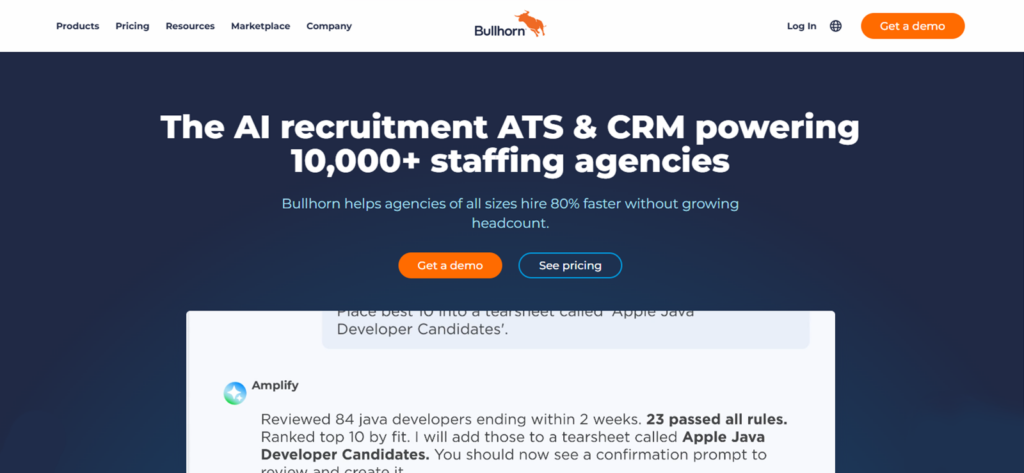
Bullhorn is an applicant tracking and customer relationship management platform for staffing and recruitment agencies. It centralizes candidate information, client records, requisitions, and pipeline data in one system.
The platform supports résumé parsing, candidate searches, interview scheduling, pipeline management, and customer relationship management (CRM), allowing recruiters to manage the hiring process from initial sourcing to final placement. Automation features also reduce repetitive administrative tasks by handling interview reminders, follow-up emails, workflow notifications, and routine record updates.
Bullhorn’s reporting and analytics help recruitment leaders monitor important recruiter productivity metrics. These insights make it easier to identify bottlenecks and allocate resources more effectively.
Although implementation requires planning and user training, Bullhorn offers a scalable solution for agencies managing high recruitment volumes. When combined with standardized recruitment processes and well-trained recruiters, it can support higher recruiter productivity and provide visibility across the entire recruitment lifecycle.
Conclusion
If you’re looking for a definitive answer to how to increase recruiter productivity, the first step is recognizing that it directly impacts your agency’s ability to fill roles faster, improve client satisfaction, and generate more revenue.
The good news is that the right strategies can make a measurable difference. However, productivity isn’t something you improve once and then forget about. Recruiting trends, client expectations, and candidate behavior change constantly, so your approach should evolve too.
Review your recruiter productivity metrics weekly, monthly, and quarterly to identify what’s working, spot bottlenecks early, and refine your processes. Consistent evaluation is what turns good strategies into long-term results.
FAQs
What is a good recruiter productivity benchmark for a staffing agency?
There is no universal benchmark that applies to every staffing agency. Appropriate targets depend on role complexity, industry, recruiter experience, placement type, client responsiveness, and available technology. Recruitment agencies should compare recruiters working under similar conditions and prioritize their own historical performance trends over broad industry averages.
How often should recruiter productivity be reviewed?
Operational indicators can be reviewed weekly to identify immediate bottlenecks, while broader outcomes should be evaluated monthly or quarterly. Reviewing results over longer periods helps managers distinguish sustained performance changes from temporary fluctuations caused by difficult requisitions, delayed client feedback, holidays, or seasonal hiring patterns.
How can agencies separate recruiter performance from client delays?
Agencies should track recruiter-controlled stages separately from client-controlled stages. For example, time to first internal submission can be assessed independently from time awaiting client feedback or interview availability. Separating these stages prevents recruiters from being penalized for delays outside their control and gives managers a clearer view of where the hiring process is slowing down.
Does recruiter productivity vary by industry or role type?
Yes. High-volume temporary hiring, specialist recruitment, executive search, and permanent placement desks require different amounts of sourcing, screening, and relationship management.
Productivity targets should therefore reflect requisition difficulty, talent availability, compliance requirements, placement value, and the level of candidate assessment required.
What privacy considerations apply to recruiter productivity tracking?
Productivity tracking should be transparent, proportionate, and connected to a legitimate operational purpose. Recruiters should understand what information is collected, how it is interpreted, and how it will be used. Agencies should avoid intrusive monitoring, restrict access to productivity data, and review applicable employment and privacy requirements in every jurisdiction where they operate.
TimeBee: Unlock Higher Recruiter Productivity
Try TimeBee



Patricia Adams
Member since July 28, 2026
Patricia Adams
Member since July 28, 2026
Patricia Adams is the Director of People and Culture, who focuses on employee experience, people operations, performance management, and the responsible use of workforce technology.
She holds an M.S. in Industrial/Organizational (I/O) Psychology from Florida Institute of Technology. She is also a Certified Information Privacy Manager through the International Association of Privacy Professionals.
With more than 5 years of experience, Patricia examines how workplace systems affect both organizational performance and the people being measured.
Therefore, her work centers on helping organizations establish practical policies that support accountability without disregarding employee privacy and professional autonomy.