

10 Best Practices For Remote Hiring I’d Recommend From Experience
October 29, 2026 14 min readRemote hiring gives businesses access to talent beyond their immediate location, but finding qualified candidates is only one part of the process. As a leader, you also need to determine whether someone can perform independently, collaborate across distances, and succeed without the support structures of a shared office.
From a people operations and organizational psychology perspective, I believe the most effective remote hiring decisions begin with clearly defined expectations and consistent evaluation methods. A strong resume or confident video interview should never substitute for evidence of someone’s ability to do the job.
In this guide, I’ll explain ten remote hiring best practices that can help you improve candidate selection and make decisions that support long-term business needs.
Everything You Need to Know About Remote Hiring Best Practices
- Define remote roles with clear responsibilities, required skills, and measurable success criteria.
- Write transparent job descriptions covering working hours, location restrictions, compensation, and expectations.
- Use structured interviews and relevant skills assessments to evaluate candidates fairly and consistently.
- Assess communication, independent working ability, and asynchronous collaboration skills during recruitment.
- Track recruitment workloads to identify bottlenecks and reduce unnecessary hiring delays.
- Make evidence-based hiring decisions while ensuring compliance, candidate privacy, and effective onboarding.
What Makes Remote Hiring More Difficult Than Traditional Hiring?
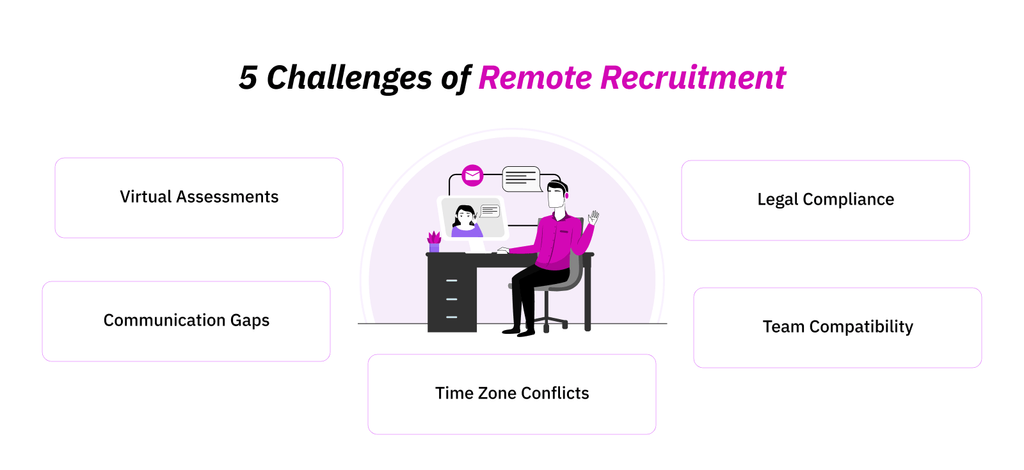
Remote recruitment presents several challenges that are less pronounced when candidates and hiring teams share a physical location. Understanding them can help you build a hiring process suited to distributed work rather than simply moving traditional interviews online.
1. Assessing Candidates Without In-Person Interactions
Virtual interviews offer only a limited view of how candidates behave in professional settings. Hiring managers primarily observe applicants during scheduled video calls, which makes it harder to understand how they approach everyday responsibilities, respond to unexpected situations, or interact with colleagues.
One difficulty I’ve observed throughout my experience is how easily confidence can influence perceptions of competence. A candidate who communicates comfortably on camera may create a stronger initial impression than someone who is equally capable but less comfortable in virtual conversations.
This creates a risk of overlooking qualified applicants or favoring candidates based on their presentation rather than their ability to perform the role.
2. Evaluating Communication Skills and the Ability to Work Independently
In remote environments, employees cannot always rely on immediate clarification or informal conversations with colleagues. They may need to interpret instructions and communicate progress.
However, these capabilities can be difficult to establish during recruitment. Someone who gives articulate interview answers may still struggle with written updates, documentation, or managing competing deadlines without regular supervision.
Over the years, I’ve seen how unclear communication expectations can create misunderstandings about ownership and accountability. In remote teams, these issues may remain unnoticed until deadlines are missed or colleagues discover they have been working with different assumptions.
3. Coordinating Interviews Across Different Time Zones
Remote recruitment often involves candidates and decision-makers working in different countries, which makes scheduling more complicated than arranging interviews within a single office or region.
For example, a candidate based in Singapore may have very limited convenient working-hour overlap with a hiring manager in California. If the recruitment process also involves a department head and an HR representative in separate locations, finding a suitable meeting time can become considerably more difficult.
These scheduling differences can prolong recruitment, particularly when each interview stage depends on feedback or availability from multiple stakeholders.
4. Building Trust and Assessing Team Compatibility Virtually
In traditional hiring, informal conversations and workplace interactions may provide additional context about how candidates communicate with others. Remote recruitment offers fewer opportunities for these interactions, making it difficult to understand how someone might approach collaboration, feedback, and professional disagreements.
This uncertainty can lead hiring managers to rely heavily on impressions from video interviews. However, shared interests, similar personalities, or an immediately comfortable conversation do not necessarily indicate that someone will collaborate effectively with a distributed team.
From an organizational psychology perspective, I consider this distinction particularly important because perceived compatibility can easily become confused with personal familiarity.
5. Managing Employment Laws and Compliance Across Locations
International remote hiring introduces legal and administrative complexities because employment requirements vary across jurisdictions.
A company headquartered in one country may recruit someone living in another, where different rules govern employment contracts, worker classification, payroll, taxation, benefits, working hours, and employee protections.
These differences become particularly challenging when organizations assume that remote employees can be hired under the same arrangements used for their domestic workforce.
Data privacy introduces another consideration. Recruitment teams may collect identity documents, assessment results, interview recordings, and other candidate information that is subject to local data protection requirements.
What Are the Top 10 Remote Hiring Best Practices?
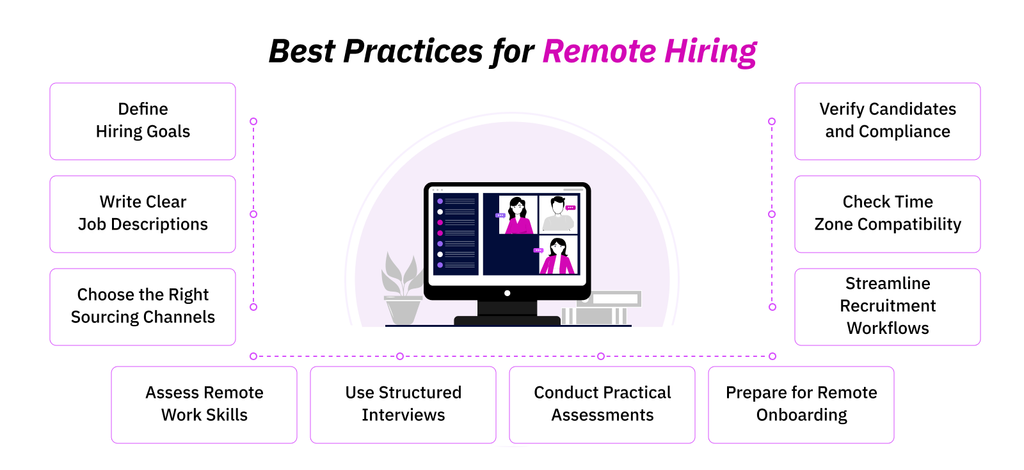
The following remote hiring practices focus on the decisions you, as a leader or manager, can influence directly, from defining a position to preparing a successful candidate for their first day.
1. Define the Role and Its Success Criteria Before Recruiting
Before approving a remote position, I recommend identifying what the employee must accomplish rather than starting with a conventional list of responsibilities.
To do so, it is always a good option to ask yourself these three questions:
- What business problem will this role solve?
- Which capabilities are essential?
- What should successful performance look like after 90 days?
For example, instead of hiring a remote customer support manager simply to “improve customer service,” you can define outcomes such as establishing escalation procedures, reviewing response quality, and ensuring reliable coverage.
Once done, it is also equally important to agree on these expectations with the hiring manager and recruitment team. This prevents different stakeholders from evaluating candidates against conflicting requirements.
You should also establish the position’s budget, reporting structure, employment arrangement, and location restrictions before sourcing begins.
As for me, my preferred principle is simple: if leadership cannot explain what success looks like, recruiters cannot reliably identify the person most likely to achieve it.
2. Write Transparent Remote Job Descriptions That Attract the Right Candidates
A remote job description should help candidates understand the actual working arrangement, not merely the responsibilities associated with the position.
For this, you need to specify whether the role is fully remote, restricted to particular countries, or requires attendance at occasional in-person meetings. Other than this, you should also include the compensation range where appropriate, expected working hours, reporting relationships, and essential qualifications.
Moreover, simply writing “flexible remote position”, you need to be specific about it, as flexibility is a subjective term. For instance, writing “remote position with four hours of required overlap between 10 a.m. and 2 p.m. Eastern Time” instead of just “flexible” can offer more clarity.
Candidates should also understand which tools the team uses, how performance is evaluated, and whether the position requires regular client interaction.
I recommend reviewing every requirement before publication. If a qualification does not meaningfully contribute to successful performance, consider whether it belongs in the description.
The objective is not to attract the largest applicant pool. It’s to give suitable candidates enough information to make an informed decision about applying.
3. Choose Recruitment Channels Based on Talent Quality
Remote recruitment opens access to numerous hiring platforms, professional communities, as well as employee referral networks. However, each source may attract candidates with different experience levels and specializations.
Rather than advertising every position across the same channels, match your sourcing strategy to the role.
For specialized technical positions, professional communities and targeted networks may be useful. Broader remote job boards can help with general business roles, while referrals may introduce candidates whose professional capabilities are already familiar to someone in your organization.
Although the general board produces the most applications, referrals usually deliver the highest proportion of qualified applicants. Understanding this is important because application volume alone is an incomplete measure of sourcing effectiveness.
In one of the hiring cycles I was leading, each sourcing channel gave me the following results:
| Recruitment source | Applications | Qualified applicants |
| General job board | 160 | 24 |
| Specialist community | 70 | 21 |
| Employee referrals | 30 | 12 |
I, therefore, recommend reviewing sourcing channels using consistent qualification criteria, candidate progression, and recruitment costs before increasing your investment.
4. Screen for Remote-Ready Skills
Previous remote employment can be useful experience, but I wouldn’t make it a universal requirement.
Someone who has successfully managed independent projects, coordinated distributed stakeholders, or handled responsibilities with limited supervision may already possess relevant capabilities.
Focus instead on the demands of the specific position. For instance, you can ask questions like:
“Tell me about a time you had to complete an important task without immediate access to your manager. How did you decide what to do?”
A strong response should explain the candidate’s reasoning, actions, as well as the outcome they got from them. It should also demonstrate when they knew to seek clarification.
You can also evaluate communication through a short written scenario that requires candidates to summarize a problem and recommend next steps.
However, avoid treating a preference for quiet working environments, particular personality traits, or polished video presentation as evidence of remote readiness. What matters is whether candidates can perform the job under the working conditions you actually provide.
TimeBee: Bring Clarity to Your Remote Hiring Workflow
Learn More
5. Conduct Structured Remote Interviews
Unstructured interviews leave considerable room for personal impressions to influence recruitment decisions.
As someone whose professional perspective is grounded in organizational psychology, I favor structured interviews because they allow managers to compare candidates using predefined, job-related criteria.
For this purpose, you need to select four to five competencies essential to the position. From there, you can develop questions that give candidates opportunities to demonstrate each competency, then establish scoring descriptions before conducting interviews.
For example, a five-point scale for problem-solving might distinguish between candidates who describe a decision vaguely and those who clearly explain the problem, available options, chosen action, and result.
Ask candidates for the same role equivalent core questions to allow relevant follow-ups without changing the underlying assessment standard.
I also recommend having interviewers record their evaluations before sharing opinions. This reduces the likelihood that an influential panel member shapes everyone else’s judgment.
That said, it is also crucial to remember that a structured process doesn’t eliminate uncertainty. However, it does give leaders a clearer basis for making and explaining hiring decisions.
6. Use Relevant Skills Assessments to Validate Candidates’ Abilities
Interviews reveal how candidates describe their experience. Practical assessments, by contrast, can provide additional evidence of how they apply their abilities.
The key here is to design or choose an assessment that reflects the actual position.
For instance, let’s say a remote project coordinator receives a project update containing conflicting deadlines, unclear ownership, and an emerging delivery risk. Within this hypothetical situation, you can ask the candidate to identify priorities, draft a stakeholder update, and explain which information they would clarify first.
You can then evaluate their response using predefined criteria such as accuracy, prioritization, communication, and reasoning.
Furthermore, a task should be proportionate to the role and respect candidates’ time. A short assessment may be appropriate for early evaluation, whereas substantial assignments warrant consideration of compensation.
I would also avoid tests that attempt to infer professional competence from facial expressions, typing patterns, or unrelated personality characteristics.
7. Streamline the Recruitment Team’s Workflow and Maintain Process Accountability
Even a well-designed selection process can become inefficient when recruitment responsibilities are poorly coordinated.
For example, sourcing may be progressing while the hiring team delays interview feedback, or recruiters may spend substantial time arranging meetings that could be scheduled more efficiently. To solve this, I recommend separating candidate management from recruitment team workload management.
An applicant tracking system should maintain candidate records, application stages, interview notes, and hiring decisions. Meanwhile, project and time-tracking information can help leaders understand the resources being consumed by recruitment activities.
I myself have used TimeBee’s project tracking and timesheet features to gain a clearer understanding of how our recruitment team’s working hours were distributed across different hiring activities.
For this, I organized recruitment work into tasks such as candidate sourcing, resume screening, interview coordination, and administrative follow-ups. Rather than relying on weekly updates or rough estimates, I could review recorded project hours and identify where the team was spending the most time.
During one review, for example, our four-person recruitment team had logged approximately 320 hours in a month, with 120 hours spent sourcing candidates, 80 hours screening applications, 72 hours coordinating interviews, and 48 hours handling administrative tasks.
TimeBee’s task-level tracking and filtered reports helped me examine that distribution more closely. What stood out was that interview coordination alone accounted for 22.5% of the team’s recorded hours. That raised an important question: were we spending too much time arranging interviews instead of evaluating candidates?
After reviewing the workflow, we consolidated scheduling responsibilities and introduced clearer availability windows, which reduced interview coordination time from 72 to 48 hours the following month.
8. Account for Time Zones and Asynchronous Collaboration Early
A candidate may meet every technical requirement and still not be suitable for a role requiring regular collaboration outside their available working hours.
That’s why I recommend distinguishing essential scheduling requirements from organizational preferences.
For example, a remote content strategist may be able to complete most responsibilities asynchronously, while a customer support specialist serving North American clients may need fixed coverage hours.
So, your recruitment team needs to explain these requirements during hiring and verify availability before progressing candidates to final interviews. Furthermore, for roles involving asynchronous collaboration, they should clearly discuss how team members document decisions, hand over responsibilities, and communicate blockers.
9. Make Fair, Compliant, and Evidence-Based Hiring Decisions
A hiring decision should reflect job-related evidence and the organization’s actual ability to employ the selected candidate.
Before finalizing an offer, compare assessment results with the requirements established at the beginning of recruitment. Investigate material inconsistencies, verify relevant credentials where appropriate, and complete necessary reference checks.
For international positions, confirm the proposed employment arrangement with qualified HR, payroll, or legal specialists familiar with the applicable jurisdictions.
Candidate data handling also deserves attention. Collect information necessary for recruitment, restrict access to authorized personnel, and establish appropriate retention practices.
If your organization uses AI-assisted screening, examine what the system measures, whether its assessments are relevant to the role, and how adverse decisions are reviewed.
I recommend keeping meaningful human oversight throughout selection rather than relying on automated rankings as the final authority.
A defensible hiring decision is the one supported by relevant evidence, consistent standards, and appropriate compliance checks.
10. Prepare Remote Onboarding Before the Candidate Accepts the Offer
Remote onboarding preparation should begin while the final hiring arrangements are being completed, not after an employee’s first working day.
Before issuing an offer, confirm that the role’s responsibilities, compensation, working arrangements, and initial expectations have been communicated accurately.
Once the offer is accepted, coordinate equipment, account access, documentation, introductions, and orientation activities so the employee can begin effectively.
I recommend establishing a simple progression:
| Period | Primary onboarding objective |
| First 30 days | Understand responsibilities, systems, and team processes |
| First 60 days | Complete initial assignments with appropriate support |
| First 90 days | Demonstrate progress toward agreed role outcomes |
The milestones should be tailored to the position and reviewed with the employee.
From a people operations perspective, I’ve learned that onboarding is also an opportunity to test the accuracy of your recruitment process.
If new hires repeatedly discover unexpected working-hour requirements or responsibilities, the problem may originate in the way the role was advertised and evaluated.
Effective onboarding therefore supports both employee integration and continuous improvement in remote hiring.
How to Make Better Remote Hiring Decisions When Candidates Are Equally Qualified
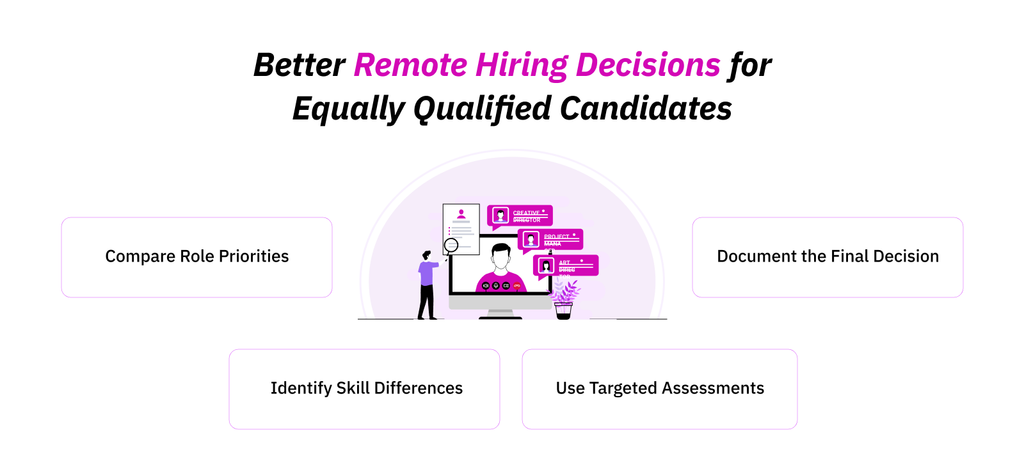
When two candidates meet the requirements of a remote position, selecting between them can become more difficult than evaluating less-qualified applicants. At this stage, I recommend looking for meaningful differences in their ability to meet the organization’s priorities rather than searching for a subjective reason to prefer one person.
1. Compare Candidates Against the Role’s Most Important Outcomes
Start by reviewing the outcomes the position is expected to deliver.
For example, two remote operations managers might receive equally strong overall evaluation scores, but one may have greater experience improving workflows while the other excels at managing distributed teams.
If your immediate priority is improving coordination across departments, the second candidate’s experience may be more relevant.
I therefore recommend revisiting the established role requirements rather than introducing new criteria simply because the decision is difficult.
2. Identify Meaningful Differences in Their Skills and Strengths
Similar overall scores can conceal important differences between candidates.
Consider two finalists who each receive 85 out of 100 points. One demonstrates exceptional technical skills but requires more support with stakeholder communication. The other offers slightly less technical depth but has stronger experience coordinating complex projects independently.
The right choice depends on which capabilities are essential from day one and which your organization can realistically develop. So, it is always a better practice to examine the underlying evidence instead of treating the total score as the complete decision.
3. Use Targeted Follow-Up Assessments to Resolve Uncertainties
If an important question remains unanswered, one of the best practices for remote hiring is to include a targeted follow-up that can provide useful evidence.
For instance, if two candidates are equally qualified but their ability to manage conflicting priorities remains unclear, present both with the same brief scenario. Ask how they would address competing deadlines, communicate decisions, and request assistance when necessary.
Keep the assessment short and relevant. I wouldn’t recommend repeating an entire interview simply because the hiring panel finds the decision uncomfortable.
4. Document the Final Hiring Decision and Its Rationale
Once a candidate is selected, record the job-related reasons behind the decision.
A useful decision record identifies the position’s essential requirements, relevant assessment results, any material differences between finalists, and the basis for the final recommendation.
This helps maintain accountability while giving recruitment teams a reference point for reviewing their evaluation practices.
How to Balance Hiring Speed With Candidate Quality
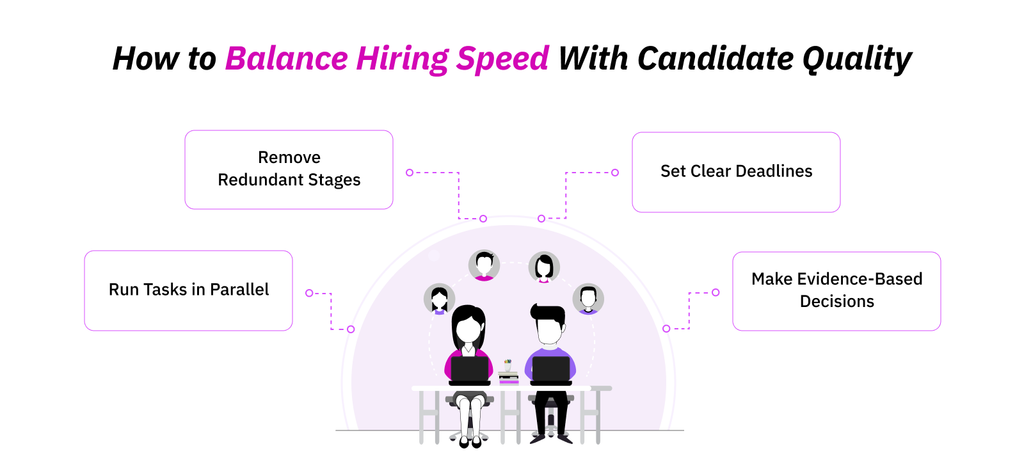
Remote hiring can become unnecessarily prolonged when every stakeholder requests another conversation or delays a decision. However, accelerating recruitment should not mean overlooking essential qualifications or employment requirements.
The objective should always be to reduce avoidable delays while preserving the evidence needed to make a sound hiring decision.
1. Identify Which Hiring Stages Add Real Value
Review what each recruitment stage contributes.
If an initial screening already establishes salary alignment, location eligibility, and basic qualifications, those questions shouldn’t require another standalone interview.
Similarly, a technical assessment should examine capabilities that have not already been adequately demonstrated.
I recommend retaining stages that answer important questions and removing activities that simply repeat existing evaluations.
2. Run Independent Recruitment Activities in Parallel
Some recruitment tasks can progress simultaneously without compromising decision quality.
For example, while a hiring manager reviews a work sample, the recruiter can prepare interview availability, confirm the candidate’s continued interest, and coordinate internal approval requirements.
This reduces unnecessary gaps between stages.
However, activities involving sensitive personal information or formal employment checks should follow the appropriate authorization and consent procedures.
3. Set Clear Decision Deadlines and Approval Responsibilities
Every recruitment stage should have an accountable owner and a reasonable completion expectation.
For example, an organization might ask interviewers to submit scorecards within one business day and schedule final decision discussions within two business days after all required assessments are completed.
These are example service standards, not universal benchmarks.
A useful process also establishes who can approve an offer, resolve disagreements, and authorize exceptions. Without this clarity, qualified candidates can remain undecided while responsibilities move between departments.
4. Know When You Have Enough Evidence to Make an Offer
I recommend asking one final question before requesting another interview: What specific uncertainty would this additional stage resolve?
If the candidate has demonstrated the essential competencies, completed the necessary evaluations, met the role’s requirements, and passed applicable checks, another conversation may add little value.
On the other hand, unresolved concerns about an essential capability deserve investigation, even when the organization is under pressure to hire quickly.
The goal is not the shortest possible process. It’s a timely decision supported by sufficient evidence.
Conclusion
Effective remote hiring requires more than finding qualified candidates across different locations. Leaders need clear role expectations, consistent evaluation methods, coordinated recruitment teams, and informed decisions about working arrangements.
My central recommendation is to focus on evidence of job-related ability rather than assumptions about how successful remote employees should look, communicate, or behave.
A well-managed hiring process should also respect candidates’ time and give decision-makers enough information to act confidently.
When you combine these principles with responsible workforce management, remote recruitment becomes a more predictable and sustainable part of organizational growth.
FAQs
How much does it cost to hire a remote employee?
The cost of hiring a remote employee depends on the role, location, recruitment methods, and internal resources involved. Beyond job advertising and recruitment platform fees, you should account for recruiter hours, interviews, skills assessments, background checks, and onboarding expenses. International hiring may introduce additional payroll and compliance costs. It is recommended to calculate your total cost per hire by combining external recruitment expenses with the internal labor costs incurred throughout the hiring process.
Should you hire remote employees or independent contractors?
You should hire remote employees for ongoing responsibilities that require consistent collaboration, organizational integration, and long-term accountability. Independent contractors are generally better suited to clearly defined projects requiring specialized expertise or temporary support. However, the distinction isn’t simply about flexibility or cost. Employment classification depends on applicable laws and the actual working relationship. I recommend evaluating the duration, responsibilities, degree of control, and legal obligations before choosing either arrangement.
How long should the remote hiring process take?
A remote hiring process may take three to six weeks for many standard positions, although specialized and senior roles often require longer. The timeline depends on sourcing difficulty, interview rounds, skills assessments, and internal approvals. To avoid unnecessary delays, establish clear deadlines for each stage and coordinate interview availability early. However, I wouldn’t prioritize speed over essential evaluations, as rushed decisions can create considerably greater recruitment costs later.
How to scale remote hiring without sacrificing candidate quality
To scale remote hiring without sacrificing candidate quality, you need standardized recruitment criteria, structured interviews, and clearly assigned responsibilities. Start by defining consistent evaluation methods for similar roles, then automate repetitive administrative tasks where appropriate. As application volumes increase, monitor screening workloads and interview capacity to prevent bottlenecks.
When should you reconsider a remote hiring decision?
You should reconsider a remote hiring decision when new, credible information raises concerns about a candidate’s ability to meet essential job requirements. These may include discrepancies in qualifications, consistently weak assessment results, incompatible working-hour availability, or unresolved employment eligibility issues. However, personal preferences and subjective impressions shouldn’t override established evaluation criteria.
Make Every Recruitment Process Transparent with TimeBee
Try TimeBee Now



Patricia Adams
Member since July 28, 2026
Patricia Adams
Member since July 28, 2026
Patricia Adams is the Director of People and Culture, who focuses on employee experience, people operations, performance management, and the responsible use of workforce technology.
She holds an M.S. in Industrial/Organizational (I/O) Psychology from Florida Institute of Technology. She is also a Certified Information Privacy Manager through the International Association of Privacy Professionals.
With more than 5 years of experience, Patricia examines how workplace systems affect both organizational performance and the people being measured.
Therefore, her work centers on helping organizations establish practical policies that support accountability without disregarding employee privacy and professional autonomy.