

How to Increase Your Marketing Agency’s Productivity: 8 Proven Ways to Get More From Your Team
By Frank Oliver
October 19, 2026 10 min readAgency productivity rarely improves because people are simply asked to work harder. In my experience, the more useful question is where your available capacity is being lost.
Any factor can contribute, including but not limited to waiting, rework, poor allocation, unclear ownership, unnecessary administration, or technology that adds friction instead of removing it.
Improving marketing agency productivity therefore requires you to look at the operating system around your team as closely as the team itself.
In this guide, I will show you eight practical ways to do that while also explaining how to distinguish genuine productivity improvements from higher activity, heavier utilization, or short-term increases in workload.
8 Ways to Increase Advertising Agency Productivity
- Establish a productivity baseline before changing how your team works.
- Improve capacity planning and workload allocation to prevent persistent overload and resource conflicts.
- Standardize briefs, handoffs, and repeatable workflows to reduce avoidable rework.
- Reduce work in progress and context switching so employees can finish more of what they start.
- Reduce approval delays and unnecessary revisions that keep finished work in queues.
- Automate repetitive work without automating professional judgment.
- Reduce tool and data fragmentation that creates duplicate administrative work.
- Remove work that should not be consuming capacity in the first place.
What Is Marketing Agency Productivity?
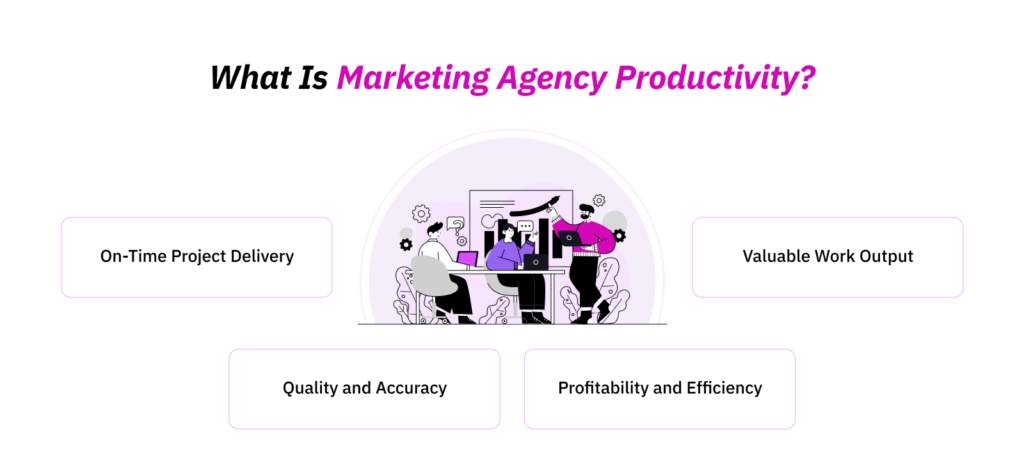
A marketing team’s productivity is the valuable output you generate from the people, time, technology, and other resources available to you. At an economic level, productivity is commonly expressed as output relative to labor input; the U.S. Bureau of Labor Statistics, for example, measures labor productivity as output per hour worked.
Inside a marketing agency, however, I would broaden the management view. Twelve finished designs are not necessarily more productive than eight if half of those 12 require extensive rework, miss the client’s objective, or consume more hours than the project can profitably support.
You therefore need to consider output, quality, delivery, capacity, and commercial value together. This also means different roles should not automatically share one productivity metric. A designer, strategist, account manager, and operations specialist create value differently.
Productivity vs. Activity vs. Efficiency: What’s the Difference?
Productivity measures valuable output, activity describes work taking place, and efficiency describes how economically resources are used. They overlap, but treating them as interchangeable can lead you to reward busyness rather than business results.
| Productivity | Activity | Efficiency | |
| What it means | Valuable output produced from available resources | Observable work or actions taking place | How economically resources are used to produce an outcome |
| Core question | What useful result are we producing? | What is the employee doing? | Could we achieve this result with less time, cost, or waste? |
| Agency example | A team delivers approved campaigns on time with fewer revisions | An employee logs hours, completes tasks, attends meetings, or uses work applications | A recurring client report falls from three hours of preparation to one |
| Useful indicators | Deliverables, cycle time, quality, rework, margin | Logged time, apps used, tasks, attendance, activity levels | Time per output, process steps, manual effort, cost |
| Common mistake | Using one metric for every role | Treating visible busyness as performance | Reducing resources so aggressively that quality suffers |
How Do You Measure Marketing Agency Productivity?
Before knowing how to improve productivity in a marketing agency, it is important to first know how to measure it. My approach in this regard is simple: never take into account a single factor. So, I always combine multiple metrics. Here’s what they are and what they can tell you:
| Metric | What it helps you understand |
| Available capacity | How much work your team can realistically absorb |
| Utilization | How available working time is being allocated |
| Cycle time | How long work takes to move from start to completion |
| On-time delivery | Whether your workflow reliably meets commitments |
| Revision rate | How frequently deliverables require additional changes |
| Rework rate | How much capacity is spent correcting or repeating work |
| Approval latency | How long completed work waits for a decision |
| Estimate variance | How closely actual effort matches planned effort |
| Project margin | Whether output remains commercially viable |
| Workload and overtime | Whether current performance is sustainable |
In one remote agency environment I worked with, 48 employees across 6 time zones initially appeared highly active. Yet over 6 weeks, the operational data showed that 31% of delayed deliverables were spending more time in coordination and approval queues than in production.
That changed the management question. Instead of asking why employees were not completing work faster, we asked where completed or partially completed work was waiting.
That was important because high utilization can coexist with poor output. If your employees are fully occupied with revisions, unnecessary meetings, administrative work, or low-margin projects, adding more activity will not solve the underlying problem.
How to Improve Productivity in a Marketing Agency: 8 Proven Ways
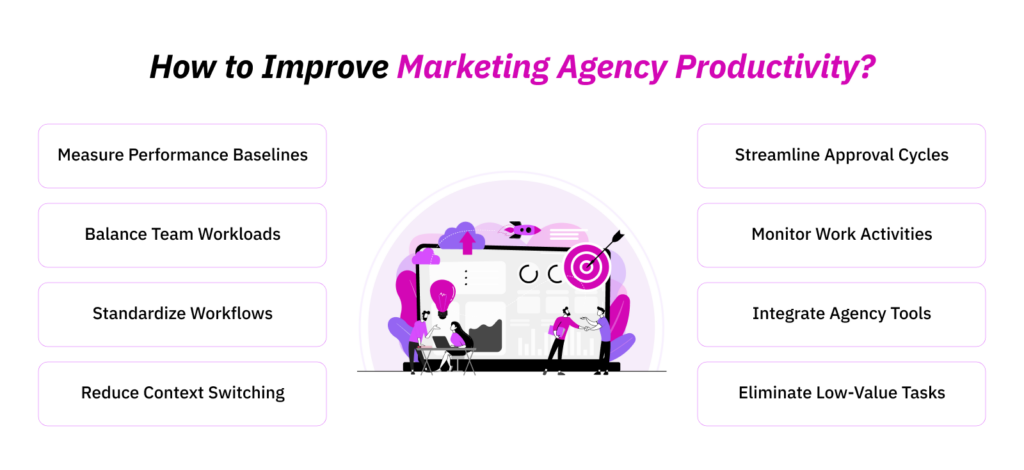
You improve productivity by fixing the constraint that is limiting useful output rather than applying the same productivity tactic to every employee. The following eight approaches show how to diagnose the issue and then fix it. However, they address different operational causes, so I would choose them according to the evidence you have.
1. Establish a Productivity Baseline Before Making Changes
Productivity problems are difficult to solve when you do not have a clear picture of current performance.
I have seen teams introduce new software and restructure workloads because delivery “felt slow,” only to discover later that the main problem was concentrated in one stage of the workflow. Without a baseline, improvements can be equally difficult to prove because there is nothing reliable to compare them against.
A useful baseline depends on the result you are trying to understand. For one agency, that may be the time between receiving a brief and delivering approved work. For another, project margins, revision frequency, missed deadlines, or overtime may provide more useful evidence.
I normally start by following work from request through delivery and comparing the time spent actively producing it with the time it spends waiting. That distinction often reveals problems that a simple count of completed tasks would miss.
2. Improve Capacity Planning and Workload Allocation
A marketing agency can have enough people overall and still experience serious capacity problems.
The reason is that available capacity is rarely distributed evenly. Certain specialists may receive most of the urgent client work, while other employees have room to take on more.
Similarly, an apparently manageable workload can become difficult when several deadlines converge, or unexpected revisions arrive at the same time.
I encountered this while reviewing a remote team with a total of 46 employees. At first, the overall workload looked reasonably balanced.
However, a six-week review showed that 4 employees accounted for 34% of recorded overtime, largely because urgent revisions were repeatedly being assigned to the same people. That was an allocation problem rather than a team-wide productivity problem.
3. Standardize Briefs, Handoffs, and Repeatable Workflows
Rework often begins before production starts.
If a designer receives an incomplete brief, an account manager does not know who has final approval, or a strategist receives essential client information halfway through a project, employees have to fill those gaps while the work is already moving.
Over time, those interruptions consume a surprising amount of capacity.
I have found that standardization works best when it removes uncertainty from repeatable parts of the workflow without restricting how employees apply their expertise. For example, every creative brief can follow the same structure and clearly state the objective, audience, deliverables, scope, deadline, dependencies, and approver.
Designers then receive the information they need upfront while still having the freedom to determine the best creative approach.
The same principle applies when work passes between departments. If nobody is certain who reviews or approves at each stage, completed work can sit idle even though everyone involved appears busy.
A good workflow therefore reduces the number of questions employees need to answer repeatedly while still leaving specialists enough discretion to do their work well.
TimeBee: See Where Your Agency’s Capacity Is Really Going
Learn More
4. Reduce Work in Progress and Context Switching
A large amount of active work can create the impression that an agency is moving quickly. In reality, it can have the opposite effect.
Consider a designer working simultaneously on three campaigns, two revision requests, an internal presentation, and several smaller client tasks. Every project may technically be “in progress,” but very little is reaching completion without interruption.
I have seen this become particularly noticeable in teams nowadays where digital requests can arrive continuously throughout the day. During my experience at a firm, I reviewed 86 on-site employees. Within this review, I found out that people working across more than 5 active assignments at a time took approximately 2% longer to complete comparable work than colleagues whose active workloads were narrower.
The number itself is less important than the pattern: starting work and finishing work are not the same thing. Reducing work in progress is therefore less about forcing people to focus and more about reducing context switching.
5. Reduce Approval Delays and Unnecessary Revision Cycles
A missed deadline does not necessarily mean production took too long.
Work can spend a substantial part of its delivery cycle waiting for internal review or client feedback. When that waiting time is not measured separately, managers may incorrectly conclude that the employees creating the work need to become faster.
Suppose an asset requires four hours of design work but then waits three business days for feedback. Reducing production time by 30 minutes would barely change the client’s overall delivery time.
I have seen the same pattern at a larger scale. In one eight-week review, 61% of delayed projects had reached the production team on schedule. The recurring delay appeared later, when projects passed through multiple reviewers before anyone had clear authority to approve the work.
Moreover, revision cycles can create a similar problem. Feedback arriving from several stakeholders at different times can make one revision become three.
In situations like these, I would say it’s important to pay close attention to approval latency as well as revision rounds.
6. Use Employee Monitoring Software
There comes a point where managers need more reliable visibility than status updates and observation can provide.
This is particularly relevant when employees work remotely or across different schedules. In an office, managers may feel they have greater visibility because they can physically see the team.
However, physical visibility is not the same as work visibility. Seeing someone at a desk tells you very little about how project time is being allocated, which applications are consuming working hours, or where a workflow is slowing down.
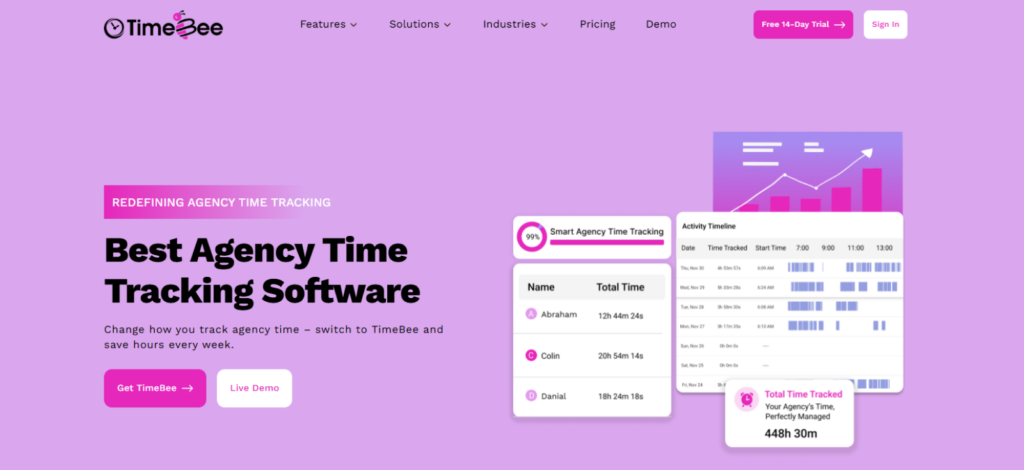
Employee monitoring software can fill some of those information gaps. Depending on the platform and the level of monitoring you choose, it can provide data on working hours, attendance, project time, website and application use, activity patterns, and screen activity.
For example, TimeBee combines time and project tracking with features such as website and application monitoring, activity data, attendance records, billable-hour tracking, and optional screenshots or screen recordings. Used appropriately, information like this can help you compare what was planned with how working time was actually distributed across projects and activities.
In my own use of TimeBee, while reviewing 46 remote employees, the software showed that 18% of recorded project time was not consistently linked to a defined client task. I did not treat that as evidence of poor advertising agency productivity.
Instead, I used it as a prompt to investigate how work was being categorized. Once we reviewed the records, around 40% of that time could be traced to legitimate client support, research, and internal coordination.
7. Reduce Tool and Data Fragmentation
Adding technology does not necessarily reduce work.
Agencies commonly rely on separate systems for project management, client communication, files, CRM data, reporting, time records, and internal messaging. Each system may serve a legitimate purpose on its own, yet the workflow between them can create additional administration.
You may see employees copying project information from one platform into another, updating the same status in several places, searching different systems for the latest file, or recreating reports from data that already exists elsewhere.
I have seen teams describe these activities as normal administrative work because they have gradually become part of the routine. Once the process is mapped, however, it becomes clear that skilled employees are spending part of their capacity maintaining the connections between tools.
For that reason, I tend to look at the workflow before the software. The relevant question is not how many tools an agency uses, but whether employees can move a project from one stage to another without repeatedly transferring and searching for information.
8. Remove Work That Shouldn’t Be Consuming Capacity
Not every productivity problem needs a faster way of completing the same work. Sometimes the work itself deserves scrutiny.
Recurring reports that nobody uses, meetings that rarely produce decisions, duplicated internal approvals, manual administrative steps, and excessive customization can all consume capacity while adding relatively little value to the client or the business.
The same pattern can appear in client work. An account may look productive because employees are constantly busy servicing it, yet repeated scope changes and unplanned requests may mean the agency is using far more resources than the original commercial assumptions allowed.
I have learned to ask a simple question when reviewing these processes:
Does this work still need to happen in this form, at this frequency, and with this amount of effort?
That question changes the marketing team’s productivity discussion entirely. Instead of asking employees to complete every existing task faster, you begin identifying which tasks should be reduced or removed entirely.
What Not to Do When Trying to Improve Marketing Agency Productivity?
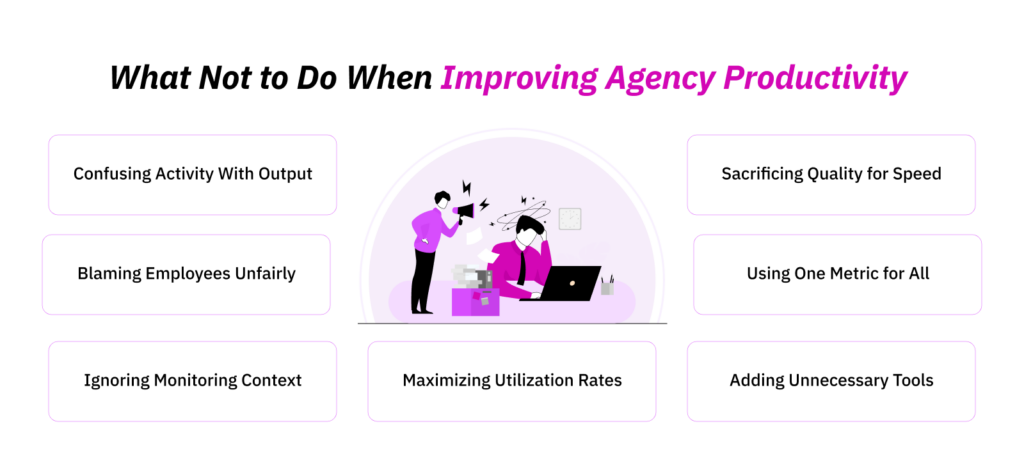
Some productivity initiatives fail because managers respond to the most visible symptom instead of investigating what is causing it. In my experience, there are several assumptions worth questioning before you change how a team works:
- Treating activity and productivity similarly.
- Assuming an individual is at fault before investigating the issues within workflow.
- Using monitoring data without context.
- Treating maximum utilization as the goal.
- Adding technology before understanding the process.
- Using the same productivity metric for every role.
- Improving speed while overlooking quality and profitability.
Conclusion
Over time, I have found that agency productivity problems are rarely explained by one metric. The more useful picture usually emerges when you look at how capacity, workload, approvals, technology, and client demands interact across the full workflow.
That is also why I would be cautious about using activity, utilization, or monitoring data as definitive measures of performance. They can reveal patterns and help narrow down where a problem may exist, but they still require context.
For me, the most productive agencies are not necessarily the ones where employees appear busiest. They are the ones where skilled time is directed toward work that creates value, unnecessary friction is kept low, and managers have enough evidence to understand where capacity is being lost.
Once that picture is clear, productivity improvement becomes less about pushing people to do more and more about designing the conditions that allow good work to move through the marketing agency with fewer obstacles.
FAQs
How can a marketing agency increase productivity?
A marketing agency can increase productivity by identifying where capacity is being lost and fixing that constraint. Common areas include workload allocation, incomplete briefs, excessive simultaneous work, approval queues, manual administration, fragmented systems, and unnecessary work.
Is utilization the same as productivity?
No. Utilization tells you how much available capacity is being used; productivity tells you what useful output results from the resources you use. High utilization can coexist with poor productivity when capacity is consumed by rework, administration, or waiting.
What causes low productivity in a marketing agency?
Low productivity can result from capacity shortages, poor prioritization, unclear ownership, excessive work in progress, incomplete information, slow approvals, repeated revisions, fragmented technology, and low-value work. Employee performance is one possible factor, not the automatic explanation.
Can AI improve agency productivity?
Yes, when you apply it to appropriate work. I would prioritize repetitive tasks where inputs and expected outputs are sufficiently clear, then retain human review where strategy, creative judgment, interpretation, or client risk matters.
What should a marketing agency automate first?
Start with frequent, repetitive work that consumes measurable employee time and requires relatively little discretionary judgment. Reporting preparation, project setup, routine data transfers, reminders, and recurring administrative workflows are often better options than complex strategic decisions.
Discover What’s Really Affecting Your Team’s Productivity With TimeBee
Get TimeBee Now



Frank Oliver
Member since July 8, 2026
Frank Oliver
Member since July 8, 2026
Frank Oliver is a Principal Consultant in Operations and Transformation, specializing in process improvement, digital transformation, operational performance, and the implementation of workplace technology.
He holds an MSc in Operations, Project and Supply Chain Management from The University of Manchester. He is also a Project Management Professional and a Prosci Certified Change Practitioner.
Overall, with more than 15 years of experience, Frank focuses on helping businesses identify the systems and workflows that influence productivity. His work further examines how processes, technology, management practices, role clarity, and data quality interact to affect organizational performance.