

Employee Monitoring Ethics: What to Track, What to Avoid, and How to Stay Fair
September 2, 2026 13 min readThere is an important difference between monitoring employees for legitimate business reasons and watching employees simply because technology makes it possible. That difference is where employee monitoring ethics becomes necessary.
I have spent the last five years helping HR leaders and founders decide what to monitor and what to leave alone. The question I hear most often is not, “Is this legal?” It is, “Is employee monitoring ethical?” Those are two different questions, and confusing them is where many monitoring programs go wrong.
Companies need to understand that employee monitoring ethics sits at the intersection of business needs and individual privacy. A tool can be fully legal and still damage trust if it collects more information than the job requires.
To help companies understand these concepts, I have created this guide. Management needs to understand what to track and what to avoid. This balance can help organizations improve productivity across their teams without compromising employee privacy.
TL;DR: Employee Monitoring Ethics at a Glance
- Monitor employees only when there is a clear business purpose.
- Track work data that directly supports meaningful business decisions.
- Avoid collecting personal information unrelated to employee responsibilities.
- Use the least intrusive monitoring method that achieves your objective.
- Never treat activity data as a complete measure of employee performance.
- Clearly communicate monitoring practices, purposes, access, and retention.
- Check applicable local laws before implementing employee monitoring.
What Is Ethical Employee Monitoring?
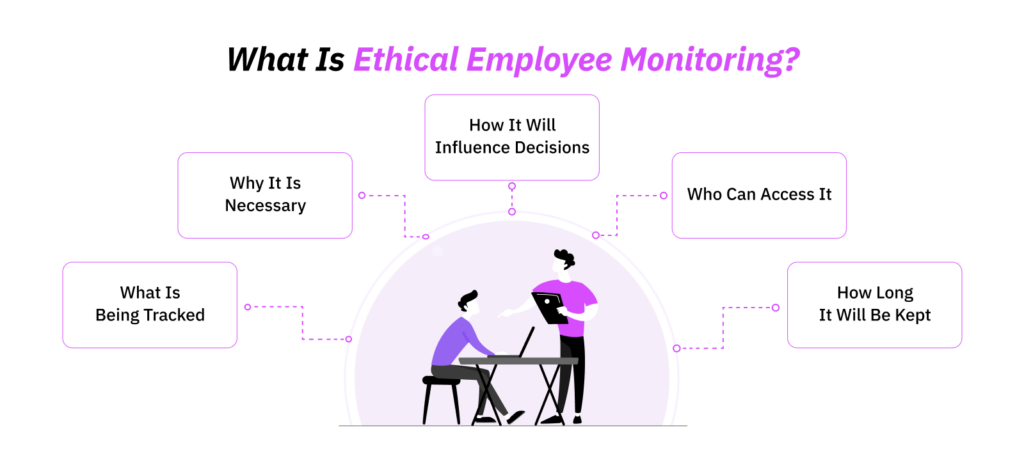
Ethical employee monitoring means collecting only the work-related data needed to solve a specific business problem. The employer should know the following things exactly;
- What is being tracked
- Why it is necessary
- Who can access it
- How long it will be kept
- How it will influence decisions
So, is employee monitoring ethical? It is when the monitoring is necessary, proportionate, transparent, and relevant to the work. Legal permission alone does not make a monitoring practice ethical.
Why Employers Use Employee Monitoring: 4 Key Reasons
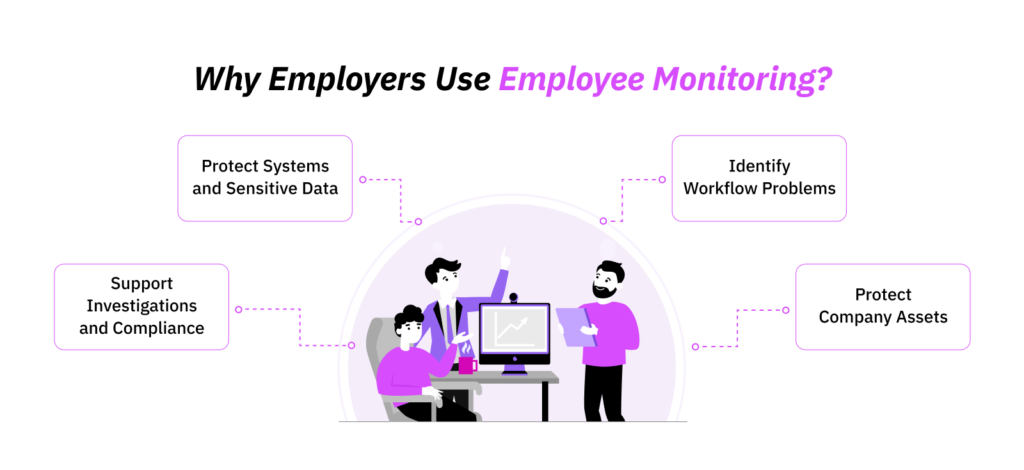
For this to work, first, companies need to understand why they want to monitor employees. Once the purpose is clear, it becomes much easier to set boundaries and stay within ethical lines.
1. Protect Systems and Sensitive Data
One of the clearest reasons to monitor employee activity is to protect company data and systems. IBM reported that the global average cost of a data breach reached $4.88 million.
Risks at that scale explain why employers track security events such as unauthorized file transfers and unusual access attempts. This becomes even more important for distributed teams that access company systems across different locations and networks.
2. Identify Workflow Problems
Monitoring also gives employers a clearer view of how work moves across teams. Asana found that knowledge workers spend 58% of their day on “work about work,” such as coordinating tasks and switching between tools.
Operational data helps management identify delays and recurring bottlenecks before assuming the problem lies with individual employees.
3. Protect Company Assets
Another reason employers monitor activity is to protect company assets, including devices and intellectual property.
Monitoring shows when these resources are accessed or used in ways that create unnecessary risk. However, the scope should stay connected to the asset being protected rather than expanding into unrelated employee activity.
4. Support Investigations and Compliance
Monitoring gives employers reliable records during internal investigations and other situations that require documentation.
However, more surveillance does not mean fewer legal and ethical issues of employee monitoring. Employers need clear limits on what data is collected and who has access to it.
What Should Employers Track: 7 Things That Make a Difference
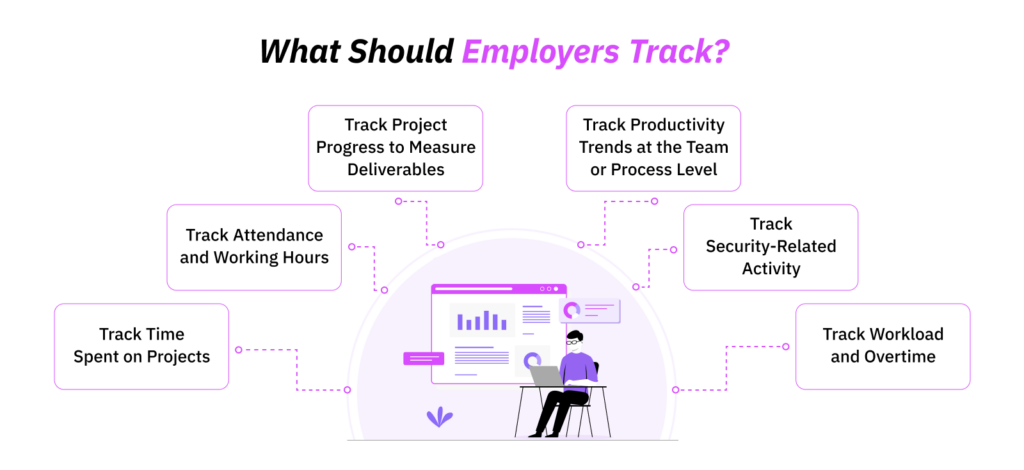
In the monitoring programs I have reviewed with HR leaders and founders, the most useful data has always answered a defined business question. It should tell management something concrete about project execution or workforce capacity. Ethics of employee monitoring follows the same principle: collect signals that help teams respond to a specific risk.
1. Track Time Spent on Projects
Track the work time employees allocate to specific projects or client accounts. Project-time data supports more accurate cost estimates and future resource planning than other forms of time data.
Furthermore, it helps managers compare expected effort with actual effort. This is especially useful when budgets regularly run over, or certain types of assignments consistently require more capacity than originally planned.
2. Track Attendance and Working Hours
Track scheduled hours alongside actual working hours. Depending on the role, this includes clock-in records or shift attendance. These records give operations teams a reliable view of workforce coverage and help payroll teams verify recorded time.
Overtime data is also useful for identifying departments where scheduled capacity repeatedly falls short of actual demand.
3. Track Project Progress to Measure Deliverables
Monitor whether work is progressing against defined milestones and whether assigned tasks are moving toward completion. Deadline status gives managers another useful signal when projects begin to fall behind.
Additionally, deliverable data is valuable because it connects monitoring with actual work output and gives management a clearer view of whether project expectations are being met.
4. Track Productivity Trends at the Team or Process Level
Track productivity patterns across a team or workflow rather than looking only at isolated activity. Data on recurring delays helps managers identify where processes slow down.
Beyond that, workload distribution adds another layer of context because it shows whether certain teams consistently carry more work than others. These trends support better process decisions and more realistic capacity planning.
5. Track Security-Related Activity
Track security events that indicate a credible risk to company systems. Suspicious login attempts are one useful signal, especially when access originates from an unexpected location.
Similarly, unauthorized file transfers highlight potential risks when sensitive company information is involved. Changes to privileged access also deserve attention because they directly affect who has access to protected systems and resources.
6. Track Workload and Overtime
Track workload levels across teams and compare them with available capacity. Sustained overtime is especially useful because it shows where normal staffing levels no longer match operational demand.
At the same time, workload distribution helps managers identify employees or teams carrying a consistently heavier load. This information gives management a stronger basis for making staffing, resourcing, and project-allocation decisions.
What Employers Should Avoid Tracking: 7 Things That Cross the Line
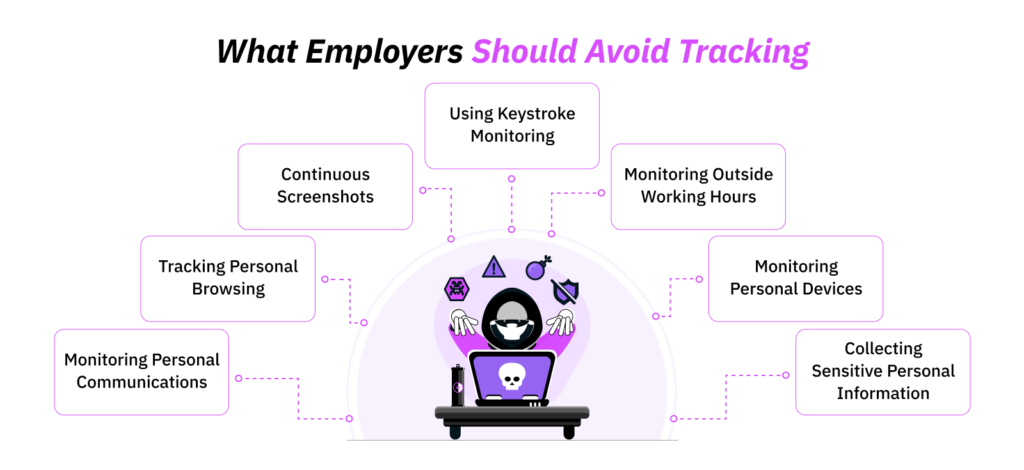
Knowing what to track is only half of the equation. Companies also need to know where monitoring should stop. In my experience, employee monitoring legal issues usually start when the data collected becomes broader than the business problem it was meant to solve.
1. Monitoring Personal Communications
One of the biggest concerns employees have about monitoring is the collection or review of their private communications. There is a clear difference between reviewing communication metadata and reading the actual content of a message.
For most security purposes, metadata already provides useful context. Message content should only enter the picture when a specific incident creates a documented reason for deeper review.
2. Tracking Personal Browsing
That same principle of limiting collection applies to browsing activity. Employers should avoid building detailed browsing histories that expose personal interests or behavior unrelated to work.
The distinction here is important. Blocking websites that create a defined security risk serves a specific purpose. By contrast, recording every page an employee visits creates a much broader data trail than the business actually needs.
3. Continuous Screenshots
Browsing records are intrusive, but continuous screenshots take that visibility even further. They capture whatever happens to be displayed on the screen at that moment. It also includes information the employer never intended to collect. For example, a screenshot could expose a password or private message.
4. Using Keystroke Monitoring as a Default Productivity Metric
The problem becomes different with keystroke monitoring because the issue is not only privacy but interpretation. A high typing count confirms keyboard activity, but it says very little about the quality or value of the work produced. This matters particularly in roles that involve research or analysis.
5. Monitoring Outside Working Hours
Monitoring boundaries should also follow working boundaries. GPS tracking or company applications should not continue collecting employee data once the business purpose for that monitoring has ended.
For distributed teams, this requires clearly defined monitoring windows. If location data is needed during assigned work, collection should remain limited to that period rather than continuing in the background after working hours.
6. Monitoring Personal Devices
Device ownership creates several employee monitoring legal issues. In BYOD environments, employers should limit monitoring to the corporate portion of a personal device.
Work profiles create that separation at the operating-system level. Similarly, managed applications keep company information under organizational control while allowing personal activity on the same device to stay separate.
7. Collecting Sensitive Personal Information
Some information deserves an even higher level of protection, specifically personnel information. Health information and biometric data require much stronger justification than ordinary work activity because misuse carries greater privacy consequences.
Accidental collection matters too. That is why monitoring systems should be configured to prevent unnecessary capture at the source.
TimeBee: Protect Employee Data With Smarter Monitoring Controls
Discover More
How to Keep Employee Monitoring and Ethics Aligned: 9 Proven Strategies
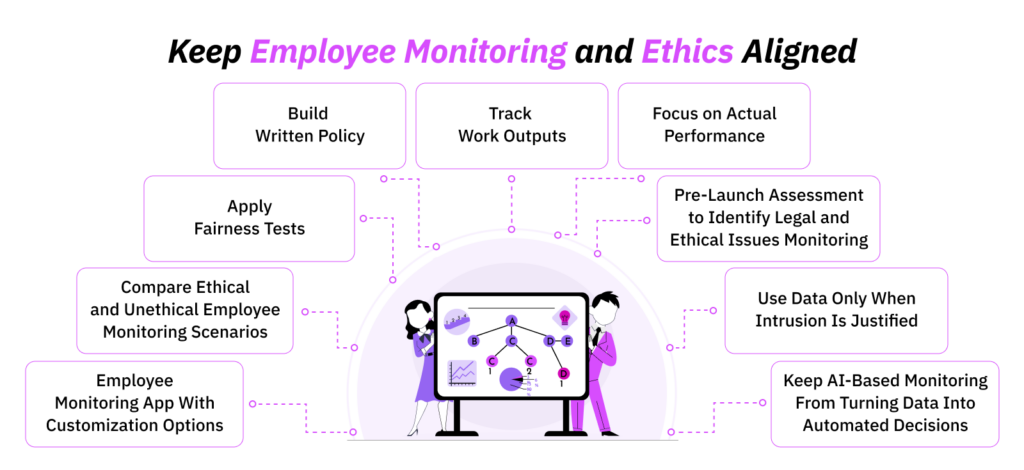
Once companies know what to track and where monitoring should stop, the next step is governance. In the monitoring programs I have reviewed, fairness rarely depends on one setting inside the software. It depends on the decisions made before collection starts and the controls applied afterward.
The following strategies help employers apply those principles in practice.
1. Apply Six Fairness Tests Before Collecting Any Employee Monitoring Data
Based on the privacy and monitoring programs I have reviewed, I use six practical tests before approving any monitoring practice. I derived this framework from established GDPR principles. It is not an official GDPR checklist, but a practical way to apply those principles to employee monitoring decisions.
- Purpose: Define the exact problem first. “Identify recurring project bottlenecks” is defensible; “see what employees are doing” is not.
- Necessity: Check whether employee-level data is actually required or whether operational data answers the same question.
- Proportionality: Use the least intrusive method that achieves the objective. An attendance issue requires attendance records, not webcam monitoring.
- Context: Confirm that the metric reflects the work accurately.
- Agency: Give employees visibility into relevant monitoring data and a way to explain errors.
- Lifecycle: Define who gets access, how the data can be reused, and when it will be deleted.
Together, these six tests turn employee monitoring ethics into a repeatable decision process rather than a vague policy principle.
2. Compare Ethical and Unethical Employee Monitoring Scenarios
The six tests become easier to apply when management compares the business objective with the level of intrusion required to achieve it.
| Business objective | Intrusive approach | More proportionate approach |
| Verify attendance | Webcam monitoring | Clock-in/out records |
| Improve workflows | Continuous screenshots | Aggregate workflow analysis |
| Detect threats | Read every message | Security alerts + targeted investigation |
| Manage field work | 24/7 GPS | Work-hours location tracking |
| Evaluate developers | Keyboard activity | Output quality + delivery metrics |
The more proportionate option still answers the underlying business question. Clock-in records verify attendance without observing employees continuously. Aggregate workflow data exposes process delays without recording every screen.
That is the practical test companies should apply: does the additional intrusion produce information that materially improves the decision? If the answer is no, the narrower method is usually the stronger monitoring design.
3. Choose an Employee Monitoring App With Customization Options
Once the monitoring boundaries are defined, the software needs to support them. I prefer monitoring tools that let companies control how much data they collect instead of forcing every employee into the same tracking configuration.
TimeBee is a good example of this approach. It is a time tracking tool that directly addresses legal and ethical issues of employee monitoring. To maintain a proper balance, it lets administrators configure tracking settings at the organization level and adjust them for individual employees when different roles require different oversight.
For example, screenshot intervals can be set from every two minutes to every 30 minutes or turned off entirely. You can also configure or disable idle-time notifications.
That flexibility matters from an employee monitoring ethics perspective. A company that only needs timesheets and project-time data does not have to use screenshots simply because the feature exists.
Likewise, teams can classify websites and applications according to how they relate to work, rather than treating every application the same way.
TimeBee also limits monitoring to active tracking sessions. It allows employees to start and stop the timer themselves, and the software does not continue recording activity once tracking is turned off.
Employees can also review their own logged data through the dashboard. The platform does not use webcams or microphones for monitoring.
For access control, owners and administrators manage individual monitoring settings, while user roles determine what different account types can access. TimeBee also offers plans that scale with team size, alongside configurable user quotas and subscription options.
The practical advantage is control over monitoring depth. Companies can match settings to the purpose they established earlier. That makes the monitoring program easier to keep proportionate and aligned with its original business goal.
4. Use a Pre-Launch Assessment to Identify Legal and Ethical Issues of Employee Monitoring
Before switching on a monitoring feature, document how it will operate in practice. I have found this step especially useful because it exposes vague purposes before they become embedded in everyday management.
Before launch, confirm:
- The purpose is specific.
- The data scope matches that purpose.
- Access and retention rules are documented.
- Employees receive a clear explanation.
- A review process exists for disputed data.
This creates an audit trail for both legal review and internal governance.
5. Track Work Outputs and Operational Signals As Per Business Purpose
Once monitoring passes the pre-launch assessment, choose the strongest signal that answers the business question. I generally use this hierarchy:
Outcomes → workflow signals → activity signals → intrusive surveillance
The best approach is to start with outcomes whenever possible because a finished project gives management more useful information than mouse movement. Similarly, a resolved support issue says more than click volume, and a quality score is usually more meaningful than keyboard activity.
If outcomes do not explain the problem, move one level deeper into workflow data. Activity signals should come later because they require more interpretation and often provide weaker evidence of actual performance.
This hierarchy keeps monitoring tied to the original business need.
6. Use Screenshots, Location, Communications, and Application Data Only When the Added Intrusion Is Justified
Some monitoring methods are not automatically inappropriate, but they require stronger justification to maintain ethics of employee monitoring. It happens usually because they expose more detailed employee information.
I use an Intrusion Ladder to decide how far monitoring should go:
- Aggregated data
- Metadata
- Event-based monitoring
- Individual activity records
- Content inspection
- Continuous surveillance
Start at the highest level that still answers the business question. If aggregated workflow data identifies the bottleneck, there is no operational reason to inspect individual screens. If metadata identifies an unusual transfer, content review should only follow when the investigation actually requires it.
The key is progressive escalation. Move further down the ladder only when the previous level cannot reasonably achieve the objective.
7. Focus on Actual Performance Rather Than Measure Employee Presence
Once monitoring becomes more granular, another problem appears: activity starts getting mistaken for performance.
Keystrokes only show that someone typed. Mouse movement shows device interaction. Idle time records a lack of detected input. Online-status indicators show presence inside a system. None of these signals independently establish whether useful work was completed.
That distinction matters for developers who spend time reviewing code. Writers research before drafting. Analysts may examine information without constant input. Managers often create value through decisions rather than visible computer activity.
Accessibility tools complicate these metrics further because employees may interact with software differently from the pattern a monitoring system expects.
For that reason, activity data should remain contextual evidence rather than an automatic performance verdict. If a metric cannot explain the quality or outcome of the work, management should not give it more weight simply because the software produces a convenient score.
8. Build Employee Monitoring and Ethics Into a Written Policy
Technical controls only work when employees and managers understand the rules around them. That is why every monitoring program needs a specific written policy, not a broad statement that “activity may be monitored.”
The policy should identify what information is collected and explain why it is collected. Employees should know when monitoring occurs and which devices are in scope. Moreover, address remote monitoring directly rather than leaving it open to interpretation.
The policy also needs governance rules. Management must state who has access to monitoring data and how long records remain available. They should also explain whether the information contributes to performance reviews. Also disclose any relevant third-party access.
Finally, give employees a clear route to raise concerns or question inaccurate data.
9. Keep AI-Based Employee Monitoring From Turning Data Into Automated Decisions
AI adds another layer to employee monitoring because it does more than collect data. It can convert that data into productivity scores or risk classifications. Some systems also produce performance predictions or recommendations that influence scheduling.
The technical problem is that an automated output can look more objective than the underlying data actually is. If the input is incomplete or poorly matched to the role, the resulting score carries the same weakness at scale.
This becomes especially important when AI-generated outputs influence discipline or another significant employment decision.
Human review should therefore sit between the monitoring system and the final decision. The reviewer needs access to the underlying evidence and enough context to challenge the system’s conclusion.
Legality of Employee Monitoring: Check the Law Before Assuming
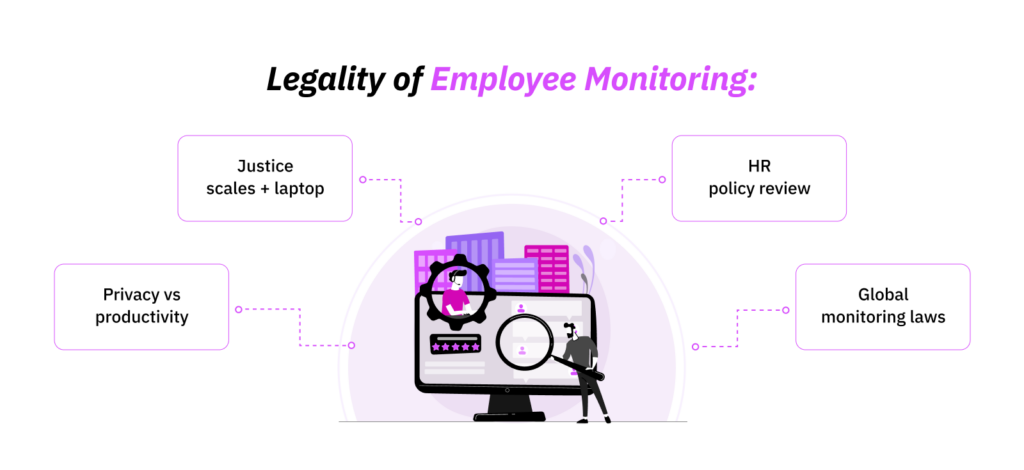
Employee monitoring is not automatically legal simply because the company owns the device or account being monitored. Instead, the rules depend on the country, state, industry, type of data collected, and how that data is used.
Before introducing monitoring, employers should first identify the laws that apply to their workforce. This includes assessing whether the proposed monitoring has a legitimate basis and whether employees receive the required notice.
Where GDPR applies, employers must also consider principles such as purpose limitation, data minimization, transparency, and proportionality.
The same principle applies when using a third-party monitoring platform. Outsourcing the technology does not remove the employer’s responsibility for how employee data is collected and processed.
Most importantly, legal compliance is only the starting point. A monitoring practice can satisfy a legal requirement and still be excessive from an ethical perspective. Employers should therefore complete a legal and privacy assessment before collecting employee monitoring data.
Final Thoughts
Ethical employee monitoring is essential because the way companies measure performance directly affects employee trust and mental pressure.
When employees feel constantly watched, monitoring can create unnecessary stress and make them focus on activity rather than meaningful work. For this reason, employers need to understand what they should track and what they should leave alone.
At the same time, choosing the right monitoring strategy is only part of the process. Companies should use a proportionate method and communicate openly with employees about what is monitored, why the data is collected, and how it will be used.
Finally, employers must consider the laws that apply to their workforce. They should know that ethical monitoring requires the right balance between business needs and employee privacy. Additionally, the legality of employee monitoring should be considered first.
FAQs
Do employees have the right to see their monitoring data?
Employees’ access rights depend on the laws that apply to their employment and location. However, from an ethical monitoring perspective, transparency should go beyond simply notifying employees that monitoring exists.
Employers should explain what data is collected and provide an appropriate process for reviewing or challenging inaccurate information.
How long should employers keep employee monitoring data?
Employee monitoring data should be retained only for as long as it serves the purpose for which it was collected. Keeping records indefinitely increases privacy and security risks without necessarily creating additional business value.
Therefore, employers should establish retention periods before monitoring begins and delete or securely dispose of data when it is no longer needed.
Can employers share employee monitoring data with third parties?
Employers should not share monitoring data just because a third party requests it. Any disclosure should have a defined business or legal purpose. Also, it should follow applicable privacy requirements.
In addition, employees should understand when external providers receive their data and what safeguards govern that access.
What is a Data Protection Impact Assessment (DPIA) for employee monitoring?
A Data Protection Impact Assessment (DPIA) helps employers identify and address privacy risks before introducing monitoring that could significantly affect employees. It typically examines the purpose of processing, types of data collected, affected employees, potential risks, and available safeguards.
As a result, a DPIA helps organizations determine whether their monitoring approach is necessary and proportionate.
Who should have access to employee monitoring data?
Access to employee monitoring data should be limited to people with a defined business need. This typically includes authorized HR staff, relevant managers, IT or security teams, and designated legal or compliance personnel.
Access should also follow role-based permissions, so employees’ monitoring records are not unnecessarily visible to managers or administrators who do not need them.
Get TimeBee & Monitor Employees Fairly Without Overstepping Boundaries
Try Now
Patricia Adams
Member since July 28, 2026
Patricia Adams
Member since July 28, 2026
Patricia Adams is the Director of People and Culture, who focuses on employee experience, people operations, performance management, and the responsible use of workforce technology.
She holds an M.S. in Industrial/Organizational (I/O) Psychology from Florida Institute of Technology. She is also a Certified Information Privacy Manager through the International Association of Privacy Professionals.
With more than 5 years of experience, Patricia examines how workplace systems affect both organizational performance and the people being measured.
Therefore, her work centers on helping organizations establish practical policies that support accountability without disregarding employee privacy and professional autonomy.