

Block Billing vs. Hourly Billing: What Law Firms Need to Know Before Choosing
November 12, 2026 12 min readLegal billing involves more than recording hours and sending invoices. The way you document an attorney’s work can affect whether clients understand their charges. It also guides whether your billing team can defend those charges, and whether a court considers a fee request reasonable.
When comparing hourly billing vs. block billing, it’s important to recognize that these aren’t competing pricing models. Block billing combines multiple tasks into one time entry, while hourly billing calculates legal fees based on time worked.
Having worked in law firm operations for over 13 years, I’ve learned that this distinction matters most when someone questions an invoice. A reliable billing process should therefore make it possible to explain what was done and whether the time charged was reasonable.
Block Billing vs. Hourly Rate Billing: Key Takeaways
- Block billing is a time-entry method, whereas hourly billing is a fee structure. Both can be used together.
- Block billing is not unethical, but vague entries can make fees harder to justify during client disputes, audits, or court reviews.
- Hourly billing provides flexible compensation for work with uncertain scope, but it requires accurate timekeeping and regular budget oversight.
- Time and billing software for legal firms can help them record employee time precisely and bill clients accordingly.
- Itemized time entries generally improve transparency, particularly when clients require task-level descriptions or separate time allocations.
- The best billing approach depends on your firm’s obligations. Client agreements, applicable professional conduct rules, and the purpose of the invoice should guide how you record and present time.
Hourly Billing vs. Block Billing: What’s the Difference?
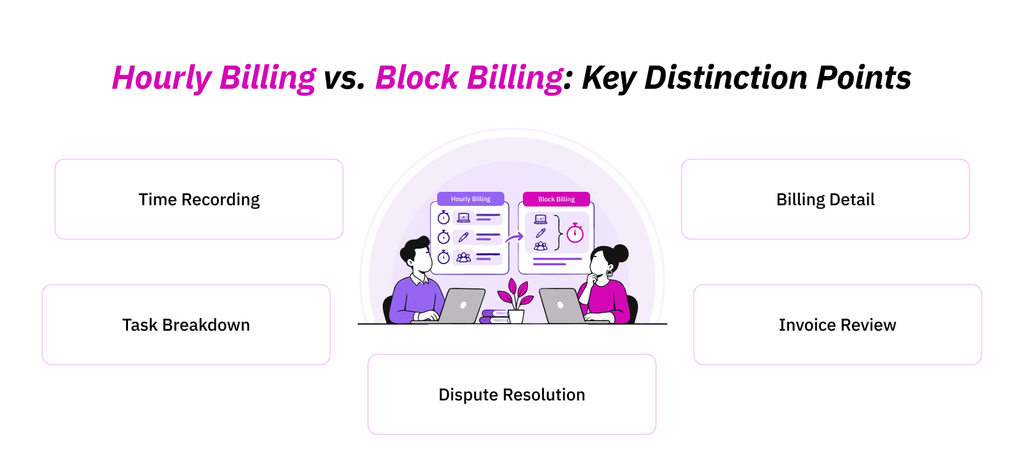
The central distinction in block billing vs. time-based billing is how fees are calculated versus how the underlying work is recorded.
Hourly billing is a fee arrangement in which attorneys charge clients for the time spent providing legal services. For example, if a lawyer charges $300 per hour and performs three hours of billable work, the fee is $900.
Block billing, on the other hand, refers to combining multiple legal activities into a single time entry without specifying how much time was devoted to each activity.
A lawyer might record:
“Reviewed discovery responses, researched applicable case law, and drafted a letter to opposing counsel – 3.0 hours.”
Although the entry identifies the activities performed, it doesn’t disclose the time allocated to research, document review, or drafting.
Here’s how the two concepts differ:
The problem with the original table is that several rows describe broad characteristics without explaining what actually changes in a law firm’s billing process. For example, saying that invoice transparency “depends on the detail provided” doesn’t tell the reader what information they gain or lose.
There’s also an important technical distinction: block billing is a time-entry format, while hourly billing is a pricing method. To make the comparison meaningful, I recommend comparing block-billed hourly entries with itemized hourly entries.
| Comparison factor | Block billing | Hourly billing with itemized entries |
| How it works | Records several legal tasks in one entry with a combined time total. | Records each legal task separately, with its own time allocation. |
| Time allocation | Shows 2 hours combined for research, drafting, and a client call without dividing the time between tasks. | Shows 0.7 hours for research, 1 hour for drafting, and 0.3 hours for the client call. |
| Invoice transparency | Clients can identify the activities performed but cannot determine each task’s duration from the entry alone. | Clients can see how much time was charged for each activity and evaluate individual charges. |
| Administrative effort | Requires fewer time entries initially, but unclear allocations may require additional review or clarification. | Requires separate task entries but makes individual charges easier to identify and review. |
| Billing disputes | Challenging one activity may require examining supporting records to establish its time allocation. | The disputed activity has its own recorded duration, allowing a more targeted review. |
| Billing compliance | May violate client guidelines requiring separate task entries, even when the total hours are accurate. | Can satisfy task-level reporting requirements when descriptions, rates, and other billing details meet applicable rules. |
Block Billing vs. Hourly Rate Billing: A Practical Invoice Example
Consider an attorney handling a commercial contract dispute at an hourly rate of $300. During one work session, the attorney researches contractual provisions, consults the client, and drafts a response letter.
In total, they complete 1.5 hours of billable work. However, the way those hours appear on the invoice can differ considerably.
Example of a Block-Billed Legal Invoice
| Billing description | Hours | Hourly rate | Amount |
| Researched contractual provisions, consulted client regarding disputed terms, and drafted response letter | 1.5 | $300 | $450 |
| Total | 1.5 | $450 |
The invoice communicates the general nature of the work and the total charge. Therefore, a reviewer cannot determine how much time the attorney devoted to each activity.
If the client questions the drafting charge, for example, the billing team would need additional supporting records to identify that portion of the work accurately.
Example of an Itemized Hourly Invoice
Now consider the same work recorded as three separate time entries.
| Billing description | Hours | Hourly rate | Amount |
| Researched contractual provisions relevant to disputed terms | 0.4 | $300 | $120 |
| Consulted client regarding contractual obligations and proposed response | 0.3 | $300 | $90 |
| Drafted response letter addressing disputed provisions | 0.8 | $300 | $240 |
| Total | 1.5 | $450 |
The total fee remains $450, but the client can now see exactly how the recorded time was allocated.
This additional detail also helps a billing reviewer identify potential duplication, assess specific charges, and compare work against the client’s billing guidelines.
From an operational perspective, I consider that distinction particularly important, as the purpose of itemization is to make the recorded work easier to understand and evaluate.
From Billable Minutes to Defensible Invoices, Make Every Entry Count With TimeBee
Learn More
What Are the Pros and Cons of Block Billing and Hourly Billing for Law Firms?
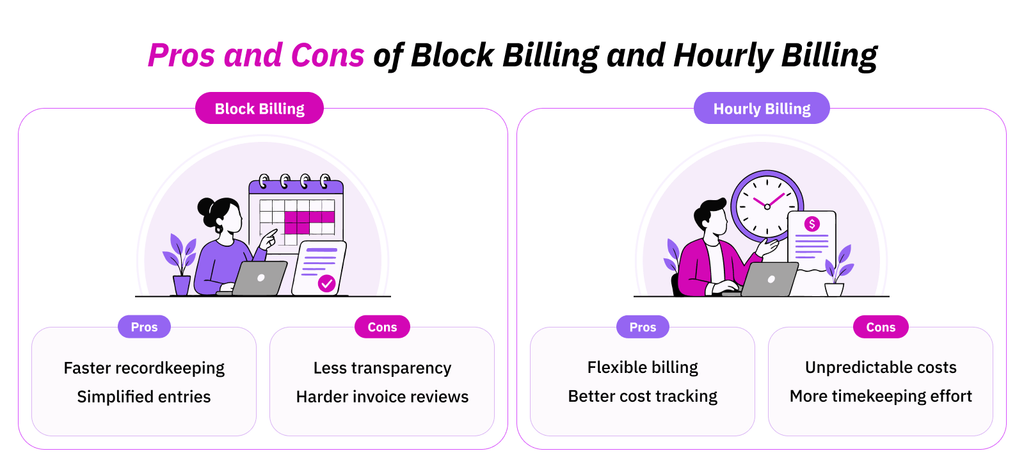
Block billing and hourly billing offer different operational advantages and limitations because they address separate aspects of the billing process.
Block Billing for Law Firms
Advantages
- Less time spent on data entry: Attorneys can document several related activities in one entry instead of creating separate records for every task.
- Simplified recording of connected activities: A single entry can summarize closely related legal work completed during one session, provided the client’s billing requirements permit it.
Disadvantages
- Limited task-level transparency: Clients cannot determine how much time was spent on individual activities when only a combined duration is recorded.
- More complicated invoice reviews: Billing teams may need to consult attorneys or supporting records to clarify grouped charges, which increases administrative effort.
- Greater difficulty defending disputed fees: Without separate task durations, firms may struggle to substantiate individual charges during client disputes or court fee reviews.
- Potential billing guideline violations: Corporate clients and insurers may reject entries that combine tasks when their outside counsel guidelines require itemized billing.
Hourly Billing for Law Firms
Advantages
- Flexibility for unpredictable legal matters: Firms can bill for reasonably necessary work as litigation, negotiations, or investigations develop.
- Compensation for additional authorized services: Attorneys can charge for work beyond initial expectations when permitted by the engagement agreement and applicable requirements.
- Better insight into matter costs: Recorded hours help firms evaluate attorney utilization, staffing requirements, and the time spent handling different matters.
Disadvantages
- Less predictable legal expenses: Clients may find it difficult to estimate their final costs when a matter’s duration or complexity is uncertain.
- Greater timekeeping responsibility: Attorneys must accurately record billable activities, apply appropriate rates, and distinguish chargeable work from nonbillable tasks.
- Potential inefficiency incentives: Charging by time rather than outcomes can weaken incentives to complete work efficiently unless firms maintain appropriate oversight and reasonable-fee standards.
Is Block Billing Ethical? ABA Rules, Court Decisions, and Billing Guidelines
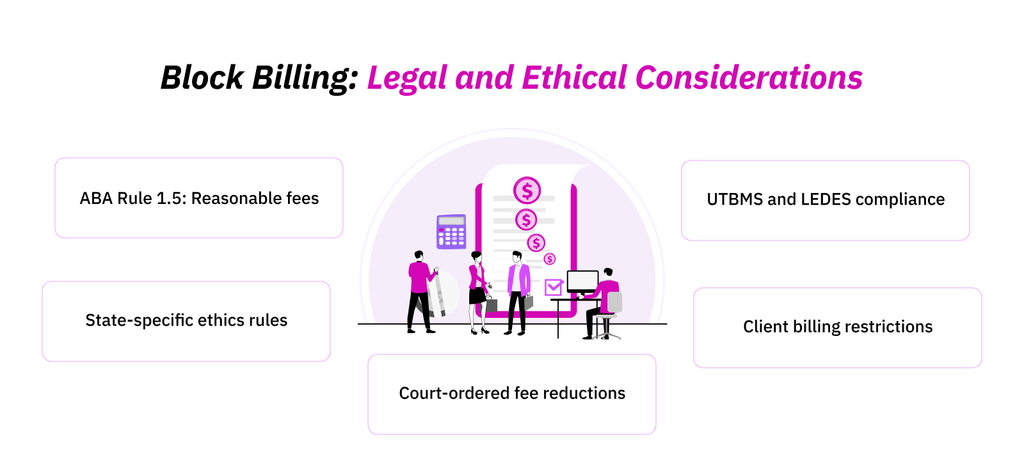
Block billing is not categorically prohibited under the ABA Model Rules of Professional Conduct. However, its acceptability depends on the reasonableness of the fees, the applicable jurisdiction’s rules, the client’s billing agreement, and the purpose for which the time records are being reviewed.
There is also an important difference between an attorney billing a client and a court deciding how much another party must reimburse in legal fees.
What Does ABA Model Rule 1.5 Say About Block Billing?
ABA Model Rule 1.5 requires lawyers to charge reasonable fees and expenses.
The rule identifies several factors relevant to fee reasonableness, including:
- The time and labor required.
- The complexity of the legal issues.
- The skill needed to perform the services.
- The customary local fee for comparable work.
- The lawyer’s experience and professional qualifications.
- The results obtained and other circumstances of the representation.
Rule 1.5 also addresses communication of the scope of representation and the basis or rate of the fee.
Although it doesn’t expressly prohibit block billing, grouped entries can make it harder to evaluate the time-and-labor component when individual activities aren’t sufficiently documented.
Importantly, the ABA Model Rules serve as a model for state regulation. Attorneys must follow the professional conduct rules adopted in their applicable jurisdictions, which may differ from the ABA’s language.
Can Courts Reduce Attorney Fees for Block Billing?
Yes. Courts may reduce requested attorney-fee awards when block-billed records make it difficult to determine whether the claimed time was reasonable.
A useful example is EXRP 14 Holdings LLC v. LS-14 Ave LLC, decided by the New York Supreme Court in September 2024.
In that case, the plaintiff requested $83,019.60 in attorneys’ fees associated with a sanctions motion.
The court identified entries combining activities such as hearing preparation, legal research, conferences, and court appearances without separately identifying the time spent on each task.
It ultimately reduced the requested award by 50%, granting $41,509.80.
However, the reduction wasn’t based solely on the presence of grouped entries. The court also identified duplicative and excessive or unreasonable billing.
The lesson isn’t that every block-billed invoice will be reduced by 50%. Rather, the decision demonstrates how inadequate task-level detail can weaken a fee application when the requesting party must establish the reasonableness of its charges.
When Do Client Billing Guidelines Restrict Block Billing?
Even when applicable ethics rules permit a particular billing format, a client’s contractual requirements may impose stricter conditions.
Corporate legal departments, insurers, and other institutional clients may use outside counsel guidelines specifying how time must be recorded and presented.
Depending on the agreement, these guidelines may require:
- Separate entries for distinct activities.
- Identification of individual timekeepers and approved rates.
- Descriptions that explain the purpose of the work.
- Restrictions on administrative or duplicative charges.
- Approved task and activity codes.
Some clients also use the Uniform Task-Based Management System (UTBMS) to categorize legal work and LEDES formats for electronic invoice submission.
However, meeting an electronic invoice’s technical formatting requirements doesn’t necessarily mean the underlying charges satisfy every client billing rule.
From a law firm management perspective, I recommend treating billing guidelines as part of matter setup rather than reviewing them only after an invoice is rejected. Attorneys and billing staff should know the client’s documentation requirements before they begin recording time.
Block Billing vs Time-Based Billing: When Should Law Firms Itemize Tasks?
When deciding how to document billable hours, law firms need to consider whether grouping multiple activities into one entry provides enough detail or whether each task should be recorded separately.
I recommend using task-level records when legal activities are distinct, particularly if the charges require detailed review. However, combining closely related tasks may be appropriate depending on the nature of the work, client billing guidelines, and applicable legal requirements.
| Legal billing situation | Recommended approach | Main consideration |
| Litigation involving a court fee application | Maintain detailed task-level records | Supporting the reasonableness of claimed fees |
| Corporate or insurance-defence matters | Follow client-approved itemization requirements | Avoiding noncompliant invoice entries |
| Complex matters involving multiple attorneys | Record work by timekeeper and activity | Identifying responsibility, hours, and applicable rates |
| Closely connected legal activities | Group only when permitted and sufficiently documented | Preserving useful information without unnecessary fragmentation |
| Client requests additional billing details | Review and provide an appropriate supported breakdown | Resolving questions accurately |
How Can Law Firms Improve Time Tracking and Avoid Billing Disputes?
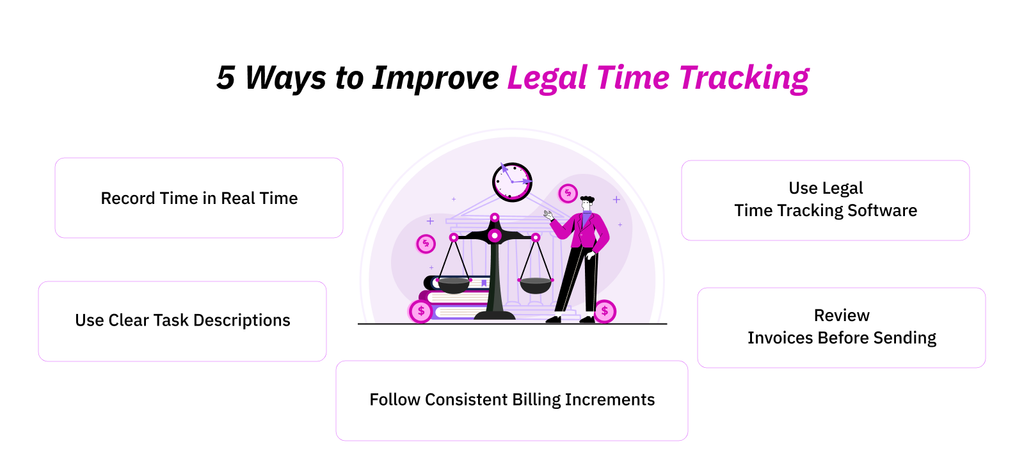
Accurate legal billing depends on what happens before the invoice reaches the client.
In my experience with law firm operations, the most useful improvements usually involve establishing dependable routines for recording time, describing work, checking charges, and correcting problems before invoices are finalized.
The following practices address those responsibilities directly.
1. Record Billable Hours as Work Happens
Attorneys should record time as the work occurs rather than reconstructing several days of activity from memory.
Contemporaneous timekeeping reduces reliance on estimates and makes it easier to distinguish between matters handled throughout the day.
For example, an attorney moving between three litigation matters should record time against the relevant matter as work progresses, rather than assigning a combined daily total afterward.
I also recommend establishing a daily time-entry review habit. This gives attorneys an opportunity to identify missing entries while their activities are still fresh in memory.
2. Itemize Legal Tasks With Clear Billing Descriptions
A useful time entry identifies the work performed and gives enough context for the charge to be evaluated.
Compare these descriptions:
- Vague entry: “Reviewed documents — 1.2 hours.”
- More informative entry: “Reviewed opposing counsel’s discovery responses to identify deficiencies relevant to the pending motion — 1.2 hours.”
The second description explains both the activity and its purpose without unnecessarily disclosing confidential legal strategy.
Where multiple distinct activities occur, attorneys should generally record their respective durations separately, especially when required by the client.
The goal is useful documentation, not lengthy narratives. A precise sentence often provides more value than a paragraph filled with generic legal terminology.
3. Use Consistent Time Increments and Follow Client Billing Guidelines
Law firms commonly use billing increments such as one-tenth of an hour, equivalent to six minutes.
For example, at a $300 hourly rate, 0.1 hour represents $30.
However, the selected increment should follow the applicable fee agreement and billing requirements. A firm shouldn’t assume that six-minute billing is mandatory or acceptable for every client.
Time entries must also reflect work actually performed, and rounding practices should not systematically inflate charges. Moreover, attorneys should avoid billing clients for activities that the agreement excludes.
To maintain consistency, establish written guidance covering increments, nonbillable work, task codes, and client-specific exceptions.
4. Review Legal Invoices Before Sending Them to Clients
A pre-bill review provides the firm with an opportunity to correct errors before they become client-facing problems.
I recommend checking invoices for:
- Missing or unclear task descriptions.
- Duplicate or overlapping time entries.
- Incorrect matter assignments.
- Unapproved billing rates.
- Potentially excessive or nonbillable activities.
- Entries that violate the client’s billing guidelines.
Where an entry needs clarification, the reviewer should consult the relevant timekeeper and supporting records rather than estimating missing task durations.
For larger firms, a designated billing administrator or supervising attorney can help maintain consistency across timekeepers. Ultimately, the responsible attorney should ensure the invoice accurately represents the services being charged.
5. Use Legal Time Billing Software to Improve Accuracy
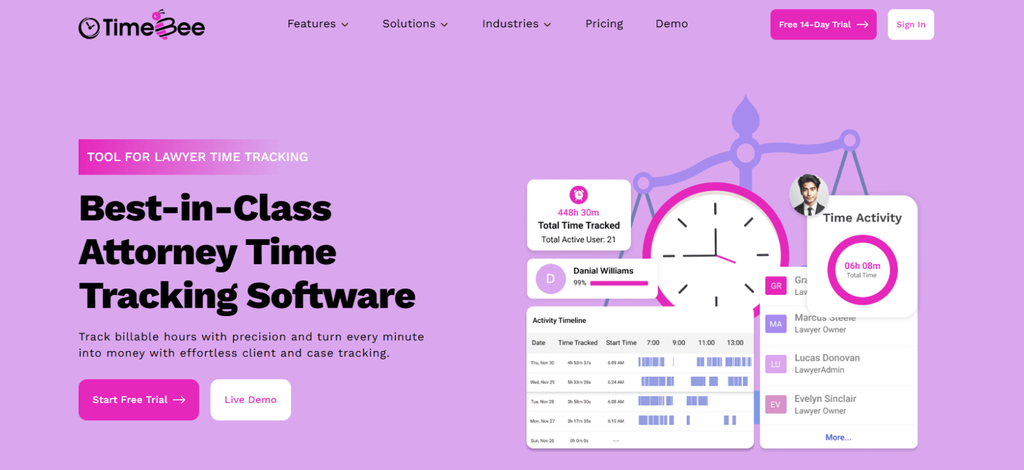
Legal time billing software can reduce reliance on reconstructed timesheets by helping attorneys record work against specific matters and activities.
In my experience, I’ve found that time-tracking software for legal firms is most valuable when it reduces the effort required to clarify billing entries before invoicing.
For instance, when I switched to the legal time tracker by TimeBee, I used to organize attorneys’ work by matter and task, distinguish billable from nonbillable hours, and review recorded time against applicable hourly rates.
In one four-week evaluation involving 12 timekeepers and 420 monthly time entries, 63 entries (15%) required clarification because of incomplete task details or uncertain allocations. After introducing task-based recording through TimeBee and a consistent review process, that number fell to 25 entries (6%).
That was 38 fewer entries requiring follow-up, and it caused a reduction of approximately 60%. The billing team, in turn, saved just over three hours of administrative review in a month.
I also used TimeBee’s project tracking reports to examine how attorneys allocate their time across matters and identify entries that need closer attention.
However, I’ve also learned that despite having a tool, attorneys must still verify the services performed, assess the reasonableness of the time charged, and protect confidential client information.
For me, the real benefit of legal time tracking software is having more accurate, organized records before the invoice reaches the client, rather than simply generating invoices faster.
Conclusion
When it comes to block billing vs. hourly billing, both address different parts of legal invoicing, so choosing an hourly fee arrangement doesn’t automatically determine how your attorneys should document their work.
For law firms, the better approach is to maintain accurate time records that support reasonable charges, satisfy applicable client requirements, and remain understandable during billing reviews.
I recommend prioritizing contemporaneous recording, clear task descriptions, and consistent invoice oversight. These practices can help you improve transparency and manage billing disputes without introducing unnecessary administrative complexity.
FAQs
Can law firms send summarized invoices while maintaining detailed internal time records?
Yes, when permitted by the applicable fee arrangement and billing requirements. A firm may maintain detailed internal time records while presenting a more concise client invoice. However, summary billing shouldn’t prevent the firm from substantiating its charges. If a client agreement requires task-level details, the invoice must follow those requirements.
Can clients request an itemized breakdown of a block-billed invoice?
Yes. Clients can request clarification or a more detailed accounting of legal charges. Under ABA Model Rule 1.4, attorneys must respond promptly to reasonable information requests. Whether a particular breakdown must be provided depends on the governing law and agreement. Any additional detail should be supported by existing records rather than invented allocations.
Can multiple attorneys or paralegals combine their time into one billing entry?
Yes, a summarized invoice may present combined amounts when permitted, but the underlying records should identify each timekeeper’s work, hours, and applicable billing rate. For example, two attorneys working on the same motion shouldn’t have their individual time obscured in a way that prevents the client or reviewer from determining who performed the services. Separate records also help identify duplicated effort and verify approved rates.
Can attorneys split block-billed entries into separate tasks after the work is completed?
Yes, but only when reliable supporting information allows the time to be allocated accurately. For example, contemporaneous notes or individual task records may support a correction to a grouped entry. Attorneys shouldn’t invent durations merely to satisfy a billing guideline. Any material correction should preserve an appropriate record of what changed, particularly when the original entry has already been invoiced or submitted for review.
How long should law firms retain timekeeping records and billing documentation?
Retention requirements vary by jurisdiction and record type, so there is no single nationwide retention period for every legal billing document. For example, Illinois Supreme Court Rule 769 requires attorneys to retain specified financial records, including time and billing records, for at least seven years after representation concludes. The ABA’s Model Rule 1.15 separately addresses retention of records relating to client funds and property. Firms should establish retention schedules that account for applicable state rules, contractual duties, pending disputes, and secure disposal requirements.
TimeBee: Bring Greater Precision to Legal Time Tracking and Billing
Try TimeBee



Rachel Bennett
Member since November 6, 2026
Rachel Bennett
Member since November 6, 2026
Rachel Bennett is a Law Firm Operations and Practice Management Consultant with over 13 years of experience working inside small and midsize law firms. Before becoming a consultant, she served as a Legal Operations Coordinator and Director of Administration, working directly with managing partners, attorneys, paralegals, and legal support staff.
She holds a Bachelor of Arts in Legal Studies from the University of Massachusetts Amherst and the Certified Legal Manager credential from the Association of Legal Administrators.
Rachel has also completed People Analytics from the University of Pennsylvania, Finance for Non-Finance Professionals from Rice University, and Legal Tech and the Digital Transformation of Law from Universidad Austral.
Her work covers attorney and staff recruitment, performance management, timekeeping compliance, attorney utilization, realization rates, matter budgeting, client billing, payroll coordination, and legal-technology implementation.
She helps firms understand how their staffing decisions, administrative processes, and technology choices affect profitability, client service, workplace culture, and more.
Her guidance is designed for managing partners and legal administrators who need practical improvements.