

Billable Hours for Accountants: Why Firms Lose Time & How to Stop It
By Morgan Ellis
November 18, 2026 13 min readAccounting is a profession where time carries measurable value. Yet, with multiple clients and different billing arrangements, keeping an accurate account of every hour is not always straightforward.
I have always believed that the greater challenge is ensuring recorded time translates into accurate billing decisions. After all, a busy team does not necessarily mean a profitable business.
Therefore, understanding where billable hours go missing, what they actually cost, and how to prevent those losses is essential to managing a financially sound accounting practice.
Billable Accounting Hours: From Recorded Time to Accurate Billing
- Accounting firms must distinguish billable, non-billable, unrecorded, unbilled, and written-off time to understand their financial implications.
- Billable hours can go missing due to delayed timesheets, overlooked tasks, disconnected systems, incorrect classifications, and billing errors.
- Scope creep reduces engagement profitability when additional client work exceeds the agreed scope.
- Daily time entries, scope approvals, classification reviews, and invoice reconciliations help prevent billable time losses.
- Time-entry compliance, billing realization, WIP aging, and invoice discrepancies help assess the accuracy of timekeeping and billing.
What Counts as Billable Time in an Accounting Firm?
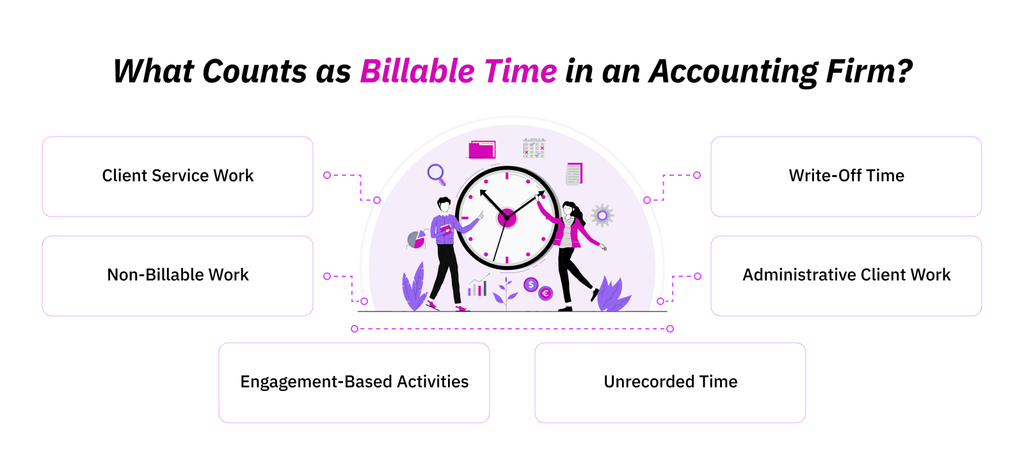
Billable time is the time spent performing client services that can be charged under the applicable engagement agreement.
For example, preparing a corporate tax return, completing audit procedures, and reviewing a client’s financial statements may qualify as billable activities. Internal training, general administration, and staff development typically do not.
However, the classification depends on the actual service and the client’s agreement.
When examining an accounting firm’s profitability, I first separate the different categories of recorded and unrecorded work.
| Classification | What it means | Accounting example |
| Billable time | Work eligible for billing under the engagement terms | Preparing a client’s tax return under an hourly agreement |
| Non-billable time | Work not directly chargeable to clients | Attending internal staff training |
| Unrecorded billable work | Eligible work omitted from the timesheet | Forgetting to record an authorized tax consultation |
| Unbilled work | Recorded work awaiting invoicing | Completed audit procedures held in WIP |
| Written-off time | Recorded work whose billing value has been reduced or eliminated | Writing down excess time on an engagement |
Why Accounting Firm Billable Hours Go Missing
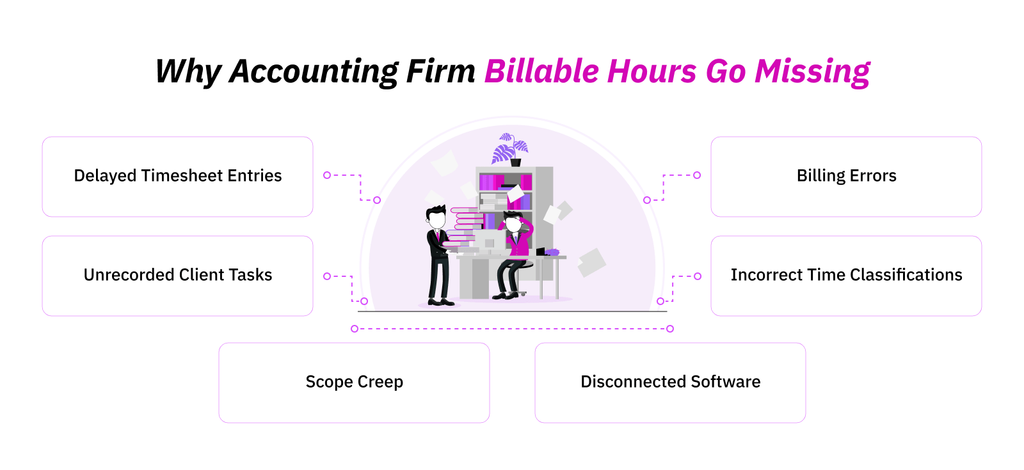
When evaluating billable hours for accountants, I start by tracing the work from completion to invoicing. This helps identify where recording or billing breakdowns cause eligible hours to go missing.
1. Delayed Timesheet Entries Cause CPAs to Miss Client Work
One of the first things I would examine is how long employees wait before recording completed work.
During tax season, an accountant might handle five or six separate client matters before lunch. By Friday, reconstructing every brief consultation, workpaper review, and correction becomes difficult.
This became abundantly clear to me when, in a review of an 11-person CPA firm, I examined four weeks of timesheets alongside client correspondence, calendar appointments, and completed workpapers.
During that time, I identified 14 client-related activities requiring further review. After checking the underlying work, six had sufficient support to establish that eligible services were missing from the timesheets.
Those six activities represented approximately 3.5 hours. At an average applicable billing rate of $185, their potential standard value was $647.50.
The most revealing finding was not necessarily the dollar amount; it was that five of the six omissions involved activities completed at least two days before the employees prepared their timesheets.
2. Small Client Tasks Go Unrecorded
Another issue I would investigate is the tendency to exclude short client interactions because they seem too minor to record.
For bookkeepers, these activities often involve answering client questions, reviewing payroll corrections, checking journal entries, or explaining transaction adjustments.
Consider an accountant handling four client interactions lasting 8, 12, 10, and 15 minutes; that is 45 minutes of work. If this occurs five days a week, it adds up to 3 hours and 45 minutes of potentially unrecorded client work.
At a billing rate of $175 per hour, those overlooked activities represent $656.25 in weekly billing value, assuming all the work is eligible for separate billing.
Therefore, when reviewing time records, I recommend comparing logged hours with client calls, emails, and completed workpapers to identify eligible activities that may have been overlooked. This helps establish whether small omissions are isolated incidents or a recurring time-recording problem.
3. Scope Creep Leaves Additional Work Uncompensated
Scope creep is one of the more consequential issues I would examine in recurring accounting engagements because it can reduce margins even when every employee records their time correctly.
For example, during a review of a firm’s recurring bookkeeping engagements, I noticed one client paying $2,400 monthly whose work had increased from the budgeted 14 hours to 23 hours.
Looking into the timesheets, I found that the additional nine hours came from historical transaction cleanup, management reports, and follow-up analysis that were not part of the original agreement.
At an internal labor cost of $70 per hour, the extra work cost the firm $630 monthly, or $7,560 annually if it continued.
The hours were not missing from the timesheets; instead, the problem was that additional services had become routine without anyone reviewing their effect on the engagement’s profitability.
4. Disconnected Software Creates Gaps in Time Records
Disconnected applications can create billing problems even when employees complete their timesheets accurately.
A firm may use one platform for project management, spreadsheets for time recording, and another system for invoicing, requiring information to be transferred manually.
For example, an accountant may record 8 hours of client work in a spreadsheet, but only 6 hours appear in the billing system because two entries were missed during the transfer. At a billing rate of $190 per hour, the omitted time represents $380 in potential billing value.
This highlights a common problem with billable hours tracking for accounting firms: employees may record their work correctly, yet disconnected systems can prevent those hours from reaching the billing process.
5. Incorrect Time Classifications Hide Billable Work
Time-entry classifications influence which activities appear in the firm’s billing reports.
An employee might record the correct duration but select an internal administration category instead of the client’s engagement code.
While examining my own non-billable accounting entries during my initial years, I once came across a 90-minute activity labeled “General Administration.”
However, when I reviewed its description, the work involved preparing an authorized adjustment to a client’s tax return, which was eligible client work worth $300.
I had not missed recording the time; I had selected the wrong billing category.
Going forward, I started paying particular attention to entries assigned to inactive projects, generic administrative codes, or engagements unrelated to the underlying work.
However, I would never recommend changing a classification merely to improve the firm’s billable utilization rate. The correction must reflect the work actually performed.
6. Billing Errors Leave Recorded Hours Off Invoices
The final breakdown occurs when approved time fails to reach the invoice.
Take this: An hourly advisory engagement with 21.5 approved hours at $210 per hour has the standard work value of $4,515.
However, if the prepared invoice includes only 18 hours, the 3.5-hour difference is worth $735 at the standard rate.
In this case, I would examine the billing instructions before assuming the full amount was omitted accidentally.
If the documentation showed that two hours were intentionally deferred to the next invoice, while 1.5 hours were excluded because the billing report used an incomplete date range, the missed current billing would be only $315, not $735.
That distinction is exactly why I prefer reconciliation over simply comparing total hours with invoice values.
From Client Timesheets to Invoices, Meet TimeBee
Learn More
How Much Revenue Can Missing Billable Hours Put at Risk?
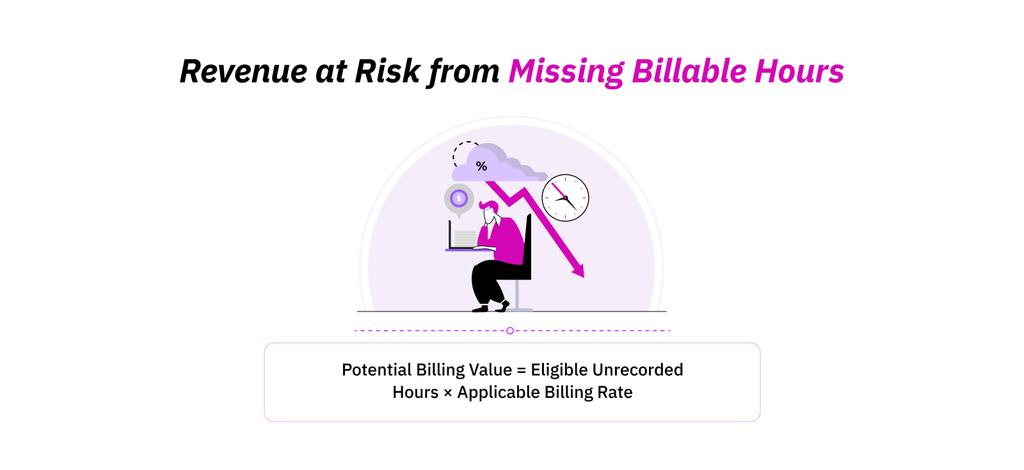
When reviewing billable-time losses, I focus on the difference between work performed, work recorded, and work that can legitimately be invoiced.
I have found this distinction essential because incomplete timesheets do not necessarily translate into an equivalent revenue loss.
For a firm with 10 accountants, just 15 minutes of unrecorded work per employee each day amounts to 500 hours over 200 working days. At an average billing rate of $200, the apparent value is $100,000.
However, I would not treat that entire amount as lost revenue without examining the underlying activities and engagement agreements.
To calculate the potential billing value, the formula I use is:
Potential billing value = Eligible unrecorded hours × Applicable billing rate
Using a 60% billing-eligibility assumption, the financial breakdown is:
| Calculation | Result |
| Total unrecorded hours | 500 |
| Hours eligible for billing (60%) | 300 |
| Average hourly billing rate | $200 |
| Potential billing value | $60,000 |
| Fees at 90% billing realization | $54,000 |
| Collections at 95% collection realization | $51,300 |
The important finding here is the difference between $100,000 in apparent time value and $51,300 in potential collections.
The remaining 200 hours may involve internal administration, work already covered by fixed-fee engagements, or activities that cannot legitimately be charged.
Even the $51,300 depends on adequate documentation, billing authorization, and successful collection. Plus, I would not describe that amount as additional profit since the firm’s labor costs and overhead still need to be considered.
My priority in any billing review is, therefore, to separate recoverable revenue from recording deficiencies that primarily affect future profitability.
How to Prevent Unrecorded Work and Ensure Accurate Billable Hour Tracking for Accountants
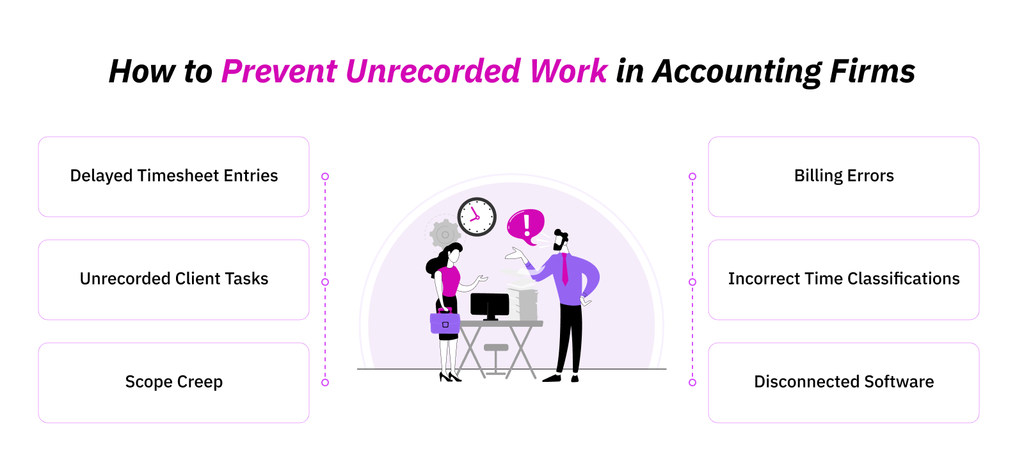
Protecting accounting firm billable hours requires controls at every stage where client work might be overlooked or excluded from billing.
1. Record Client Work on the Same Day
I would require accountants to record time when completing an activity or, at the latest, before finishing their workday.
For CPAs moving between multiple tax returns, that could mean recording the completed task before opening the next client’s file.
I would also pay attention to the quality of descriptions. For example, an entry labeled “Tax work – 2 hours” provides less useful evidence than one identifying the return, relevant schedule, and work performed.
A clear description makes subsequent approval and billing reviews easier.
If a firm struggles with late submissions, I would examine whether employees lack time to record work, whether the system is inconvenient, or whether managers have failed to establish consistent expectations.
2. Capture Every Eligible Client Interaction
Employees need guidance on recording short calls, emails, document reviews, and consultations. However, I would distinguish the recording policy from the billing policy.
For example, an accountant should record a seven-minute client consultation even if the service is included in a fixed monthly fee because that information helps the firm understand engagement costs.
Moreover, where an hourly agreement specifies minimum billing increments, those increments should be applied according to the agreed policy rather than changing the underlying record of actual work.
I would also encourage managers to investigate clients generating unusually frequent support requests because these activities may indicate a need to review engagement scope.
3. Track Additional Work Against Engagement Scope
For recurring accounting engagements, I would make the agreed service scope accessible to employees performing the work.
I believe junior accountants and bookkeepers should not have to interpret a lengthy contract whenever a client asks for an additional report or historical transaction review.
Instead, the firm should maintain a straightforward scope reference identifying included services, excluded services, and the approval process for additional requests.
In addition, when substantial new work is requested, the accountant should document the activity and obtain the appropriate authorization.
This protects the client from unexpected charges while preventing additional work from becoming an undocumented obligation.
4. Synchronize Time Records Across Systems
Before recommending an integration, I would trace how existing time records move into billing.
For example, select 20 approved entries and follow them through their original timesheets, project records, billing reports, and invoices. Then check whether each entry retains the correct client identifier, duration, task description, rate, and billing classification.
Where manual transfers create repeated discrepancies, standardized imports or integrations may reduce the risk.
However, the firm should test those changes before adopting them across every engagement.
5. Review Billable Time Classifications
I recommend establishing an exception review before the billing cycle closes.
Managers should examine client-related work classified as non-billable, entries with missing descriptions, and records assigned to incorrect projects.
For example, if an employee records three hours against a generic administration code while working on an active tax engagement, the manager should investigate the classification.
The aim is not to increase the number of billable hours artificially; instead, it is to ensure that the firm’s records accurately represent its professional services.
6. Reconcile Recorded Hours With Client Invoices
Before issuing invoices, compare approved time with the amounts prepared for billing.
I would expect the reconciliation to account for invoiced work, authorized write-downs, deferred WIP, and applicable fixed-fee arrangements.
Consider the following example:
| Billing component | Value |
| Standard value of approved hourly work | $6,000 |
| Authorized write-down | $500 |
| Work deferred to the next billing cycle | $1,000 |
| Expected current invoice | $4,500 |
| Actual prepared invoice | $4,200 |
| Unexplained difference | $300 |
The $300 difference should be investigated before the invoice is finalized. A documented adjustment can explain it, or the firm may need to correct an omission.
Proven Methods and Metrics for Reliable Billable Hours Tracking for Accounting Firms
A reliable tracking system should help you record client work accurately, identify missing entries, and verify the hours included in invoices. However, the right approach depends on your firm’s size and reporting requirements.
Time Tracking Methods for Accountants and Bookkeepers
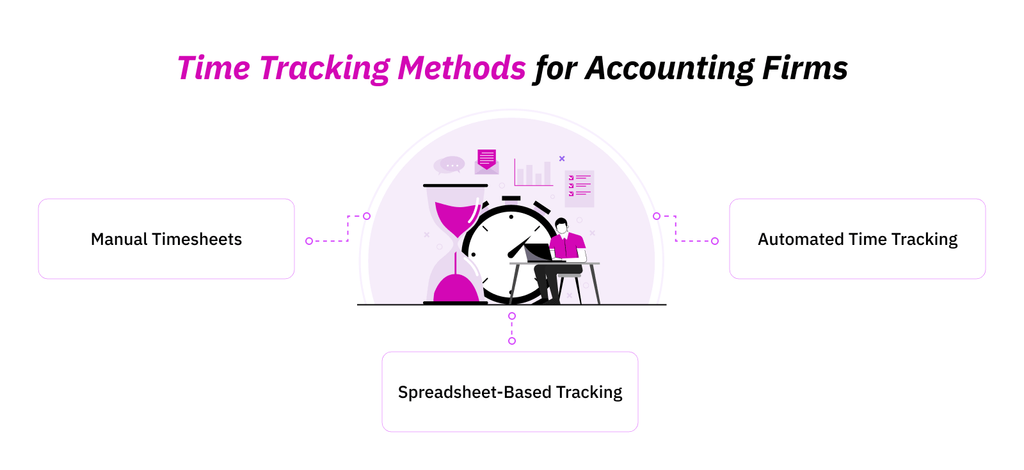
Accounting firms generally use three approaches to record billable time. Each offers a different level of flexibility, administrative effort, and control over billing records.
1. Manual Timesheets
Manual timesheets allow accountants to record client work using paper forms or basic time-entry sheets. A typical timesheet includes the following fields:
| Date | Client | Task Description | Start Time | End Time | Total Hours | Billable Status |
This format creates a straightforward record of who worked on which client, what they completed, and how much time each activity required.
Overall, manual timesheets are inexpensive and easy to implement. However, their accuracy depends on employees recording activities promptly, while calculating totals and identifying missing entries require manual review.
2. Spreadsheet-Based Time Tracking
Spreadsheet-based tracking offers greater flexibility by allowing firms to organize time entries, calculate totals automatically, and filter records by client or engagement.
For example, an accounting firm can create a Microsoft Excel timesheet with columns for dates, client names, engagement codes, task descriptions, hours worked, billing rates, and billable status.
Moreover, using Excel’s SUMIFS function, the billing manager can calculate total billable hours for a particular client without manually adding individual entries. PivotTables can summarize hours by accountant, engagement, or billing period, while drop-down lists can help employees select consistent client codes and billing classifications.
Google Sheets offers similar capabilities, with the additional convenience of multiple employees updating a shared workbook.
These features make spreadsheets practical for firms that need more structured reporting than paper timesheets provide.
However, incorrect formulas, inconsistent entries, and accidental changes to shared records can affect billing accuracy.
3. Automated Time Tracking
Automated time tracking uses software to capture active work sessions and organize recorded hours against specific clients, projects, or tasks.
For example, TimeBee allows accountants to start a timer against a specific client project and task. As they work, the system records the session duration and organizes the hours into timesheets.
If an accountant forgets to track an activity, they can add the missed time manually.
Once the hours are recorded, managers can then review billable classifications and use project reports to see how much time employees have spent on each engagement.
When preparing invoices, TimeBee’s autofill feature can also retrieve recorded hours for the selected billing period and apply the configured rates to calculate billing amounts.
Administrators can then review the charges, make necessary adjustments, and approve the invoice.
This workflow reduces manual calculations and repeated data entry between timekeeping and billing. However, accountants must still verify their entries and ensure the charges comply with the client’s engagement agreement.
Key Metrics for Detecting Missing Billable Hours
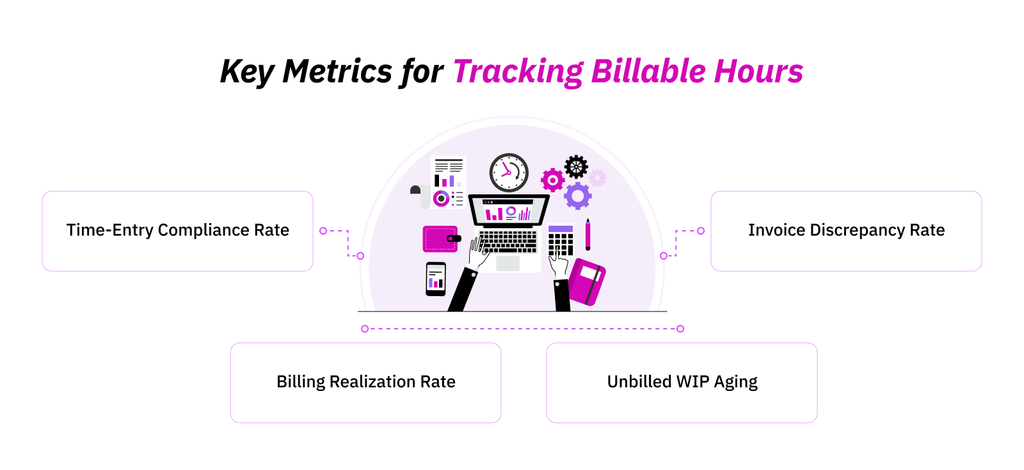
Recording hours consistently is only part of the process. To understand whether eligible work is reaching invoices, I would monitor four measures that highlight different weaknesses in timekeeping and billing.
1. Time-Entry Compliance Rate
Time-entry compliance measures how consistently employees complete their timesheets within the firm’s required deadlines.
Formula: Time-entry compliance = (Timesheets submitted on time ÷ Timesheets due) × 100
Suppose an accounting firm expects 50 employee timesheet submissions in a week, but only 46 arrive by the deadline. Its compliance rate is 92%.
The remaining four submissions warrant attention because delayed entries can increase the risk of forgotten work.
2. Billing Realization Rate
Billing realization measures how much of the standard value of recorded eligible work is ultimately invoiced.
Formula: Billing realization = (Net fees billed ÷ Standard value of recorded eligible work) × 100
For example, assume a firm records $10,000 in standard billable work but invoices $8,500 after approved adjustments; then its billing realization rate is 85%.
The remaining $1,500 does not necessarily represent missing revenue; instead, it could reflect authorized write-downs, contractual discounts, or other billing arrangements.
When reviewing a low realization rate, I would examine the reasons behind those adjustments before concluding that the firm has a time-tracking problem.
3. Unbilled Work-in-Progress (WIP) Aging
WIP aging shows how long recorded client work has remained uninvoiced. Unlike utilization or realization, it measures the time elapsed.
Basic calculation: WIP age = Review date − Date work was performed
If an accountant completes 12 hours of audit work, but the corresponding amount remains in WIP 45 days later, that balance deserves examination.
However, older WIP is not automatically lost revenue since the client might be billed at an agreed milestone.
4. Invoice Discrepancy Rate
The invoice discrepancy rate measures how frequently billing records contain unexplained differences between approved time entries and their expected invoice treatment.
Formula: Invoice discrepancy rate = (Entries with unexplained discrepancies ÷ Entries reviewed) × 100
Suppose a billing manager reviews 100 approved time entries and finds four that cannot be reconciled with the invoice records or documented adjustments; then the discrepancy rate is 4%.
Those exceptions could involve omitted hours, incorrect client assignments, duplicate records, or undocumented billing changes.
Therefore, I recommend investigating each exception individually because the rate identifies potential control weaknesses.
How to Reduce Missing Billable Hours
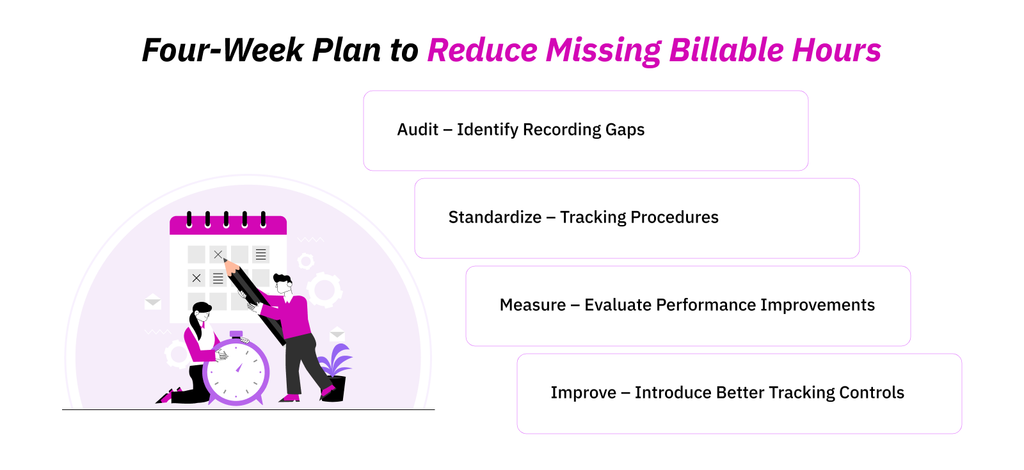
Improving billable hour tracking for accountants does not necessarily require an immediate software investment.
I would begin by reviewing the existing process, correcting its most frequent weaknesses, and measuring the results before committing to larger changes.
The following four-week plan provides a practical starting point.
| Timeline | Key actions | Responsible role | Measurement |
| Week 1: Audit | Compare selected timesheets, client activity records, WIP, and invoices | Practice manager | Baseline recording compliance and billing discrepancies |
| Week 2: Standardize | Establish recording deadlines, activity codes, and scope-change procedures | Practice manager and team leads | Percentage of records with complete classifications |
| Week 3: Improve | Pilot timer-based recording, reduce duplicate entry, and introduce billing reconciliations | Operations lead and billing manager | Number of missing or mismatched entries identified |
| Week 4: Measure | Compare the pilot results with the baseline | Firm leadership | Changes in compliance and reconciliation accuracy |
Final Thoughts
The real cost of missing billable hours is not always apparent in monthly revenue reports. Instead, it often becomes visible when you examine how much client work was completed compared with what was actually recorded and billed.
Therefore, I would recommend that you start with a review of your most recent engagements and look for unexplained differences between completed work and invoices.
By doing so, you may uncover recoverable billing opportunities or weaknesses that need attention.
Remember, the goal is to ensure that every hour of legitimate client work is properly accounted for.
FAQs
What is the difference between billable utilization and billing realization in accounting firms?
Billable utilization measures the percentage of available working hours spent on billable client activities. On the other hand, billing realization measures the percentage of recorded billable time’s standard value actually invoiced. Utilization reflects how accountants allocate their time, while realization indicates how effectively firms convert that time into billed revenue.
Should accounting firms use hourly billing, fixed-fee pricing, or value-based pricing?
The appropriate pricing model for accounting firms depends on the engagement. Hourly billing suits unpredictable workloads, fixed-fee pricing works well for recurring services with defined deliverables, and value-based pricing reflects the benefit delivered to clients.
Should accountants charge clients for time spent correcting errors or reworking assignments?
Accountants generally should not charge clients for correcting mistakes caused by their own firm. However, additional work resulting from inaccurate client information, revised instructions, or changes in engagement scope may be billable if the agreement permits it.
How should accounting firms handle client disputes over billed hours?
Accounting firms should review the engagement agreement, timesheets, task descriptions, and invoice details before responding. They should explain disputed charges, correct documented errors, and discuss reasonable adjustments where necessary.
What is the average hourly billing rate for a CPA in 2026?
There is no single established national average hourly billing rate for CPAs. Nonetheless, the AICPA’s National MAP Survey reports a $170 median net hourly billing rate. Rates vary by experience, location, firm size, and service complexity.
TimeBee: Stop Managing Time From Memory Alone
See How It Works



Morgan Ellis
Member since October 30, 2026
Morgan Ellis
Member since October 30, 2026
Morgan Ellis is a Certified Public Accountant and Senior Accounting Consultant with expertise in financial accounting, auditing, management accounting, internal controls, and financial management.
With more than 14 years of experience in public accounting, corporate finance, and business advisory, Morgan has helped organizations improve internal controls and establish more effective accounting practices.
He holds a Bachelor of Science in Accountancy and a Master of Accounting Science from the University of Illinois Urbana-Champaign’s Gies College of Business.
He also earned the Certified Management Accountant (CMA) designation from the Institute of Management Accountants and the Certified Internal Auditor (CIA) certification from the Institute of Internal Auditors.
Drawing on this academic and professional background, his writing translates complex accounting concepts into clear, practical guidance for business owners and finance professionals.