

Billable Hours Optimization for Creative Agencies: Common Problems and How to Fix Them
By Frank Oliver
September 23, 2026 14 min readI did not fully appreciate the phrase “time is money” until I began working with creative agencies. In a client-service business, profitability depends on how effectively the agency uses the hours allocated to each project.
Billable-hours optimization does not mean asking employees to work relentlessly or rely on overtime. It means using available client hours to deliver the strongest possible outcome with the least avoidable waste.
That is harder than it sounds. Creative agencies must manage several variables that are further related to several parties. Mistakes are inevitable, but recurring process gaps can quietly reduce margins.
When I begin consulting with a creative agency, I first address the most common operational problems. This aligns the delivery process and makes revenue leakage easier to identify. So, let’s start there.
The Essentials of Billable-Hour Optimization for Creative Agencies
- Billable hours optimization for creative agencies is about converting existing client work into accurately recorded and successfully invoiced revenue.
- Daily time capture helps agencies record short calls, research, revisions, and other easily forgotten tasks.
- Clear time categories help employees classify billable work, unbilled client activity, and essential internal tasks consistently.
- Revision limits, approval criteria, and change requests prevent additional deliverables from becoming unpaid work.
- Utilization should be reviewed alongside realization rate, effective billable rate, and project gross margin.
- Time-tracking, resource-planning, and financial-management tools work best when scopes, pricing, responsibilities, and workflows are already clear.
What “Billable Hour Optimization” Actually Means for a Creative Agency
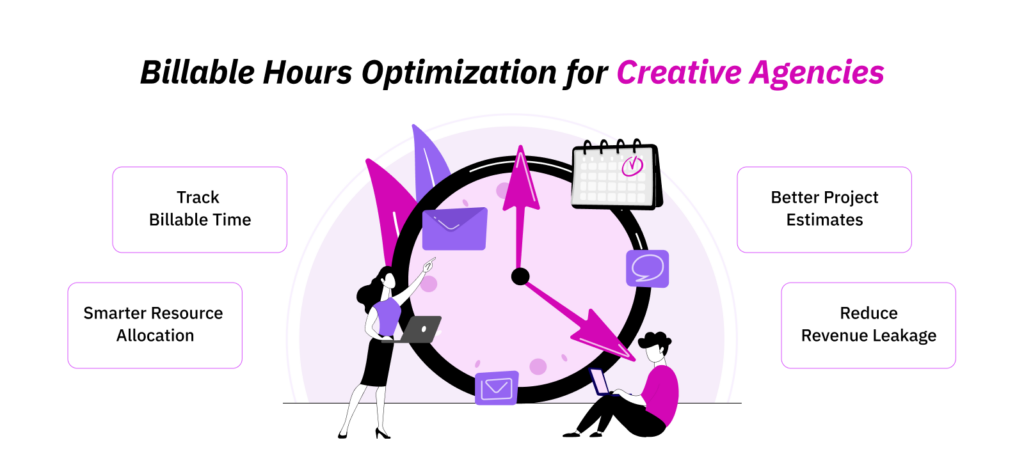
Billable hours optimization is the process of maximizing the amount of client work that can be accurately billed while minimizing unnecessary, non-billable activities.
For creative agencies, billable-hour optimization improves the commercial return from existing clients. It reveals where client activity becomes unrecorded time. Also, it highlights unpaid revisions and avoidable rework. Finally, it exposes invoice write-offs.
Time tracking is the most essential part of the process, but the entire focus is not the entirety of it. The wider objective is to understand the relationship and create a seamless flow between employee capacity and project revenue.
The Difference Between Billable, Unbilled Client, and Internal Time for a Creative Agency
Billable time covers client work that can be charged under the agreed contract. Examples include strategy sessions, design production, development, client presentations, approved revisions, etc.
Unbilled client time covers work completed for a client but not invoiced. It usually includes excess meetings, informal requests, or revisions outside the agreed allowance.
Internal time supports the agency rather than a specific client. Training, business development, mentoring, and process improvement may be non-billable, but they are still necessary.
It is essential that the agency records all three categories. Otherwise, management will not be able to see the true cost of client delivery or the capacity required to operate the business.
Why a 100% Billable Target Is a Warning Sign
Kantata’s current professional-services guidance places sustainable billable utilization around 70% to 80%. It also stresses that the correct target depends on the service model and cost structure.
From a realistic viewpoint, a 100% billable target leaves no room for essential non-billable work. Teams still need time for management and unexpected project demands.
It can also create pressure to classify every hour as billable. When that happens, time data becomes less reliable, and the agency becomes prone to hiding workload issues and operational gaps.
5 Reasons Why Creative Agency Billable Hour Optimization is Important
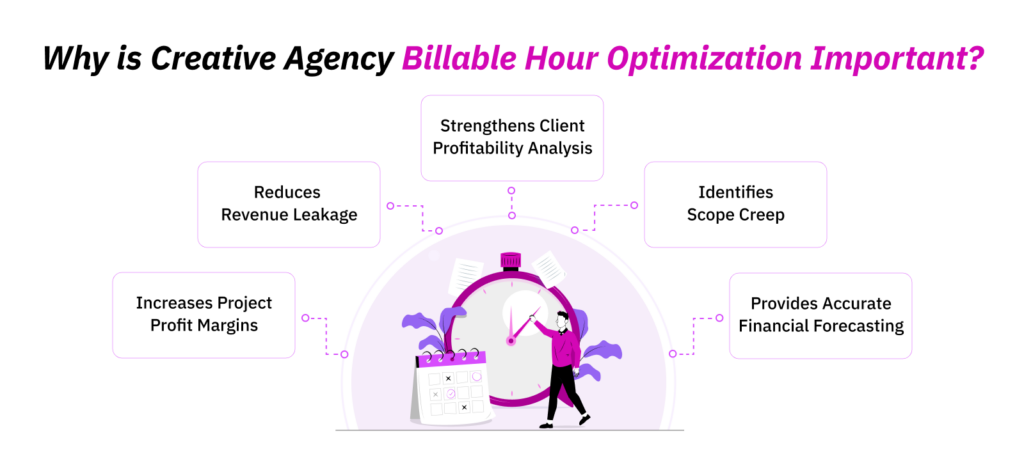
Here are the most essential reasons to track billable hours accurately.
1. Increases Project Profit Margins
Accurate time records show whether the agency delivered a project within its planned labor cost. If the agency has stronger scope controls and fewer write-offs, they are likely to retain more of the agreed fee.
This matters in a sector where margins can be limited. Promethean Research found that digital agencies produced an average after-tax net margin of 13% in 2025, although results varied by size and operating model.
2. Reduces Revenue Leakage
A current Accelo summary, which cites MGI Research, estimates that professional-services organizations lose an average of 4.3% of annual revenue to leakage.
Revenue leakage occurs when an agency completes work but fails to bill or collect the full value. Common examples include forgotten meetings, delayed timesheets, unapproved discounts, and work completed outside the agreed scope.
3. Strengthens Client Profitability Analysis
Not every high-revenue account is a profitable account. One client may require repeated meetings or extensive revisions that are not reflected in the fee.
Billable-hour data allows agencies to compare revenue with actual delivery effort. It allows management to renegotiate the contract or redirect resources toward better-performing accounts.
4. Identifies Scope Creep
PMI’s 2018 cross-industry research found that 52% of completed projects had experienced scope creep or uncontrolled scope changes. Scope creep occurs when project requirements expand without a corresponding change to the budget or resources.
Hours tracked against approved phases and deliverables expose overruns before the project closes. The project manager can then raise a change request while commercial options remain available.
5. Provides More Accurate Financial Forecasting
Billable utilization connects scheduled client demand with expected revenue capacity. When the billable hours offer more reliable data, it gives finance and operations teams a stronger basis for monthly revenue and margin forecasts.
One thing to remember here is that the forecast still depends on several attributes such as sales conversion, project timing, realization, and collection. Billable hours are therefore one input within a wider financial model, not a guaranteed revenue figure.
9 Common Problems in Optimizing Billable Hours for Creative Agencies + Fixes
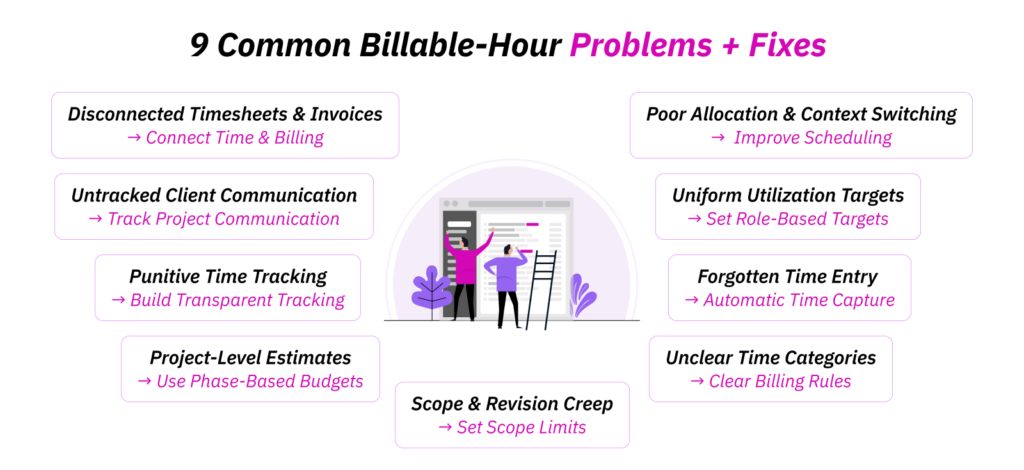
Across creative-agency transformation engagements, I have found that lost billable time is rarely caused by one major failure. It usually develops through small process gaps between time capture and invoicing.
These gaps can be difficult to spot because the team still looks busy. Projects continue to move, clients receive their work, and invoices are issued. However, the agency may still be absorbing hours that were never planned, recorded, or billed.
I also advise agencies to treat activity data as diagnostic evidence. It can reveal patterns and operational friction, but it should not be treated as definitive proof of an employee’s performance.
The following are some of the most common problems I have encountered while helping creative agencies improve their billable-hour processes.
1. Delayed Time Entry Causes Billable Work to Be Forgotten
One of the first areas I review is how often employees record their time. Weekly timesheets may appear convenient, but they force people to reconstruct several days of work from memory.
Many project-related tasks are easy to forget when employees log their time later. These may include short client calls, research tasks, feedback messages, and minor revisions. Employees may also round their entries because they can no longer recall the exact duration.
This creates two problems. The agency loses billable time, and its project data becomes unreliable. Consequently, future estimates are based on incomplete delivery records.
Fix Delayed Timesheets With Daily Time Capture
I usually recommend daily time entry rather than weekly reconstruction. The process should be quick and supported by simple project and task categories.
You can also use a time-tracking tool, but accuracy should remain the main priority. Review the recorded data regularly to identify missing or inconsistent entries.
Whichever method you choose, it should fit the team’s existing workflow. Reminders can help, but they should reduce friction rather than create more administration.
TimeBee: Track Time Accurately for Every Client Project
Learn More
2. Unclear Time Categories Create Inconsistent Billable-Hour Records
Employees often interpret billable work differently. One designer may record concept research as client time, while another may classify it as internal work.
The same issue can affect presentations, feedback calls, quality checks, file preparation, and account management. Different rules across departments make project comparisons unreliable.
Fix Inconsistent Classification With a Billable-Time Policy
Create a short policy with practical examples for each department. It should explain how supporting tasks are classified.
Also clarify that non-billable work is not always unproductive. Training and quality control may not be invoiced, but they still support agency performance.
Review unclear categories during project retrospectives and update the policy when needed.
3. Untracked Client Communication Hides Chargeable Project Work
Creative teams usually record design or production time. However, they often overlook added discussion time with clients, whether it is emails, calls, presentations, or feedback discussions.
I have seen client communication consume far more time than the agency expected. The work was completed, but the true delivery cost remained hidden.
Fix Hidden Communication Time With Project Codes
Add a communication code to each client project. Estimates should also include a realistic allowance for meetings and feedback.
If a client regularly exceeds that allowance, review the cause. The agency may need stricter meeting controls, or updated contract terms.
This supports chargeable hours optimization for creative agencies without billing clients for every small interaction.
4. Scope and Revision Creep: Turn Extra Work Into Unpaid Work
Scope creep often begins with a request that appears small. A client may ask for another concept or one final revision.
I have seen these requests accumulate until the project requires far more time than planned. The work is still delivered, but the original fee no longer reflects the true delivery cost.
Not every additional request creates a problem. The issue begins when extra work is completed without reviewing the scope, price, or timeline.
Fix Scope Creep With Clear Limits and Change Requests
In such a case, I suggest defining everything, including deliverables, revision rounds, stakeholders, and approval criteria, before work begins.
When a request falls outside the agreed scope, raise a simple change request. Explain the effect on price or timeline before the team proceeds.
This protects the project margin while keeping client expectations clear.
5. Project-Level Estimates Hide Where Time Overruns Occur
A single project estimate can show that the budget was exceeded. However, it does not always reveal which stage caused the overrun.
I have come across projects losing margin during discovery, creative development, client feedback, or revisions. Without phase-level data, managers may apply the wrong solution.
The agency may increase the full project price when only one stage needs better control.
Fix Inaccurate Estimates With Phase-Based Budgets
Break each project into clear delivery phases. Give every phase its own hour allowance and role mix.
Compare estimated and actual hours throughout the project. This allows the team to adjust the process or discuss a commercial change before the budget is exhausted.
Phase-based estimates also show whether expensive senior resources are being used where they add the most value.
6. Disconnected Timesheets and Invoices Cause Revenue Write-Offs
Time records, project budgets, invoices, and collected revenue are often managed in separate systems. This makes it difficult to trace the value of an hour from payment delivery.
Usually, projects report strong utilization while producing weak financial results. Some hours are removed before invoicing, while others are absorbed within fixed fees.
Without a clear review process, these losses can become routine.
Fix Revenue Leakage by Connecting Time and Invoicing
I suggest reviewing recorded time before each invoice is prepared. Every write-off should have a clear reason.
Separate goodwill discounts from delivery problems, such as rework or poor estimates. Management needs to understand each issue requires a different response.
Track realization alongside utilization. Utilization shows how capacity was used, while realization shows how much recorded work became billed revenue.
7. Uniform Utilization Targets Distort Performance Across Roles
A junior designer, creative director, project manager, and agency founder do not contribute in the same way. Applying one billable target to every role ignores those differences.
I have seen lower utilization rates treated as poor performance even when employees were handling mentoring, quality control, staffing, or sales support. These tasks may not be billable, but they still support the agency.
A lower rate is not always a problem. It may reflect responsibilities that sit outside direct client delivery.
Fix Misleading Targets With Role-Specific Benchmarks
Set utilization expectations by role family. Each role should also have clearly defined non-billable responsibilities.
Review the targets against workload, historical margins, and business needs. Avoid copying benchmarks from another agency without considering your own operating model.
8. Context Switching and Poor Allocation Reduce Billable Capacity
Employees can remain busy without completing enough focused client work. Too many active projects, urgent requests, and fragmented meetings divide attention.
I have also seen senior employees spend time on routine tasks while specialist skills remain unused elsewhere. The problem is not always limited capacity. Sometimes the available capacity is simply assigned poorly.
Fix Lost Capacity With Better Scheduling and Allocation
Limit the number of active assignments per employee. Group internal meetings where practical and protect blocks of focused delivery time.
Match task complexity with the right level of experience. Planning can reveal overload early and show where available skills are not being used effectively.
9. Punitive Time Tracking Produces Inaccurate Data
Employees may underreport time when they believe timesheets will be used to judge or punish them. They may hide difficult revisions or place excess hours under broad internal categories.
I have found that pressure rarely improves data quality. It usually encourages employees to record what they think management wants to see.
Fix Resistance With Transparent Billable-Hour Management
Explain why time data is collected and how it supports pricing, staffing, and workload planning.
I recommend reviewing utilization alongside overtime, quality, and client demands. Employees should also have a safe way to report unclear briefs, repeated rework, or unrealistic deadlines.
Effective billable hour management for creative agencies should improve the system rather than blame the individual.
These nine problems are closely connected and cumulatively become the biggest issue for creative agencies.
I do not recommend fixing each issue in isolation. Start by identifying where time and revenue separate during the delivery process. Then address the causes in the right order.
How to Build a Measurement Baseline to Optimize Billable Hour Management for Creative Agencies
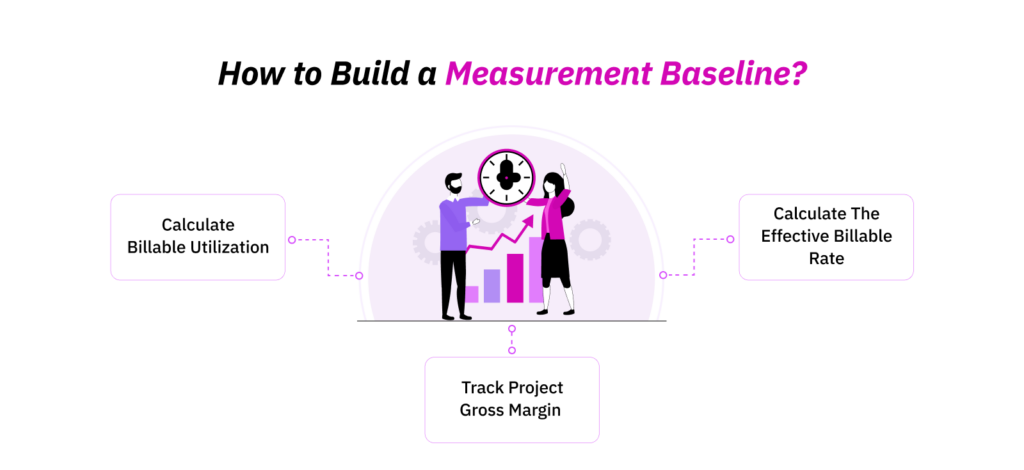
The nine problems above show where billable time can be lost—a measurement baseline shows which problem is having the greatest financial effect.
Consider a hypothetical fixed-fee branding project. The agency charges $24,000 and expects to complete the work in 160 hours.
During the project, the team has 280 gross working hours. Approved leave and public holidays reduce the available capacity to 240 hours.
The agency records 180 billable hours. However, only the equivalent of 160 hours is reflected in the final invoice. Total delivery reaches 205 hours, while direct labor costs rise to $15,375.
Calculate Billable Utilization To Measure Available Capacity For Client Work
Billable utilization = Billable hours ÷ Available working hours × 100
- Gross utilization: 180 ÷ 280 × 100 = 64.3%
- Net utilization: 180 ÷ 240 × 100 = 75%
Gross utilization includes all scheduled working hours. Net utilization removes time that was never available for client delivery.
- Identifies poor allocation across teams and roles
- Highlights context switching that reduces focused work
- Exposes unrealistic role-based utilization targets
- Indicates missing or incomplete time entries
Measure Realization Rate To Identify Billable Hours
Realization rate = Invoiced billable hours ÷ Recorded billable hours × 100
- Realization rate: 160 ÷ 180 × 100 = 88.9%
- Recorded hours not reflected in the invoice: 20 hours
The realization rate shows how much recorded billable work becomes invoiced revenue.
- Identifies invoice write-offs
- Reveals unpaid revisions and additional requests
- Highlights gaps between time tracking and invoicing
- Exposes fixed-fee projects that absorb excess hours
Calculate The Effective Billable Rate To Expose Unprofitable Fixed-Fee Work
Effective billable rate = Project revenue ÷ Total delivery hours
- Planned effective rate: $24,000 ÷ 160 = $150 per hour
- Actual effective rate: $24,000 ÷ 205 = $117.07 per hour
- Reduction in effective rate: $32.93 per hour
The effective billable rate shows how much revenue the agency earns for every hour spent delivering the project.
- Exposes scope and revision creep
- Reveals hidden client communication time
- Shows whether fixed fees cover actual delivery effort
- Supports better pricing for future projects
Track Project Gross Margin To Connect Time Data With Actual Agency Profitability
Project gross margin = (Revenue − Direct delivery cost) ÷ Revenue × 100
- Project revenue: $24,000
- Direct delivery cost: $15,375
- Gross profit: $8,625
- Project gross margin: $8,625 ÷ $24,000 × 100 = 35.9%
Gross margin confirms the final commercial outcome of the project.
- Exposes excessive use of senior resources
- Highlights services that may be underpriced
- Supports client and service-line profitability analysis
- Shows whether operational improvements produce financial value
When optimizing billable hours for creative agencies, I recommend reviewing all four metrics together.
Best Tools For Optimizing Billable Hours For Creative Agencies
Once the agency has corrected its policies and workflows, software can make those improvements easier to maintain. The right tool depends on whether the main problem involves time capture or resource allocation.
Use Time-Tracking Software – TimeBee

TimeBee is a time-tracking tool for creative agencies with project-level time capture. It allows employees to record work against specific clients and projects. This helps agencies separate billable work from internal activity and see where delivery time is being spent.
Its online timesheets can reduce the risk of forgotten tasks. Employees can record all added tasks instead of relying on memory at the end of the week. Also, managers can then review tracked hours for missing or inconsistent entries.
TimeBee also tracks billable and non-billable hours. Management can easily identify unpaid work and improve project reporting. Moreover, it provides activity reports that can show where time is being lost, but they should be used to diagnose workflow problems rather than judge employees in isolation.
The client portal provides access to project progress and tracked hours. This can improve transparency when clients question invoices or request delivery updates.
Overall, TimeBee connects tracked hours with billing and invoice preparation. From accurately tracking each task to invoicing, it offers comprehensive features for creative agency billable hour optimization.
Use Resource-Planning Software – Float
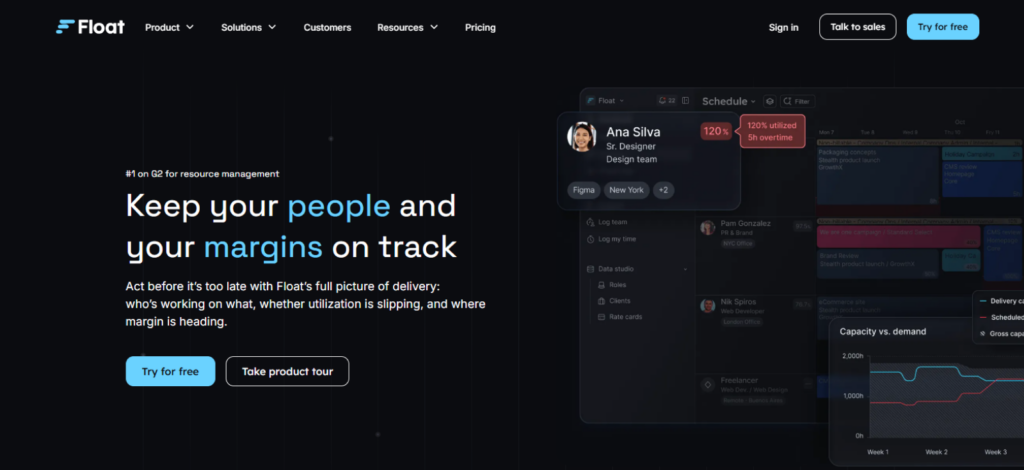
Float is useful when the main problem is poor allocation rather than missing time records. Its scheduling view combines project assignments and capacity in one place. This helps managers see who is overloaded and who still has room for client work.
Agencies can assign roles, departments, skills, or seniority tags to employees. This makes it easier to match project complexity with the right level of experience. It can also reduce situations where senior employees spend too much time on routine delivery tasks.
Float accounts for holidays. It also separates billable and non-billable allocations in its reports. These features support more realistic utilization targets across different roles.
Tentative projects allow managers to plan unconfirmed work before it enters the live schedule. This can reveal future capacity gaps and reduce last-minute overbooking. It also supports better hiring and freelancer decisions when the pipeline exceeds available resources.
Connect Project Budgets, Time Records, And Invoices – Productive
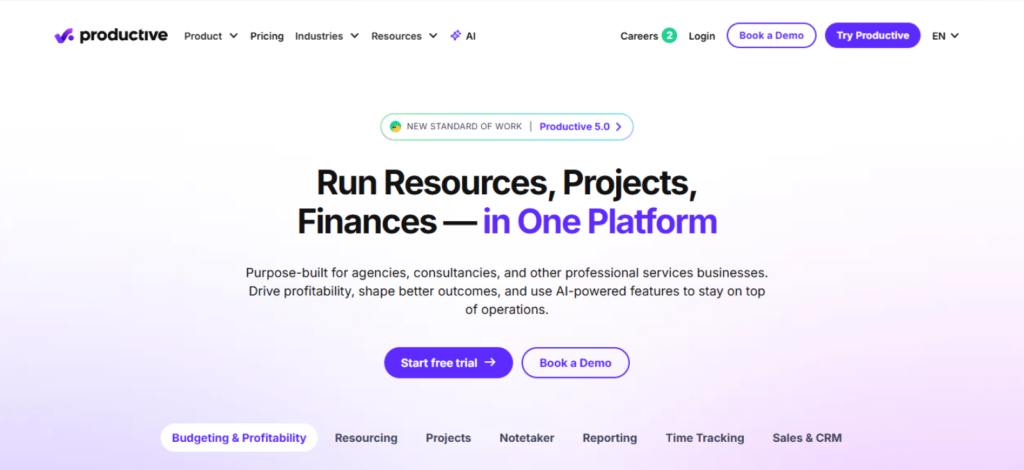
Productive is designed for agencies that need one system for project delivery and financial management. It connects sales deals, project budgets, services, resource bookings, time records, invoices, and profitability reporting.
Employees can record time against a specific budget and service. The agency can then compare planned hours with actual delivery effort. This can be used to identify inaccurate estimates and services that require more work than expected.
Productive also links budgets directly with invoices. Fixed-fee, time-and-materials, percentage, and non-billable services can be managed according to their commercial structure. This reduces the gap between recorded work and invoiced value.
Its profitability views bring together revenue, costs, tracked time, and margins. This can help agencies explain write-offs, assess client profitability, and trace a project from the original deal through delivery and billing.
Software cannot correct unclear scopes, weak pricing, or poor management practices. It can only make those problems more visible and easier to manage.
Final Thoughts
Chargeable hours optimization for creative agencies is not about demanding more time from employees. It is about improving how client work is scoped, from allocation to invoicing.
From my experience, the biggest losses usually come from small gaps rather than one major failure. Once you address those, it becomes much easier to optimize the entire process.
The most effective approach is to fix these problems in sequence. Start with accurate time capture, then connect the data with budgets, utilization, realization, and project margin.
Tools can support this process, but they cannot replace clear policies or sound management. For best results, analyze the results of the fixes through these tools and adjust your strategies accordingly.
FAQs
Should freelancers and contractors be included in agency utilization reports?
Yes, when freelancers and contractors contribute directly to client delivery, they should appear in utilization and capacity reports. However, agencies should report them separately from employees because their cost structure and contractual hours differ.
How often should a creative agency review its billable rates?
A creative agency should review its billable rates at least once a year and examine them quarterly against current costs and margins. An earlier review should be conducted when costs and expenses change materially.
Agencies should also compare planned rates with effective billable rates, since a strong rate card can still produce weak margins when projects consistently overrun.
What is a healthy write-off rate for a creative agency?
There is no universal healthy write-off rate for every creative agency. The practical goal is to keep write-offs low and stable rather than chase an unsupported industry percentage.
Creative agencies should track the rate by client, service, project manager, and cause. Any sustained increase should trigger a review of every related area before the loss becomes routine.
Which pricing model works best for agencies with unpredictable revision cycles?
Time-and-materials pricing usually suits projects with unpredictable revision cycles because the client pays for the additional effort required. A capped time-and-materials model can provide budget protection, while a retainer may suit recurring creative work with variable monthly demand.
Fixed-fee pricing is safer only when the scope, approval process, and revision limits are clear. Many agencies therefore use a blended approach.
How can agencies audit billable-hour data for accuracy?
Agencies should compare timesheets with project schedules, calendars, task records, invoices, and approved budgets. Look for missing entries, unusual rounding, duplicate hours, inconsistent classifications, and work recorded after long delays.
Also, if you are using the tool, ensure the data entered is accurate. The aim is to improve data quality and processes, not to use isolated time records as proof of employee performance.
Optimize Billable Hours With Smarter Time Tracking
Buy Now



Frank Oliver
Member since July 8, 2026
Frank Oliver
Member since July 8, 2026
Frank Oliver is a Principal Consultant in Operations and Transformation, specializing in process improvement, digital transformation, operational performance, and the implementation of workplace technology.
He holds an MSc in Operations, Project and Supply Chain Management from The University of Manchester. He is also a Project Management Professional and a Prosci Certified Change Practitioner.
Overall, with more than 15 years of experience, Frank focuses on helping businesses identify the systems and workflows that influence productivity. His work further examines how processes, technology, management practices, role clarity, and data quality interact to affect organizational performance.