

7 Major Causes of Delays in Construction Projects & How to Avoid Them
November 16, 2026 14 min readI have seen this more times than I care to admit: a crew arrives ready to start, only to find another trade still working in the area it needs. The supervisor begins rearranging the day. Meanwhile, the client is arranging deliveries and booking an opening around the completion date he was promised.
So, if you ask me how to manage delays in construction projects, I start with situations like this. Understanding exactly what is holding up the work gives you a practical basis for deciding what happens next. It also helps you explain to the client whether the promised date remains achievable.
This guide covers construction delay causes, recovery options, business consequences, and prevention for future projects.
TL; DR Construction Delays and More In Under a Minute
- Construction delays stem from unrealistic schedules, scope creep, poor workforce allocation, trade coordination gaps, resource shortages, funding problems, and unexpected site conditions.
- A delayed task pushes back completion when available schedule flexibility cannot absorb it.
- Recovery starts by identifying the obstacle and the milestone it threatens.
- Before adding workers, compare planned labor hours with actual availability and completed work.
- Delays can weaken client trust, restrict new work, reduce client income, and trigger disputes.
- Prevent future delays through realistic schedules, approved changes, and confirmed resources.
3 Types of Delays in Construction Projects
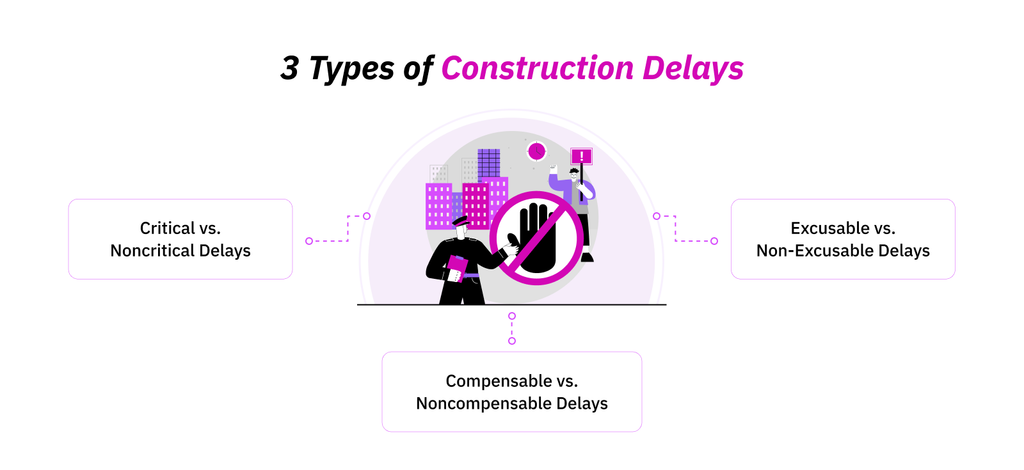
Construction delays fall into overlapping categories: critical or noncritical, excusable or non-excusable, and compensable or noncompensable. Their breakdown is given below.
Critical vs. Noncritical Delays
A critical delay affects work on the critical path: the sequence of activities that determines when the project or a key milestone can finish.
A noncritical delay affects work with enough scheduling flexibility to finish late without moving the project’s completion date. This flexibility is called total float.
For example, if an activity has four days of total float and finishes two days late, you still have two days of float remaining. The project can finish on schedule, assuming the rest of the work proceeds as planned.
Excusable vs. Non-Excusable Delays
An excusable delay generally comes from an event outside your team’s reasonable control and may qualify you for additional time under the contract.
For example, if the owner fails to provide access to a required work area when promised, you may have grounds to request an extension of the completion deadline.
A non-excusable delay, by comparison, generally results from your team’s actions or risks assigned to you under the contract. For instance, if your team submits required approval documents late and that holds up the work, the resulting delay would normally remain your responsibility. You would not usually qualify for extra time on that basis.
Compensable vs. Noncompensable Delays
A compensable delay is one for which you may claim payment for additional costs under the contract. These could include extra site supervision, extended equipment hire, or other expenses directly caused by the delay.
A non-compensable delay may still justify extra time without payment for the additional costs.
The Society of Construction Law’s Delay and Disruption Protocol treats time extensions and compensation as separate assessments. The contract and applicable law determine whether either is due.
7 Causes of Construction Delays That Disrupt Site Progress
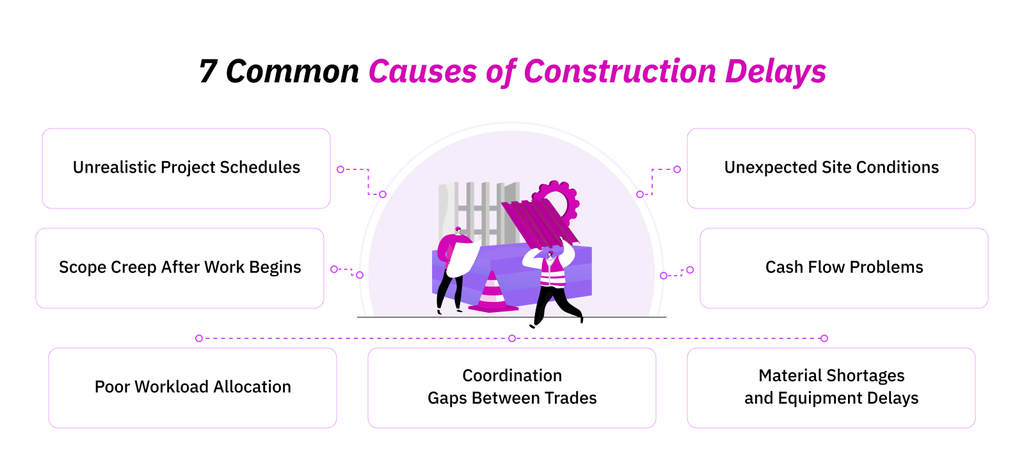
The following causes explain some of the most common reasons construction work starts late or takes longer than the schedule allows.
1. Unrealistic Project Schedules
I consider a schedule unrealistic when the time allowed for an activity does not cover the complete work sequence.
You may have time for installation but no allowance for testing, inspection windows, curing, or commissioning. The activity can therefore reach its planned finish while essential steps remain outstanding.
The same problem can arise in the working calendar. If a plan assumes uninterrupted outdoor production through a predictably wet season, it may overstate the days available.
In each case, the completion date rests on an assumption that actual working conditions cannot support.
2. Scope Creep After Work Begins
Among the causes of delays in construction projects, scope creep is easy to underestimate because each request arrives separately.
A revised layout may alter quantities, affect completed work, or introduce activities outside the original allowance. These seemingly small requests can add up to a substantial change in what the team must deliver.
Incomplete design information can make that change even harder to track, particularly when decisions arrive after work has begun.
Where the scope has expanded, the delay comes from expecting the additional work to fit within the original time and labor allowances. As those allowances become insufficient, work that was already promised is displaced.
3. Poor Workload Allocation
Poor workload allocation creates a gap between the hours or skills an activity needs and those actually available.
For instance, a company may have enough employees overall, yet the people needed for a particular task may be committed elsewhere.
A similar gap occurs when specialist work is assigned to a crew without the necessary capability.
I encountered this situation at the beginning of my career on a warehouse fit-out where I planned for six installers working five eight-hour shifts, giving the task 240 labor-hours.
However, when two of them were assigned to another job for three shifts, the task lost 48 hours. With that 20% reduction in planned capacity, I later learned to compare the lower output against the hours actually available.
4. Coordination Gaps Between Trades
Coordination breaks down when trades have different expectations about access, completion, or responsibility.
Without coordination, one team may book space that another still occupies, or interpret a general progress update as confirmation that an area is available.
The resulting handoff can then be uncertain because the teams do not share a precise understanding of what must be handed over.
5. Material Shortages and Equipment Delays
An item can be recorded as ordered even though technical approval, order release, fabrication, or dispatch is still incomplete.
Moreover, its quoted lead time may depend on a condition that has not yet been satisfied. As a result, the order status can suggest that supply is progressing even when the material is not ready for installation.
Likewise, equipment can create the same gap between planned and actual availability since a booked machine may be unsuitable, develop a fault, or have no qualified operator available.
Whether the missing resource is material or equipment, the activity cannot proceed as planned without something usable at the required time.
6. Cash Flow Problems That Interrupt Work
A project can be profitable while still lacking cash for an immediate obligation. Supplier deposits, payroll, rentals, and subcontractor payments may fall due before the corresponding client payment arrives.
That timing gap can widen if missing billing evidence, a disputed amount, or an unrealistic collection assumption holds the receipt back further.
Although the work may remain within the approved budget, funds may be unavailable to release the next order. Once the shortage interrupts that order or another commitment needed for production, the financial problem becomes a delay on site.
7. Unexpected Site Conditions
Undocumented utilities, unsuitable ground, groundwater, buried obstructions, or concealed building conditions can make the planned construction method unworkable.
The resulting interruption may continue while the condition is investigated, its implications are assessed, and an alternative approach is agreed.
Weather can create a similar problem by changing previously usable access or ground conditions, or by restricting outdoor operations.
How to Manage Delays in Construction Projects: Damage Control
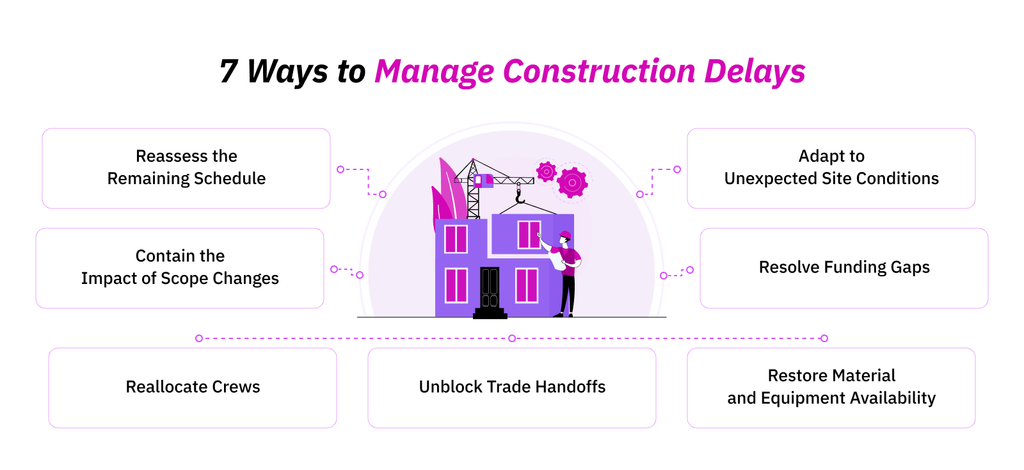
When work falls behind, I first establish what is preventing progress and what can realistically be done about it. The aim is to recover useful time while limiting the cost and disruption of the response.
Each approach below addresses one of the seven causes discussed earlier.
1. Reassess the Remaining Schedule Against Actual Progress
When a schedule proves unrealistic, I first establish how far the job has actually fallen behind.
I compare the work completed on site with what should have been finished by that point, then confirm how long the remaining work will take. This shows where the original plan needs to change before I recommend a recovery approach.
With the remaining work confirmed, I focus recovery on the activities controlling the affected milestone.
The GAO Schedule Assessment Guide recommends concentrating recovery efforts on critical activities because they drive key completion dates. I then assess whether changing the sequence or adding resources would shorten those activities.
Nonetheless, any proposed adjustment still needs to allow for required inspections, curing, and testing, so those periods remain part of the revised sequence.
Where the practical options recover only part of the delay, I update the completion forecast to show what remains. That gives you a realistic date for the commitments that follow.
2. Contain the Impact of Scope Changes
A scope change needs to be clearly defined because an unclear instruction can lead to work that later has to be altered.
Therefore, I recommend establishing what has been authorized, which activities it affects, and what still needs a decision.
Once those limits are clear, the next decision is when to carry out the changed work. For example, immediate execution may be necessary where subsequent activities depend on it.
Where that dependency does not apply, a staged or deferred approach may protect work already progressing, provided the client authorizes it.
However, where the price or additional time remains unresolved, check which written instruction the contract permits before proceeding.
For example, AIA distinguishes a change order from a construction change directive. Under its contract framework, a change order records an agreed change, while a directive can authorize changed work before the cost or time adjustment is settled.
3. Reallocate Crews to Restore Lost Capacity
Before moving people to resolve workload allocation issues, I first establish whether the delayed activity lacks labor or whether something is preventing the assigned crew from making progress.
This means comparing the hours and skills needed for the remaining work with those actually available.
However, where the labor requirement is unclear, recorded hours from comparable completed tasks help me assess whether the original allowance was realistic.
For example, tools like TimeBee can display project progress alongside recorded hours, including how much of that time is billable.
In such situations, I compare those records with completed deliverables and site reports to understand where the crew’s time is going and what it has produced.
Where the comparison confirms a labor shortfall, returning reassigned workers or transferring suitably skilled people may restore progress.
Before making that transfer, though, check whether their current activities can spare them without missing another deadline.
Lastly, where the assigned crew already has enough capacity but cannot proceed because of blocked access or an outstanding decision, resolving that obstacle takes priority.
Give Every Construction Project the Crew Time It Needs With TimeBee
Learn More
4. Unblock Trade Handoffs
When one crew cannot start because the previous trade has not released the work area, my approach is to inspect it with the supervisors of both crews.
The supervisor finishing the work identifies what remains incomplete, while the supervisor taking over explains what must be ready before the next task can begin.
Checking these requirements together helps establish whether the whole area is unavailable or whether part could be handed over sooner.
For example, during a commercial fit-out a few years ago, I found the drywall crew waiting for the entire floor to be released. However, a joint inspection with the electrical and drywall supervisors confirmed that the electrical work in eight of the twelve rooms was complete and had passed the required inspections.
After access was agreed, two drywall installers fixed 40 m² of boards to the prepared framing during one eight-hour shift, using 16 labor-hours.
Following the partial release, the crew completed the boarding by 15 September, meeting the original deadline. The previous forecast had put completion on 18 September.
5. Restore Material Supply or Equipment Availability
When missing materials or broken equipment stop work, I suggest comparing recovery options by when the crew can actually resume its task.
For a material shortage, that starts with asking the supplier what is holding up the order and when the missing items can reach the site. The answer determines which response could help.
If some materials are ready, a partial delivery may allow the crew to complete one section while the rest arrive.
On the other hand, if the order is ready but transport is the problem, faster shipping may recover time. A substitute is another possibility, but its delivery date needs to allow for any technical approval or design changes required before installation.
For broken equipment, I recommend comparing when the existing machine can be repaired with when a suitable replacement can be ready to operate on site.
A replacement available at the rental yard may still need transport, an appropriately qualified operator, and access to the work area before it becomes useful.
Once those arrangements are confirmed, the comparison is clearer: how soon can each option restart the work, and how much will it cost? I use that comparison to judge whether the time recovered justifies the additional expense.
6. Resolve Funding Gaps Holding Up Site Work
When an unpaid bill is stopping work, the finance team needs to know who must be paid, how much is due, and which activity depends on that payment. For example, a supplier deposit may need to be paid before materials can be released for delivery.
If an overdue client payment has created the shortage, the accounts team can first establish what is delaying collection.
However, the expected payment may still arrive too late to keep work moving. In that case, the finance lead needs to confirm another funding source or negotiate a payment arrangement that the supplier or subcontractor accepts as a basis for resuming work.
7. Adapt the Work to Confirmed Site Conditions
When work uncovers an unexpected condition, such as an undocumented utility or unsuitable ground, the site lead needs to stop the affected operation and secure the area.
Recording what has been found and notifying the responsible project team gives the specialist the information needed to investigate.
That investigation should establish how the condition affects the planned work and what needs to change before it can resume.
Depending on the finding, this may require an approved design adjustment or a different construction method. Meanwhile, identifying which nearby activities can safely continue allows those crews to keep working while the affected area is assessed.
4 Costly Effects of Delays in Construction Projects
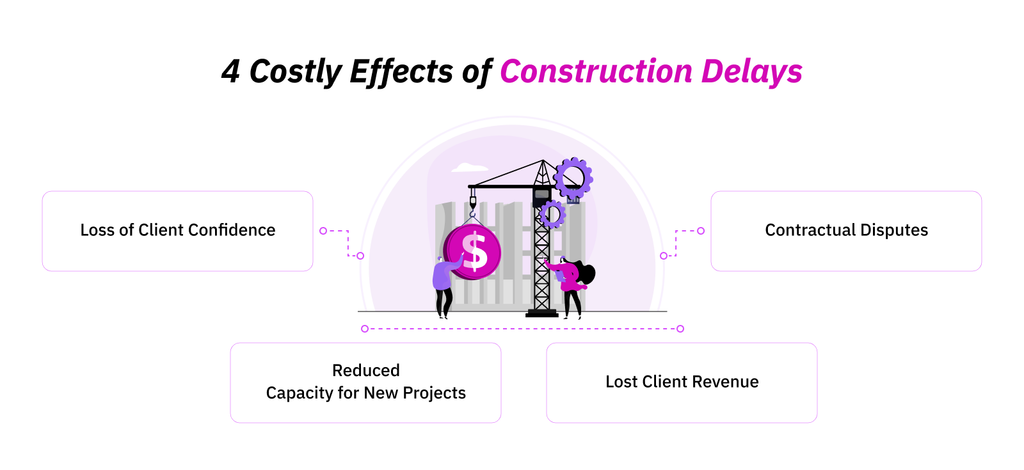
A construction delay can have consequences for both your business and your client, even after the affected work is complete.
1. Loss of Client Confidence When Completion Dates Keep Slipping
When completion dates keep changing, clients may become reluctant to plan around your next forecast. Moreover, they may request more evidence or independent checks before accepting another commitment.
Speaking from experience, during a retail fit-out, I had to revise the handover forecast three times in six weeks.
By the third revision, the client wanted evidence supporting every remaining milestone, and even a more realistic forecast faced greater scrutiny because the earlier dates had proved unreliable.
That loss of confidence can influence whether the client recommends your firm or appoints you again.
2. Reduced Capacity to Take On Other Projects
A project that runs late can keep the supervisor, specialist crew, or equipment needed to start another job.
As a result, you may have to postpone a new project or decline work you would otherwise accept.
The restriction can come down to one person; for example, an experienced site supervisor may still be needed on the delayed job, leaving nobody suitable to lead the next one.
This limits potential income without necessarily appearing as an additional expense in the delayed project’s accounts.
3. Lost Client Revenue From Delayed Openings
When a commercial property opens late, the client may lose trading days, rental income, or production time.
While some income can be earned later, other opportunities disappear. A hotel, for example, may permanently lose bookings tied to an event that takes place before it opens.
When assessing this impact, I separate income postponed from income lost altogether. In these calculations, I also account for operating costs the client avoided while closed, because missed sales do not automatically equal lost profit.
4. Contractual Disputes Over Missed Completion Dates
A missed contractual deadline can trigger disagreement over who caused the delay, whether additional time is justified, and who should bear the associated costs.
The types of delays in construction projects help frame that discussion, but the assessment still depends on evidence connecting the event to the missed deadline or the costs claimed.
Resolving the disagreement can keep your team occupied even after construction ends. Staff may need to retrieve records, explain earlier decisions, and reconstruct events involving people who have already moved to other projects.
How to Avoid Delays in Construction Projects on Your Next Job
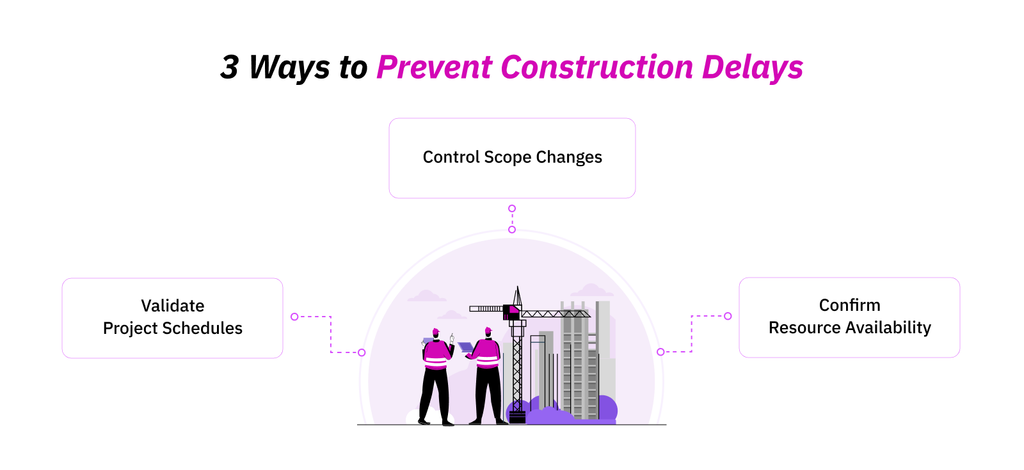
Prevention starts with checking what your completion date depends on. It then continues through clear change approvals and confirmed resources.
1. Validate Schedule and Site Assumptions Before Mobilization
Before agreeing to a completion date, document the work quantities, expected daily output, available working days, and time needed for inspections, curing, and testing. You can then check whether the evidence supports the time allocated to each activity.
I use records from previous projects to check these estimates, provided the scope, crew capability, and working conditions are comparable. That comparison also requires reliable information about the new site, since ground conditions or buried utilities may change how the work must be carried out.
Where site information is incomplete, qualified specialists should determine what further investigation is needed.
For buried utilities, this may involve subsurface utility engineering, which FHWA describes as a way to improve utility information and identify conflicts during planning.
Overall, the findings should inform the schedule before you commit to a completion date. Where uncertainty remains, document what you have assumed, the time allowed for it, and how the team will respond if actual conditions differ.
2. Set Clear Rules for Authorizing Scope Changes
Before work begins, agree who can request a scope change, who assesses its impact, and who can authorize the revised work. This establishes how a proposal becomes an instruction the site team can act on.
For that process to work, each request needs to explain exactly what would change and identify the affected drawings or specifications. The reviewer can then assess the additional work, labor, materials, cost, and time, giving the approver a clear basis for deciding whether to proceed.
The procedure also needs to cover urgent work. Where price or time adjustments remain unresolved, specify who can authorize an instruction under the contract and how it must be recorded.
Once the work is authorized, send the revised instructions to every affected subcontractor and site supervisor, and withdraw outdated drawings. This keeps crews working from the same approved information.
3. Confirm Workforce, Supply, and Funding Commitments
Before crews arrive on site, check whether the people, materials, equipment, and funding needed for each activity will be available when required:
- Workforce: Confirm how many workers are available, whether they have the required skills, and whether commitments to other projects will limit their availability.
- Materials and equipment: Confirm delivery dates and equipment reservations, including any approvals or deposits required before orders can proceed.
- Funding: Compare payment deadlines for deposits, wages, and subcontractors with expected client receipts to identify any shortfall before those obligations fall due.
- Alternatives: Check which replacement suppliers, equipment, or suitably skilled crews would be available if a resource essential to the schedule became unavailable.
These commitments need to be checked together. A supplier’s delivery date may depend on receiving a deposit, so confirming delivery also means confirming that payment can be made on time.
Where payment dates need adjustment, finance should negotiate terms in advance, as CFMA recommends.
Conclusion
Knowing how to avoid delays in construction projects should shape the completion dates you promise. Those dates need to reflect the work required, the resources available, and the conditions your team expects to face.
I want the people delivering the work to be able to explain why the agreed date is achievable. That means understanding what the schedule depends on and checking whether those conditions still hold as construction progresses. When something changes, you can then assess its impact before continuing to rely on the original forecast.
Before agreeing to your next schedule, identify the assumption that would cause the greatest delay if it proved wrong.
Remember, repeated missed deadlines can cost you clients’ trust as well as money.
FAQs
What percentage of construction projects finish behind schedule?
Around 50% of project owners’ projects missed completion deadlines in KPMG’s 2023 Global Construction Survey. In practical terms, that means roughly one in two projects ran late, potentially postponing handover and keeping crews and equipment committed longer than planned.
Does every unfinished item prevent handover?
No, minor unfinished items can remain at substantial completion if the work is usable for its intended purpose and contractual requirements and necessary approvals are satisfied.
How do you calculate the additional costs caused by a construction delay?
To calculate the financial effects of delays in construction projects, total the additional costs directly caused by each event, including extended site overheads, standby, remobilization, and recovery work. Then, deduct avoided costs and prevent double counting.
Can overlapping delays be added together to calculate the total overrun?
Delays that overlap in calendar time may affect different activities or share the same impact on completion. Therefore, their combined effect on the critical path must be assessed, allowing for float and recovery. Simply adding their durations can count the same delay period twice.
What is a time impact analysis, and when is it needed?
A time impact analysis models a delay event in an updated critical-path schedule, comparing completion dates with and without that event. It is generally used during construction to assess proposed changes or support extension-of-time requests, particularly when required by the contract.
TimeBee: See How Much Time Every Project Really Takes
Try Out TimeBee


Daniel Mercer
Member since November 16, 2026
Daniel Mercer
Member since November 16, 2026
Daniel Mercer is a Construction Systems and Field Performance Consultant with over 17 years of experience across commercial buildings, residential developments, industrial facilities, renovations, and civil works.
He holds a Bachelor of Science in Building Construction from Virginia Tech and the Certified Professional Constructor credential from the American Institute of Constructors.
He has also completed Construction Cost Estimating and Cost Control from Columbia University, BIM Fundamentals for Engineers from National Taiwan University, and Contract Law and Construction Documents from the University of Alberta.
After his academic and professional education, he began his career in field operations and later served as a Site Superintendent, Constructability Lead, and Regional Operations Manager. These roles involved working directly with general contractors, trade contractors, estimators, schedulers, safety teams, design consultants, developers, and project owners.
Through his work, Daniel now aims to help construction businesses understand how decisions made during design, procurement, preconstruction, and field execution affect delays, quality, cash flow, profit margins, and client relationships.
His guidance is intended for contractors, developers, construction executives, superintendents, estimators, field leaders, and operations teams seeking practical improvements across the full construction lifecycle.