

Call Center Time Management: What Nobody Tells You and What You Can Fix
By Frank Oliver
October 16, 2026 14 min readTime management in call centers is quite easy to misdiagnose. When queues build, after-call work stretches, or customers spend too long waiting, the immediate assumption is often that agents need to work faster. In my experience with operational processes, that is rarely the most useful place to start.
You need to separate time an agent can reasonably control from time consumed by the operating environment. An agent may be able to improve how they document a call or search for information, but they cannot personally fix understaffing, a slow CRM, unclear escalation rules, poor call routing, or five systems that require the same customer information.
The objective here is not to squeeze more activity into every minute. It is to remove avoidable delays while preserving the time required to understand the customer and resolve the issues correctly.
Improve Call Center Time Management: Key Points
- Better time management starts with fixing workflows, not pushing agents to work faster.
- Common time wasters often stem from operational issues. Excessive after-call work, frequent task switching, slow systems, and unclear escalation procedures can reduce efficiency.
- Staffing should reflect peak call volumes, not just daily averages. Aligning agent availability with demand helps reduce customer wait times and prevent workload imbalances.
- Essential non-call activities need dedicated time. Scheduling callbacks, documentation, and follow-ups prevents backlogs and keeps customer issues moving toward resolution.
- Clear call-handling processes help agents work more efficiently. Consistent call stages, accessible information, and defined escalation rules reduce repeated work and unnecessary delays.
- Performance metrics alone cannot explain lost time. Managers should investigate the underlying causes of lengthy calls, extended wrap-up times, and unusual activity patterns before adjusting targets.
- Time-tracking tools can reveal hidden workflow bottlenecks. Solutions like TimeBee provide visibility into application usage.
Why Is Time Management in Call Centers Important
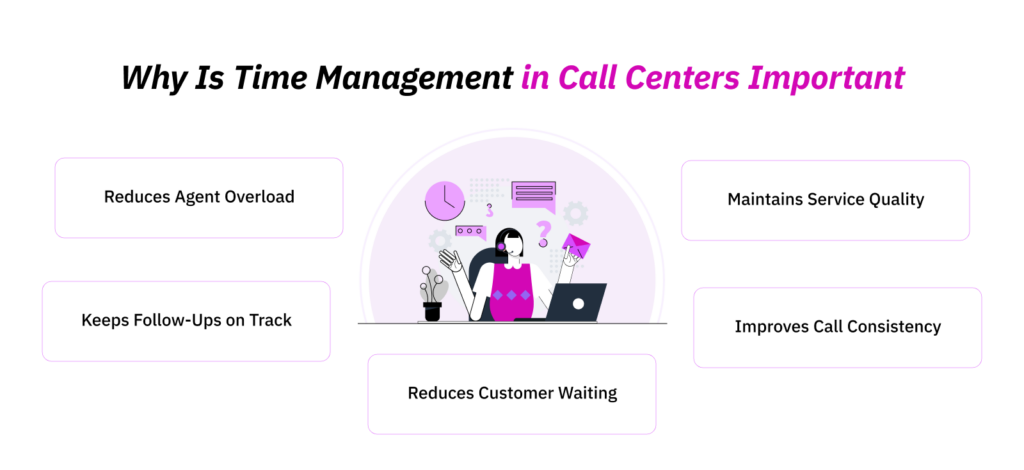
Efficient time management affects far more than the duration of individual calls. It determines how smoothly work moves through the queue and how well your operation absorbs periods of heavier demand.
Most importantly, it gives you more control over avoidable time. That is the portion managers should be trying to reduce, not every minute agents spend with customers. Here are some key ways it can help your customer service firm.
1. Reduces Avoidable Customer Waiting
Managing time well can reduce customer waiting by helping agents complete each stage of an interaction without unnecessary delays. When agents know where to find information, when to escalate an issue, and what needs to be documented, customers spend less time on hold or waiting through avoidable internal steps.
The same principle applies beyond the individual call. If agents spend less unnecessary time searching, switching systems, or dealing with unclear handoffs, they can return to the queue sooner. That helps prevent avoidable delays from accumulating across the team.
For example, if 30 agents each lose eight minutes per shift to unnecessary searches and handoffs, the call center loses four hours of available handling time every day. Better time management helps recover that time without rushing customer conversations.
The goal, therefore, is not to make every call shorter. It is to remove the delays that do not contribute to resolving the customer’s issue.
2. Creates More Consistent Call Handling
Maintaining consistency within customer interactions is yet another way contact center time management can help you.
When agents follow a clear flow, know where to find information, and understand what needs to happen before a call ends, they spend less time retracing steps or correcting missed details.
That consistency matters because it makes workload and capacity easier to manage. In my operations work, I have found that large variations in how the same task is handled often reveal process issues that averages can hide.
The same applies in call centers: predictable use of time makes the operation easier to plan without forcing every interaction into the same rigid script.
3. Helps Agents Stay on Top of Required Follow-Ups
Your firm’s agents need enough structure to complete work that continues after the call. These can include callbacks, case updates, escalations, and promised customer actions. All of these compete for time if they are not accounted for properly.
When those tasks are delayed, they can create more work later through repeat contacts, duplicated investigations, or missed commitments. Managing follow-up time well helps prevent old work from spilling into new demand and keeps customer issues moving toward completion.
4. Reduces Mental Overload During Busy Shifts
Customer service time management is also important because unfinished work creates mental clutter. When agents are carrying several open tasks at once, each interruption forces them to remember where they left off and what still needs to happen.
That constant rebuilding of context consumes time and attention. Better time management creates clearer boundaries around work, so fewer tasks remain mentally open at the same time. The reason why this is especially important in call centers is that new interactions can arrive unexpectedly.
5. Protects Service Quality When Call Volume Increases
Maintaining service quality when demand rises is yet another factor that deserves attention. When time is planned well, it can reduce the amount of avoidable friction inside each interaction.
Small delays such as slow information searches, unclear handoffs, or excessive documentation become much more costly when they occur across hundreds of calls.
Without strong time management, managers may respond to rising queues by pushing agents to shorten calls. That can create the wrong trade-off. The better approach is to remove time that does not improve the customer outcome while preserving the time needed to understand, resolve, and document the issue properly.
This is why effective time management in customer service is not about making every call shorter. It is about helping the operation absorb higher demand without sacrificing the quality of service.
TimeBee: Spot Hidden Time Loss Across Your Call Center’s Workflow
Learn More
7 Common Contact Center Time Management Problems
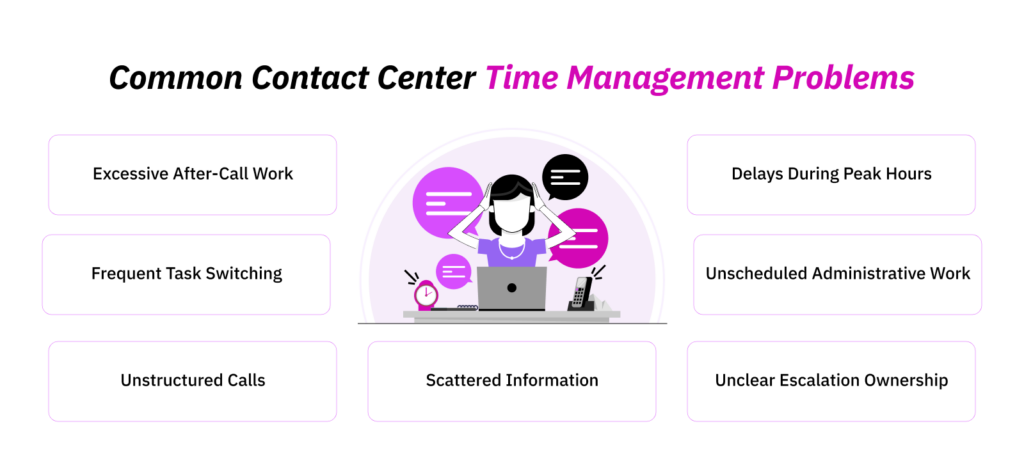
Before you change schedules, targets, or expectations, you need to understand where time is actually being consumed. The following problems can look like individual time-management failures on a dashboard, even when the underlying cause sits elsewhere in the operation.
1. Too Much Work Gets Deferred Until After the Call
After-call work is necessary, but it becomes a time-management problem when too much of the interaction is left to be documented after the customer disconnects.
Agents may then have to reconstruct decisions, actions, and next steps from memory, which extends wrap-up time and makes it less predictable. A long ACW (After-Call Work) figure, therefore, does not automatically mean an agent is working inefficiently. It may indicate that the workflow is pushing too much required work to the end of the call.
2. Agents Constantly Switch Between Unrelated Tasks
Frequent task switching fragments an agent’s time. When agents repeatedly move between calls, emails, case updates, internal messages, and unfinished follow-ups, they have to rebuild context every time they return to a task.
That lost context can lead to repeated checking, missed details, unfinished work, and tasks spilling into later parts of the shift. In many cases, the problem is structural rather than behavioral, especially when agents must move across several systems to complete a single customer request.
3. Calls Become Open-Ended Instead of Following a Clear Progression
Calls consume unnecessary time when agents repeatedly move between identifying the issue, troubleshooting, searching for information, and clarifying details without a clear sense of what should happen next.
This can lead to repeated questions, unnecessary holds, duplicated troubleshooting, and late escalations. The customer may also need to restate information because the conversation keeps moving backward instead of progressing toward resolution.
4. Critical Information Is Spread Across Too Many Places
Time is easily lost when agents have to search across multiple systems to answer routine questions.
The problem becomes worse when different platforms contain conflicting or outdated information. Agents then spend additional time not only finding information but deciding which source they can trust.
In my experience, I have seen organizations focus on whether employees know how to use individual tools while overlooking the time lost moving between them. Each system may work properly on its own while the overall workflow remains inefficient.
5. Ownership Becomes Unclear When a Request Needs Escalation
Time is wasted when agents do not know where their responsibility ends or when another team should take over.
Some agents may continue investigating an issue they cannot resolve, while others may transfer it too early. Both situations create delays through longer holds, repeated explanations, duplicated investigation, and unnecessary handoffs.
When escalation thresholds vary from one agent to another, similar cases can also consume very different amounts of time. The underlying problem is unclear ownership, not simply slow decision-making.
6. Administrative Work Has No Clear Place in the Shift
Call-center schedules often prioritize live customer demand while treating necessary administrative work as something agents will complete whenever they find time.
That creates a conflict because callbacks, case updates, documentation, internal follow-ups, and other required tasks still consume capacity. If they are not given a realistic place in the shift, they either compete with live calls or accumulate for later.
I have seen the same issue in accounting operations, where managers plan around client-facing work while assuming review and administrative tasks will fit around it. If 25 employees each require 35 minutes of necessary non-live work, that represents almost 15 staff-hours that must exist somewhere in the schedule.
7. Peak Call Volume Exposes Existing Workflow Friction
Busy periods often make time-management problems more visible, but the volume itself may not be the root cause.
A small delay caused by slow software, duplicate entry, difficult information searches, or unnecessary approvals can appear manageable during quieter periods. Once the same delay is repeated across hundreds of calls, however, it becomes operationally significant.
For example, an unnecessary 40-second step repeated across 1,000 interactions consumes more than 11 hours in total. Peak demand therefore acts as a stress test, revealing small sources of friction that become costly at scale.
8 Proven Call Center Time Management Tips for Managers
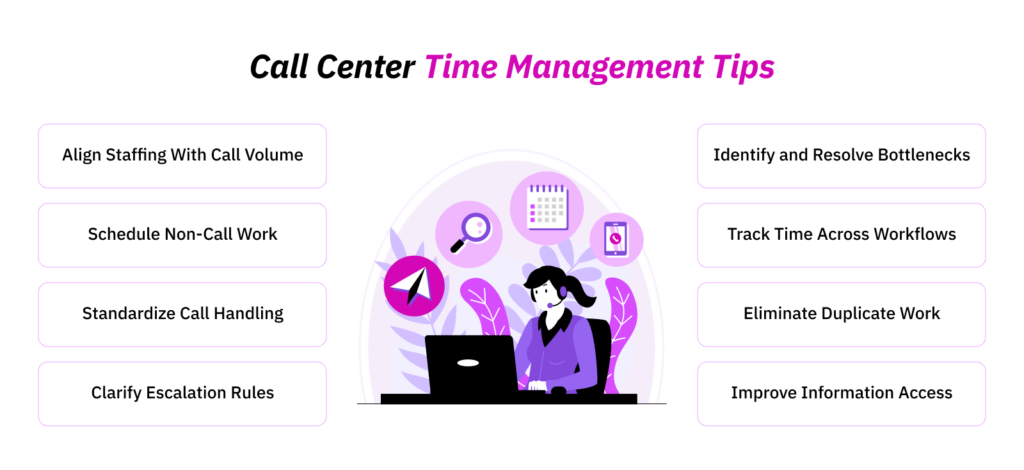
Once you understand where time is being consumed, you can make targeted changes. The objective is not to make every minute measurable or every interaction shorter. Instead, you want to organize work so agents spend less time navigating avoidable friction and more of the shift completing the work the customer actually requires.
Here are some effective call center time management tips for you:
1. Plan Staffing Around Expected Call Volume
Time management starts with having enough capacity when demand actually arrives. If your morning queue receives half the day’s calls within three hours, a schedule based only on daily volume can leave agents overwhelmed early and underused later.
In situations like these, I prefer looking at demand by shorter intervals because it exposes where the schedule and workload stop matching. If a 30-agent center regularly needs 24 agents between 9:00 and 11:00 but schedules only 19, those five missing seats cannot be recovered through better individual time management.
In my operations work, I have seen the same mistake in professional-service teams: managers treat a capacity shortfall as an execution problem because the total weekly hours appear sufficient. The issue is often when those hours are available.
Your staffing plan should therefore reflect when customer demand occurs and how much time the work actually requires. Otherwise, agents begin every busy period trying to recover time the schedule never provided.
2. Protect Dedicated Time for Essential Non-Call Work
If agents are expected to complete follow-ups, documentation, or case administration, that work needs a realistic place in the shift. Telling people to handle it “when things get quiet” creates unpredictable backlogs because quiet periods may never arrive.
I have seen this in accounting-firm workflows where client work was scheduled carefully, while necessary review and administration were assumed to fit around it. They did not disappear; they simply moved into less suitable parts of the day.
The same capacity issue applies in a call center. If 25 agents each require 30 minutes of legitimate non-call work, the operation needs to accommodate more than 12 hours of that work every day. Ignoring those hours does not save them.
Protecting appropriate work windows makes the use of time more predictable and reduces the tendency for unfinished customer commitments to carry into the next shift. The amount of protected time should reflect your actual workload rather than an arbitrary company-wide allowance.
3. Standardize Call Handling Without Over-Scripting Agents
Consistent call structure can reduce wasted time without forcing agents to sound identical.
I generally prefer a conversation to move naturally from understanding why the customer called to diagnosing the issue, resolving it, confirming the outcome, and closing with clear next steps. The structure matters because poorly ordered calls often move backward. An agent may begin troubleshooting too early, discover missing information later, and repeat work that could have been avoided.
Throughout my experience, I have learned that standardization is most useful when it defines what should happen next, not exactly how every person must perform it.
That distinction is important in call centers. A straightforward account query and a complex complaint should not take the same amount of time. However, both should progress logically rather than drifting between diagnosis and resolution.
Even eliminating 30 seconds of repeated questioning from 800 daily calls recovers more than six cumulative staff-hours. But again, it’s equally important to remember that the objective is not shorter conversations at any cost; it is removing unnecessary movement inside them.
4. Set Clear Rules for Holds, Transfers, and Escalations
Agents lose significant time when they do not know when investigation should stop and escalation should begin.
An agent may keep searching because they are unsure whether another team owns the issue. Another may transfer too quickly and create a second handoff. In both cases, unclear boundaries consume time while the customer waits.
Your escalation process should make ownership obvious enough that an agent can decide whether continuing the investigation is likely to move the case forward. If the agent lacks the authority or access required to resolve the problem, another five minutes of searching may add no value.
For example, if 40 agents each spend only five unnecessary minutes per shift seeking guidance on cases outside their authority, the center loses more than three staff-hours every day.
A consistent issue I have noticed in similar situations is that unclear role boundaries often appear as individual inefficiency because the delay occurs at an employee’s desk. In reality, the employee may simply be waiting for the process to tell them who should act next.
5. Make Frequently Needed Information Faster to Access
Agents should not have to conduct a new investigation every time they answer a common customer question.
When frequently needed information is buried across several systems or appears in conflicting versions, retrieval becomes part of the handling time. Experienced agents may know the answer exists yet still spend several minutes finding the approved version.
Organizations often train employees extensively on individual systems but pay less attention to the time spent moving between those systems. Each platform may function correctly while the combined workflow remains slow.
To solve this issue, you need to measure the retrieval journey for common requests. If an agent needs several minutes and system changes to locate a routine policy, the important question is not whether the agent searches quickly enough. It is whether the information architecture makes routine knowledge unnecessarily difficult to reach.
6. Reduce Unnecessary Administrative Steps and Duplicate Work
Call-center workflows often accumulate administrative steps long after their original purpose has disappeared.
I see this frequently in operational transformation. A field is introduced for one reporting request, a manual check is added after an isolated incident, or employees begin copying information between systems because an integration does not exist. Eventually, the workaround becomes accepted as part of the job.
That matters much more in high-volume operations because tiny delays repeat constantly.
If agents spend an unnecessary 20 seconds duplicating information across 2,000 interactions, the organization consumes more than 11 staff-hours every day on that one step. Asking agents to enter the same information faster addresses the symptom while preserving the waste.
I would instead examine whether each administrative action still contributes to the customer record, a genuine control, or the next stage of the workflow. Time management in customer service improves substantially when you remove work that never needed to consume agent time in the first place.
7. Identify Where Agent Time is Being Lost Across the Workday
You cannot improve time management reliably from averages alone. You need to understand where delays repeatedly occur inside the workday.
In my experience, patterns are often more useful than isolated numbers. If one workflow consistently takes longer, investigate what employees are doing during that additional time before concluding that they are simply slower.
For example, suppose agents working one queue require an additional 35 minutes per shift compared with agents handling similar work. The difference may come from repeatedly reopening cases, navigating between disconnected applications, waiting for internal responses, or completing additional administration. Each explanation points to a different management problem.
This is also why I am cautious about interpreting activity data without operational context. A metric can accurately show that additional time exists while telling you very little about why.
The manager’s job is therefore to connect observed time patterns back to the actual workflow. Once you know where the time is going, you can distinguish a genuine work-habit issue from a process or capacity constraint.
8. Review Time-Management Bottlenecks Before Changing Expectations
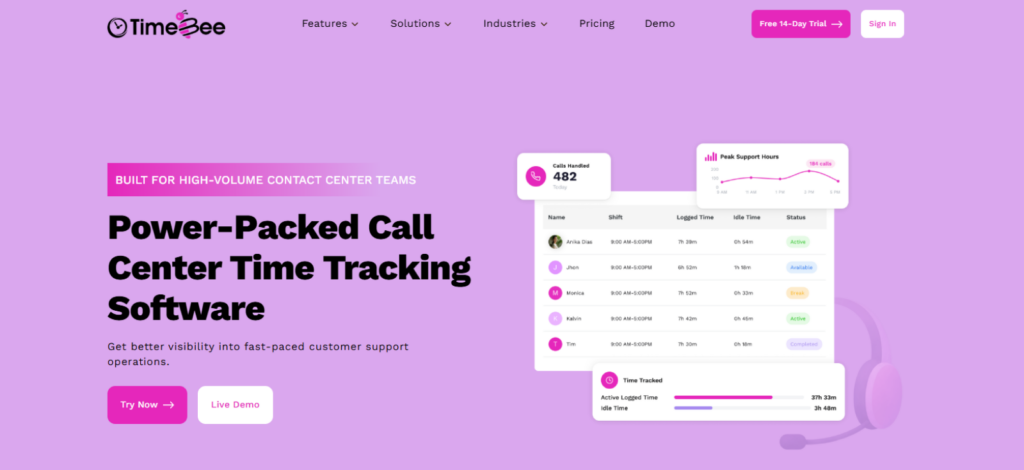
When you find an unusual time pattern, you need to treat it as evidence to investigate rather than proof of poor performance. And for that, you can use TimeBee’s call center time tracking software. Its Web & App Usage report can show how long employees spend in particular applications and websites, with reports available at individual and group level.
Suppose one call-center team spends about 55 minutes more per shift in a legacy account portal than comparable teams. TimeBee can make that difference visible through application-usage data, giving you a concrete place to investigate.
You can then compare the pattern with the team’s actual workflow to determine whether the extra time comes from lengthy navigation, repeated data entry, a process requirement, or another source of friction.
The same visibility can help you understand how time is distributed across other parts of the workday. If administrative applications consistently consume more time than expected, or agents repeatedly move between several tools to complete the same type of customer request, those patterns can point you toward workflows worth reviewing.
In my experience, I have found that this kind of visibility is especially useful because bottlenecks are often difficult to see at the process level until you examine how work is actually being carried out. TimeBee gives managers another layer of evidence for identifying those patterns.
Conclusion
Call center time management is not about forcing agents to work faster. It is about removing the delays, handoffs, system friction, and scheduling gaps that make necessary work take longer than it should.
As a manager, your biggest opportunity is to look beyond surface-level metrics and examine how time actually moves through the operation.
In my experience, the most useful improvements come from identifying where time is being absorbed and then fixing the underlying cause rather than simply tightening expectations.
When you manage time at the process level, you create a more predictable operation, reduce avoidable waiting, and give agents a better chance to handle customer work without unnecessary pressure.
FAQs
How can a call center agent manage back-to-back calls?
When calls arrive back-to-back, agents should rely on a consistent workflow rather than trying to create time. Clear call stages, easy access to information, concise documentation, and defined escalation rules help each interaction move forward without unnecessary delays. Managers also need to protect breaks and account for after-call work. The goal is to reduce avoidable friction so agents can handle continuous demand without rushing or carrying unfinished work forward.
How can agents manage time without rushing customers?
Agents can manage time without rushing customers by removing delays that add no value to the interaction. Faster information retrieval, escalation paths, fewer repeated questions, and simpler documentation can shorten handling time without cutting the conversation. Managers should focus on where time is lost rather than pushing for shorter calls indiscriminately. Good customer service time management preserves the time needed to understand the issue, provide a resolution, and confirm the customer’s next steps.
What should call center agents do during quiet periods?
During quiet periods, agents should use time for work that supports future customer interactions. Depending on your operating model, that may include completing follow-ups, reviewing open cases, preparing callbacks, updating documentation, or reading approved knowledge updates. Managers should define which activities are appropriate and which require protected time. The key is to use quieter intervals deliberately without starting work that will be difficult to pause when the next interaction arrives.
How much time should an agent spend on after-call work?
There is no universal ideal amount of after-call work because the required time depends on call complexity, documentation standards, systems, compliance requirements, and the type of customer issue. Instead of enforcing an arbitrary target, managers should compare similar interactions and examine what agents do during wrap-up. If after-call work is consistently high, investigate duplicate entry, unnecessary documentation, slow systems, or unclear processes before deciding that agents need to work faster.
Is lower average handle time always better?
No. Lower average handle time is only beneficial when agents can reduce delay without weakening the customer outcome. A short call may create more work if the issue remains unresolved, requires a transfer, or causes repeat contact. Managers should interpret average handle time alongside measures such as first-contact resolution, quality, and customer satisfaction. The better objective is efficient resolution, where avoidable time decreases while necessary service and documentation remain intact.
Use TimeBee’s Workday Insights to Improve Time Management
Get TimeBee
Frank Oliver
Member since July 8, 2026
Frank Oliver
Member since July 8, 2026
Frank Oliver is a Principal Consultant in Operations and Transformation, specializing in process improvement, digital transformation, operational performance, and the implementation of workplace technology.
He holds an MSc in Operations, Project and Supply Chain Management from The University of Manchester. He is also a Project Management Professional and a Prosci Certified Change Practitioner.
Overall, with more than 15 years of experience, Frank focuses on helping businesses identify the systems and workflows that influence productivity. His work further examines how processes, technology, management practices, role clarity, and data quality interact to affect organizational performance.