

10 Accounting Outsourcing Mistakes That Taught Me to Manage My Business Differently
By Morgan Ellis
November 6, 2026 13 min readAn accounting firm’s reputation is often tested long after the financial reports have been closed.
A client might ask whether they can afford another employee, why profits have declined despite increasing sales, or whether their financial position supports a loan application.
In those moments, clients are not particularly concerned with who entered the transactions. They want an accountant who can interpret the figures and help them make informed decisions.
That expectation is what makes accounting outsourcing more consequential than it might initially appear.
The work may pass through several hands, but clients ultimately experience it as one professional service, and their impression of the firm depends on the advice they receive.
Over time, this has changed how I think about the decisions that shape an accounting practice.
These ten mistakes in accounting outsourcing demonstrate how management decisions can affect client confidence and the quality of professional judgment.
A Quick Rundown of Key Mistakes in Outsourced Accounting
- Common outsourcing mistakes in accounting firms include choosing providers based on price alone, unclear responsibilities, inadequate knowledge transfer, and weak financial controls.
- Hidden outsourcing costs arise when internal accountants spend additional hours reviewing inaccurate work and correcting recurring errors.
- Financial risks increase when payment duties lack separation, accounting queries remain unresolved, or automated transactions go unchecked.
- Outsourced accounting performance should be measured through financial accuracy, reporting timeliness, review hours, and rework costs.
- Successful accounting outsourcing requires clearly assigned month-end responsibilities, qualified professionals, reliable opening balances, and documented accounting procedures.
10 Outsourcing Mistakes in Accounting Firms and the Financial Lessons Behind Them
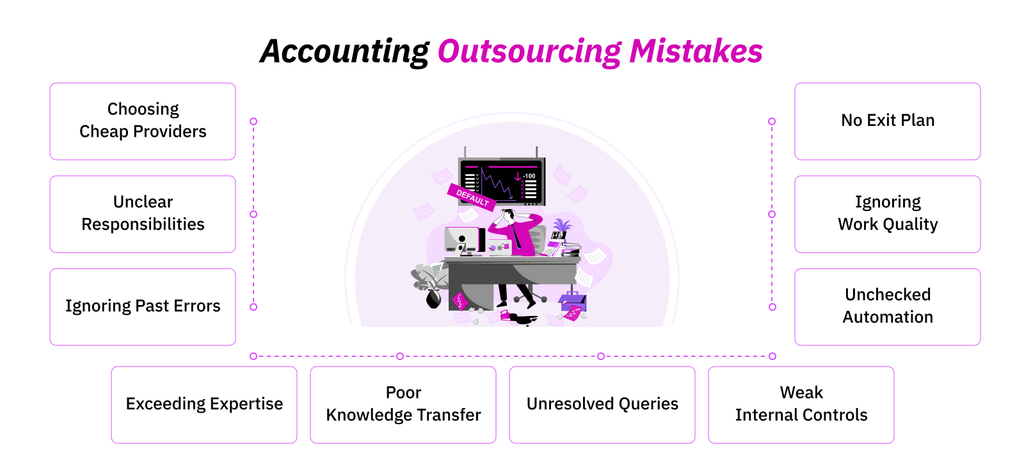
Accounting outsourcing challenges rarely begin with a single catastrophic error. More often, they develop through seemingly minor decisions.
The following table summarizes the mistakes I have used to shape my approach to managing outsourced accounting engagements.
| Mistake | Potential Impact | Management Lesson |
| Choosing based on low fees | Unexpected review and correction costs | Evaluate the total cost of accounting work |
| Unclear month-end ownership | Incomplete reconciliations and delayed reporting | Assign responsibility for each close deliverable |
| Outsourcing inaccurate records | Historical errors carried into later periods | Verify existing financial information |
| Assigning work beyond expertise | Incorrect accounting judgments | Match responsibilities to competence |
| Inadequate knowledge transfer | Misclassified transactions and unreliable reports | Document business-specific accounting rules |
| Unresolved accounting queries | Delayed reconciliations and closing activities | Establish ownership and escalation procedures |
| Weak segregation of duties | Unauthorized or incorrect transactions | Maintain independent financial controls |
| Unchecked automation | Duplicate postings and classification errors | Review exceptions and reconcile automated entries |
| Incomplete performance evaluation | Poor accuracy and excessive rework | Measure quality and operational efficiency |
| No provider transition plan | Disrupted accounting operations | Maintain access to records and handover documentation |
1. Choosing a Low Monthly Fee Without Accounting for Review and Rework Costs
One of the earliest accounting outsourcing mistakes I encountered was that a lower monthly fee does not necessarily translate into lower operating costs.
The difference often becomes apparent only after you account for the work your internal team still performs.
I remember examining an arrangement where a small CPA firm had contracted an external bookkeeping provider for approximately $900 per month.
Compared with the other proposals, the fee seemed reasonable because the firm wanted to free its senior accountants for more specialized client work.
However, the outsourced team regularly submitted entries requiring additional review. The firm’s senior accountant spent roughly 9 hours each month checking classifications and reviewing supporting schedules, while a junior accountant devoted another 4 hours to corrections.
Using fully loaded hourly costs of $65 and $40, respectively, that represents $745 in additional internal labor alongside the $900 provider fee.
While the mistake was not necessarily choosing an inexpensive provider, it was comparing quotes without establishing what each service included and how much review the engagement required.
Since then, I have paid closer attention to the scope of deliverables, quality assurance arrangements, excluded services, and anticipated supervision costs.
2. Signing an Outsourcing Agreement Without Defining Who Owns the Month-End Close
An outsourcing agreement can describe the accounting tasks a provider performs without establishing who is responsible for completing the financial close.
I have encountered this distinction over the years when reviewing engagements where both the internal and outsourced teams believe they have fulfilled their responsibilities while the reporting package remains unfinished.
In one particular instance, the outsourced accountants of a firm had recorded transactions and prepared several reconciliations.
Meanwhile, the internal team assumed the provider would also investigate outstanding adjustments and finalize the statements. The provider, however, considered those activities outside its agreed scope.
As a result, certain accruals and account reviews remained outstanding when the firm’s reporting deadline arrived.
What had concerned me back then, and still does, was not simply the delay; it was that nobody had been assigned responsibility for confirming that the complete close process was finished.
Given that a month-end close can involve the following activities, they require clear ownership:
- Reconciling material accounts,
- Reviewing journal entries,
- Assessing accruals,
- Investigating unusual balances, and
- Approving the final reporting package.
I now prefer engagement agreements supported by a close clooking hecklist that identifies the preparer, reviewer, expected completion date, and approval requirements for significant tasks.
This approach gives both teams a clearer understanding of where their responsibilities begin and end.
3. Outsourcing Accounting Without Verifying the Accuracy of Existing Financial Records
Transferring accounting responsibilities does not automatically resolve errors already present in the books. In fact, starting a new outsourcing engagement with unreliable balances can make it harder to determine which problems originated before the transition.
I came across this issue when an outsourced team inherited a general ledger containing an unexplained clearing-account balance of approximately $11,800. The account had carried the amount forward from an earlier reporting period, but the supporting documentation was incomplete.
Because the new provider had been instructed to begin processing current transactions, the historical discrepancy initially received little attention. It resurfaced later when a reviewer requested evidence supporting the balance.
The amount alone did not establish whether the financial statements were materially misstated. Nevertheless, it represented an unresolved accounting item that needed investigation before anyone could confidently accept the relevant records.
That experience changed how I approached financial handovers. I began distinguishing between historical cleanup and ongoing accounting services, particularly when a firm was taking responsibility for records prepared by another team.
I believe firms should review material bank and balance-sheet reconciliations before transferring recurring work, identify unexplained balances, and make supporting schedules available.
Moreover, any unresolved discrepancies should be documented along with their status and the person responsible for investigating them.
4. Expecting a Bookkeeper to Handle Controller-Level Accounting Responsibilities
Outsourcing becomes problematic when the complexity of the assigned work exceeds the expertise or supervision available to the person performing it.
While reviewing the accounting process of a service company that received advance payments for annual maintenance agreements, the impact of this seemingly small mistake became evident to me.
So, its outsourced bookkeeper handled customer invoices, receipts, and routine ledger entries competently. However, the company also expected that person to determine the appropriate revenue recognition treatment independently.
In a transaction, the business received $24,000 at the beginning of a twelve-month service arrangement. The full receipt had initially been recorded as revenue, even though the contract required services to be provided throughout the year.
Where the applicable reporting framework and contractual terms support recognizing revenue evenly over that period, the appropriate amount would be $2,000 per month rather than the full $24,000 immediately.
The issue was not whether the bookkeeper could enter the transaction correctly. It was whether the underlying accounting judgment had received appropriate professional consideration.
Therefore, firms should draw a clearer line between routine bookkeeping and responsibilities involving technical accounting policies, material estimates, unusual transactions, or financial statement review.
Accordingly, I recommend looking beyond general bookkeeping experience when evaluating outsourced professionals.
For example, understand which matters they can address independently, when they must escalate a technical question, and who is authorized to approve the accounting treatment.
TimeBee: Spot Costly Accounting Mistakes Before They Become Routine
Learn More
5. Giving an Outsourced Team Software Access Without Explaining the Business Rules
Accounting software gives an external team access to your financial records, but it does not explain how your firm or its clients interpret those records.
I once happened to work for a business with two operating divisions: equipment installation and ongoing maintenance. Although the outsourced accountants could navigate the general ledger and process transactions, they had not received detailed guidance on how direct project costs were allocated.
Consequently, approximately $8,000 in installation materials were classified under general operating expenses rather than the relevant project-cost accounts.
Now, while the total recorded expenditure had not changed, the classification affected the way management evaluated divisional profitability.
The installation division appeared to have lower direct costs than it actually incurred, while the broader expense categories were overstated. This was a clear knowledge-transfer failure instead of a software failure.
Since then, I have placed more emphasis, even in my own practice, on documenting accounting rules before handing over routine processing.
For a CPA firm, that might involve client-specific charts of accounts, expense allocation policies, billing arrangements, and instructions for unusual transactions.
It also helps to walk through representative entries during onboarding since a written policy becomes considerably more useful when the accountant can see how it applies to an actual entry.
6. Letting Unanswered Accounting Queries Accumulate Without an Escalation Process
Even a capable outsourced accounting team can struggle to complete its work when essential transaction information remains unanswered.
During one month-end review, I examined an accounting workflow with fourteen outstanding queries. Several concerned missing supplier invoices, while others involved unidentified customer receipts and expenses awaiting classification.
The external accountants had submitted their questions, but the requests were spread across email threads. Some had been forwarded to internal employees, while others remained in a shared inbox without a clearly assigned owner.
Four business days later, several questions were still unresolved, delaying the relevant reconciliations.
Initially, the obvious recommendation seemed to be more frequent communication. However, the team was already communicating. Instead, the problem was that the communication was not producing decisions.
To resolve it, I began treating unresolved accounting queries as formal work items. Each question needed a reference to the affected transaction, a specific person responsible for responding, a required action, and an expected resolution date.
More complicated questions also needed an escalation procedure.
For example, if an accounts payable coordinator could not obtain a missing invoice, the issue should not remain open indefinitely. It should move to someone authorized to resolve the documentation problem or determine the appropriate next step.
This approach can be particularly useful when an accounting firm works with offshore teams across different time zones. Instead of relying on everyone being available simultaneously, a documented query process gives the teams continuity between working hours.
7. Allowing the Same Person to Record, Approve, and Reconcile Payments
One of the more easily overlooked internal control weaknesses in outsourced accounting is allowing a single individual to manage every stage of the payment process.
Although assigning these responsibilities to one accountant may seem efficient, it reduces the independent checks that help identify errors and unauthorized transactions.
Consider an outsourced accountant who can create supplier records, enter invoices, approve payments, and reconcile bank transactions.
If an incorrect or unauthorized payment occurs, the same person may have the ability to influence how that transaction is recorded and reviewed. Even when no misconduct takes place, this concentration of responsibilities creates unnecessary financial risk.
This is precisely why segregation of duties matters. By separating transaction recording, payment authorization, and reconciliation responsibilities, accounting firms can establish independent checks at critical stages of the process.
The U.S. Government Accountability Office’s Green Book provides a useful framework for designing internal controls, including control activities that address risks involving improper payments and financial reporting. While developed for federal agencies, its underlying control principles can also inform accounting firms’ financial procedures.
In practice, I recommend allowing the outsourced accountant to prepare and record supplier transactions while an authorized individual independently approves payments.
Of course, smaller accounting firms may lack the staff needed to separate every responsibility. In those cases, restricted system permissions, documented management approvals, and independent reviews of bank activity can provide compensating controls.
8. Assuming Automated Accounting Entries Were Accurate Without Reviewing Exceptions
Automation can reduce repetitive accounting work, but a successfully processed transaction is not necessarily an accurately recorded transaction.
While examining a workflow, I came across expense transactions that were transferred automatically from a supporting platform into accounting software.
The integration had evidently reduced manual data entry. However, during a subsequent reconciliation, an accountant identified an expense of approximately $6,200 that had been recorded twice.
It turned out one entry arrived through the automated integration, while another was posted manually during the same reporting period.
This is why I evaluate automated accounting workflows through their controls, not simply their processing speed.
After all, preventing duplicate entries is only one part of maintaining accuracy. Even transactions imported once can create problems if they are assigned to the wrong ledger accounts or transferred with incomplete information.
To address these risks:
- Account mappings should reflect the intended accounting treatment,
- Transaction imports should be monitored for duplicates or failures, and
- Exceptions should be reviewed by someone capable of evaluating their financial effect.
For accounting firms handling substantial transaction volumes, exception-based monitoring can be more efficient than manually checking every entry. However, that approach depends on reliable exception criteria and appropriate reconciliation procedures.
Overall, while automation is valuable when it reduces unnecessary manual effort, it becomes a liability when the team assumes its output no longer requires professional scrutiny.
9. Focusing on Timely Financial Reports While Overlooking Accounting Accuracy and Team Efficiency
For a long time, I regarded meeting reporting deadlines as an important sign that an outsourced accounting arrangement was performing well. I still consider timeliness essential, but I have also learned that it tells only part of the story.
An accounting firm can complete its client reports by the agreed date while requiring substantial internal effort to review incomplete work or resolve recurring discrepancies.
During one research project, back in 2020, I examined an arrangement where financial reports regularly reached clients by the fifth business day.
Yet the firm’s senior accountants spent approximately 28 hours each month reviewing the outsourced team’s work, with another 16 hours devoted to corrections and rework.
The deadlines were being met, but the process was not operating as efficiently as the original outsourcing proposal had suggested.
Through the research, I reached the conclusion that accounting accuracy and operational efficiency should be evaluated separately.
Reconciliation completion, material adjustments, unresolved exceptions, and report quality help assess the reliability of accounting information. Meanwhile, recorded work hours, rework effort, and task completion patterns provide insight into how efficiently the accounting process operates.
For the operational side, tools such as TimeBee can provide additional visibility. Its project and task-level time tracking allows accounting firms to distinguish hours spent on various tasks.
By comparing these records across reporting periods, managers can identify recurring workload patterns and investigate why particular engagements consistently require more review time.
TimeBee also supports planned task durations, allowing firms to compare expected effort with recorded hours.
Its timesheets, activity timelines, and optional screenshots also provide supporting information for reviewing tracked work, although they cannot independently confirm accounting accuracy.
Additionally, project costing and profitability reports connect recorded hours with employee rates and client billing information to help firms understand how repeated corrections affect engagement profitability.
For me, the takeaway is that accounting performance should be measured through both the reliability of financial information and the resources required to produce it.
10. Failing to Establish Data Ownership and Exit Procedures Before Changing Providers
I used to regard provider transitions mainly as an operational handover. Experience with incomplete accounting records changed that perspective when an accounting firm decided to replace an external service provider after its reporting requirements became more complex.
The incoming accountants received access to the general ledger, but several supporting reconciliation schedules were missing.
There was no consolidated record of outstanding adjustments, and the previous provider’s documentation did not clearly explain the status of certain account balances.
Although the accounting data was technically available, the new team could not immediately determine which balances had been reviewed or what work remained unfinished.
The transition therefore required additional time to reconstruct information that should have been documented throughout the engagement.
What concerned me was that the firm had considered the practical implications of leaving its provider only after deciding to terminate the relationship.
Since then, I have considered record access and transition responsibilities part of the initial outsourcing agreement.
Accounting firms should understand how financial data will be exported, which supporting records they can retrieve, how outstanding work will be documented, and how system permissions will be transferred when the arrangement ends.
It is equally important to distinguish client records from a CPA firm’s proprietary working papers. Their ownership, retention, and release can depend on applicable laws and contractual terms.
While a good exit plan does not guarantee that changing providers will be effortless, it reduces the likelihood that the incoming accounting team will spend several weeks trying to reconstruct the history of work already performed.
How I Manage Accounting Outsourcing Challenges Differently Today
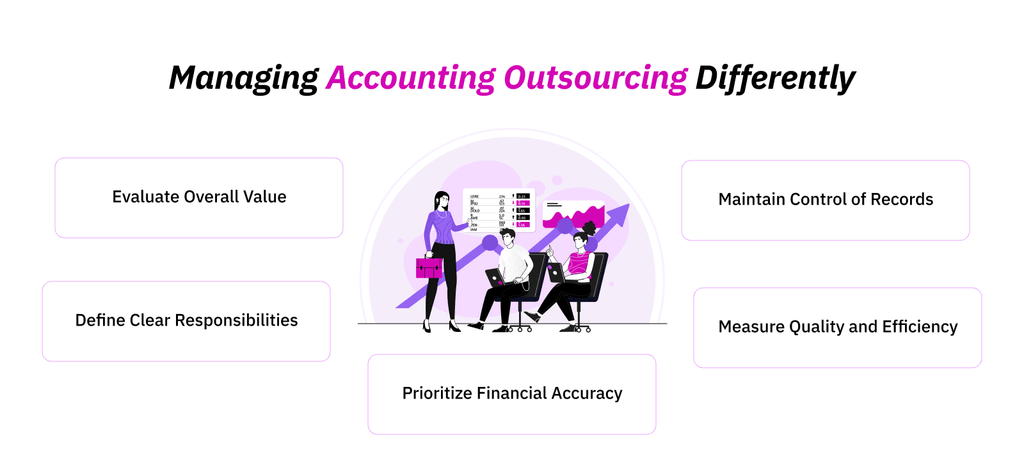
These experiences changed how I evaluate outsourced accounting arrangements. The principles I rely on now are straightforward:
- I look beyond the provider’s fees to understand whether the quality of work justifies the time and resources my firm continues to invest.
- I establish clear responsibilities from the outset so everyone understands their role in preparing, reviewing, and approving accounting work.
- I pay close attention to the reliability of financial records, particularly where unresolved discrepancies or weak internal controls could affect reporting.
- I assess whether the accounting team is producing accurate information without consuming unnecessary time or resources.
- I make sure the firm retains access to essential records and documentation so its accounting operations can continue smoothly, even if the provider changes.
I also recognize that responsibility does not rest entirely with the outsourced provider. Accounting firms must provide the business context, supporting documentation, internal decisions, and supervisory review necessary for external teams to perform their work.
Final Thoughts
Looking back, I think the biggest shift in my approach to accounting outsourcing has been learning when to step back without becoming disconnected from the work.
After all, the purpose of outsourcing is not to give yourself another team to manage; it is to create enough room for your accountants to focus on work that requires their expertise.
And that is the standard I would encourage you to consider. If outsourcing leaves your senior accountants with more time for meaningful client work and fewer operational distractions, it is serving its purpose.
The real achievement is not getting work off your desk; instead, it is making better use of the expertise still sitting around it.
FAQs
How can business owners evaluate the performance of outsourced accountants?
Business owners can evaluate outsourced accountants by assessing the accuracy of financial records and efficiency of their work. Financial reports should be reliable and delivered on time, with minimal recurring corrections. Tracking the time spent on reviews and rework also helps determine whether outsourcing is delivering measurable operational value.
When should a business consider changing its accounting provider?
A business should consider changing its provider when mistakes in accounting outsourcing persist despite reasonable efforts to resolve them. If the arrangement consistently demands more supervision than expected or undermines confidence in financial reporting, switching may be justified.
What accounting tasks should a CPA firm outsource first?
CPA firms should initially outsource routine, standardized accounting tasks such as transaction categorization, accounts payable processing, and bank reconciliations. These activities typically follow established procedures and require less professional judgment. Starting with well-documented, lower-risk work allows firms to assess provider reliability before delegating more complex accounting responsibilities.
What is the difference between accounting outsourcing and offshoring?
Accounting outsourcing involves hiring an external provider to handle accounting functions, regardless of location. Offshoring involves moving accounting work to another country, either through an external provider or an overseas subsidiary. The key difference is that outsourcing concerns who performs the work, while offshoring concerns where it is performed.
How can accounting firms protect confidential client information when outsourcing?
Accounting firms can protect confidential client information by selecting providers with appropriate security controls and enforcing confidentiality agreements. Moreover, access to financial records should be restricted according to job responsibilities, with multifactor authentication and encryption in place.
Do CPA firms need client consent before outsourcing accounting services?
CPA firms generally must inform clients when using third-party service providers, but explicit consent is not always required under AICPA rules if appropriate confidentiality safeguards are established. However, sharing tax return information may require written consent under IRC Section 7216, particularly for offshore outsourcing. State regulations may impose additional requirements.
Turn Workforce Data Into Actionable Insights With TimeBee
Try Today


Morgan Ellis
Member since October 30, 2026
Morgan Ellis
Member since October 30, 2026
Morgan Ellis is a Certified Public Accountant and Senior Accounting Consultant with expertise in financial accounting, auditing, management accounting, internal controls, and financial management.
With more than 14 years of experience in public accounting, corporate finance, and business advisory, Morgan has helped organizations improve internal controls and establish more effective accounting practices.
He holds a Bachelor of Science in Accountancy and a Master of Accounting Science from the University of Illinois Urbana-Champaign’s Gies College of Business.
He also earned the Certified Management Accountant (CMA) designation from the Institute of Management Accountants and the Certified Internal Auditor (CIA) certification from the Institute of Internal Auditors.
Drawing on this academic and professional background, his writing translates complex accounting concepts into clear, practical guidance for business owners and finance professionals.