

How to Evaluate Remote Employees (Based on 7 Years of Managing Remote Teams)
By Frank Oliver
September 18, 2026 13 min readEvaluating remote employees becomes much more accurate when you stop asking, “How busy did this person look?” and start asking, “What did this person contribute, and how well does the evidence suggest they delivered?”
With over seven years of experience working with remote teams, I have found that the strongest evaluations combine several dimensions, since no single metric tells the whole story. That means looking at outcomes and work quality alongside patterns in time use, activity, communication, reliability, and contribution.
Each of these signals can add context, but their value depends on how closely they relate to the employee’s actual responsibilities and expected results. When you assess them together, you get a much more complete picture of remote performance than any one measure can provide.
In this guide, I’ll be walking you through all the do’s and don’ts of remote performance reviews.
All About Work-From-Home Performance Review
- A fair performance review for remote employees should assess a remote employee against clearly defined expectations using a combination of metrics.
- Performance expectations: Compare the employee’s performance with the responsibilities, targets, and standards that were agreed for the review period.
- Results: Assess whether the employee achieved the intended outcomes of their work, rather than simply counting completed tasks.
- Work quality: Evaluate accuracy, completeness, rework, errors, and other role-specific quality indicators separately from output volume.
- Reliability: Look at how consistently the employee follows through on commitments, meets agreed deadlines, and delivers predictable results.
- Time utilization and work patterns: Review working-time and activity patterns in the context of the employee’s responsibilities, workload, and actual output.
- Communication effectiveness: Assess whether the employee communicates the information, updates, risks, and decisions necessary to perform their role effectively.
- Contribution to shared work: Consider the employee’s observable impact on shared deliverables, handoffs, dependencies, and outcomes involving other remote employees.
- Ownership: Evaluate how effectively the employee exercises judgment, takes accountability, handles issues within their remit, and works with appropriate independence.
How to Carry Out a Performance Review for Remote Employees?
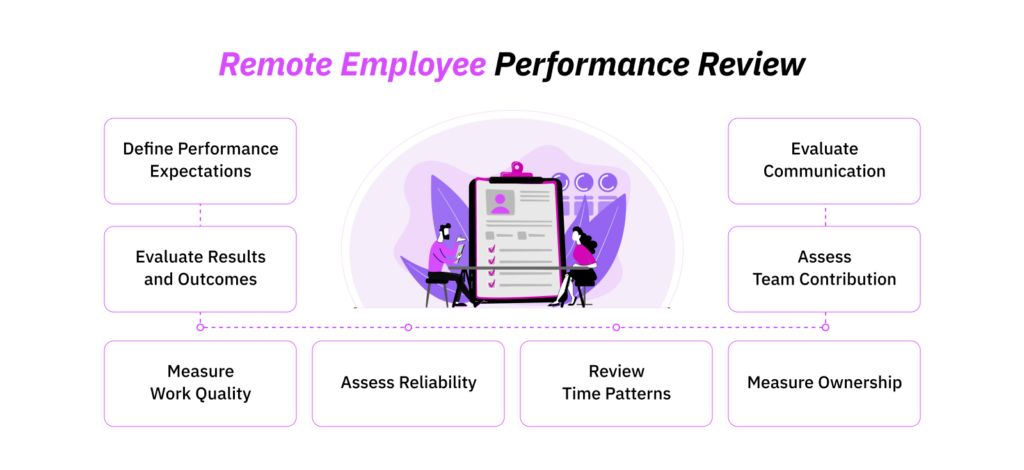
A useful work-from-home performance review does not begin with micromanagement. It begins by identifying what successful performance meant for that employee during the assessed period.
Starting from there, I evaluate several distinct dimensions. Keeping them separate matters because an employee can perform strongly in one area and poorly in another.
Here are all the metrics I focus on, and you should too.
1. Define the Agreed Performance Expectations
You need a benchmark before you can make a meaningful judgment.
To do so, it is always a good idea to start with what the remote employee was actually responsible for during the evaluation period. That may include:
- role responsibilities;
- expected outcomes;
- agreed deliverables;
- relevant KPIs;
- deadlines or service levels;
- quality requirements; and
- any role-specific standards.
The important part here, yet easily ignorable, is specificity.
For instance, “Produce good work” is not an evaluable standard. On the other hand, “Deliver 20 completed client reports each month with fewer than 2% requiring correction for material errors” gives you an outcome, quantity, quality threshold, and time period.
I, myself, have learned to be particularly cautious when an evaluation criterion appears only at review time. If responsiveness, documentation, turnaround time, or another behavior will materially influence someone’s rating, that expectation needs to have been part of the role standard during the period you are evaluating.
Otherwise, you risk grading the employee against rules they did not know were being applied.
2. Evaluate Results, Not Just Task Completion
Completing a task proves that an activity occurred. However, what it does not prove is whether the intended result was achieved.
Suppose two remote employees each complete ten assigned tasks. On paper, their completion rates are identical. However, one employee’s work resolves the underlying problems without further intervention, while six of the other employee’s ten tasks have to be reopened.
Counting completed tasks alone would describe their activity while concealing a substantial performance difference.
That is why I always make sure that I move from activity to accomplishment to outcome:
- Activity: What did the employee do?
- Accomplishment: What did the work produce?
- Outcome: Did that result create the value the role was expected to deliver?
However, it is also important to remember that every remote role won’t always have a neat, easily measurable business outcome. In some roles, performance may be reflected in revenue or conversion rates; in others, it may be better judged through accuracy, problem resolution, project completion, service quality, or another role-specific result.
So, the goal is not to force every responsibility into a single headline metric. It is to identify what successful work was supposed to achieve and then evaluate whether the employee’s contribution actually produced that result.
3. Measure Work Quality Separately From Output Volume
Quantity and quality answer two different questions:
“How much was produced?”
and
“How good was what was produced?”
I keep them separate because a strong output number can sometimes conceal weak performance.
I saw this firsthand when a remote employee I was managing produced 28 deliverables in a month against a target of 20. On volume alone, the result looked exceptional. However, 12 of those deliverables required material rework. Another employee completed 19, one below target, but none required correction.
Raw output favored the first employee. Once quality entered the evaluation, the picture changed considerably.
Since then, I have looked at the quality indicators that matter for the specific role before drawing conclusions about performance. Depending on the work, these may include:
- error or defect rates;
- revision frequency;
- accuracy;
- completeness;
- compliance with specifications;
- customer outcomes;
- stakeholder acceptance; or
- downstream problems caused by the work.
The lesson for me was that poor-quality output can move work through a workflow without actually completing it. An employee may appear highly productive while the cost of correcting that work is simply being passed to someone else.
That is why I assess output volume and work quality separately before deciding whether higher production represents stronger performance.
4. Evaluate Reliability Through Consistency and Follow-Through
Results tell you what an employee achieved, but reliability tells you how consistently you can depend on their commitments.
To find this out in remote employees, I look at patterns such as:
- meeting agreed deadlines;
- following through on commitments;
- delivering at the expected frequency;
- providing realistic estimates where estimation is part of the role;
- flagging material risks before they make a commitment impossible; and
- maintaining reasonably consistent performance over time.
Reliability should not be reduced to “never misses a deadline.” Some delays are outside an employee’s control. Instead, the right way to go about it is to consider whether the employee’s commitments are generally trustworthy.
For example, suppose someone delivers 23 of 25 agreed milestones when expected and flags the two remaining risks several days in advance with clear supporting evidence. That may represent stronger reliability than an employee who delivers all 25 but repeatedly requires last-minute intervention to do so.
I therefore assess the pattern of follow-through, not simply whether the final deadline was met.
5. Assess Time Utilization and Work Patterns in Context
Time data is particularly important when it comes to employee performance assessment for remote employees. It can add useful context to a remote employee evaluation, provided you do not confuse time spent with value produced.
The first question I ask is not, “How many hours did this employee log?” It is: “Do the work patterns help explain the performance results I am seeing?”
In my experience, this is where tools like TimeBee are most useful. I do not treat tracked hours, activity levels, idle time, or app usage as performance scores. Instead, I use them as supporting evidence when the results need more context.
For example, I have seen remote employees log around 39 hours a week while still missing expected output. In those cases, TimeBee helped me see whether working time was being fragmented across low-value activities or whether there were other patterns worth examining.
That did not prove underperformance by itself, but it gave me a clearer starting point for understanding the gap.
I have also seen employees record lower activity levels than their peers while consistently meeting targets and producing higher-quality work. That reinforced an important lesson: more activity does not automatically mean stronger performance.
I therefore pay more attention to patterns over several weeks than to isolated daily numbers. Used carefully, time and activity data can add useful context.
TimeBee: Turn Remote Work Data Into Performance Context
Learn More
6. Assess Communication Effectiveness Where It Affects Performance
Remote work creates a temptation to evaluate communication by volume because volume is easy to see.
However, my experience has taught me not to consider someone a stronger performer merely because they send more messages or respond within minutes. Instead, I evaluate communication only to the extent that it affects the employee’s ability to perform the role.
Now, to figure it out, you need to ask relevant questions during evaluation:
- Did the employee provide necessary information when others depended on it?
- Were important decisions documented appropriately?
- Were material risks communicated early enough to act on them?
- Were handoffs understandable?
- Did their communication prevent avoidable ambiguity?
- Did they comply with the response expectations attached to the role?
For example, an employee who sends 80 short messages a day is not automatically communicating more effectively than someone who provides three well-structured updates containing the decision, rationale, risk, owner, and next action. I therefore evaluate communication utility rather than communication volume.
7. Evaluate Contribution to Shared Work and Team Outcomes
Some remote roles produce easily attributable individual outputs. Others depend heavily on shared work. In the latter case, individual metrics alone can understate or overstate contribution.
To ensure that doesn’t happen, what I like to do is to try and look for observable evidence such as:
- successful handoffs;
- contribution to shared deliverables;
- resolving dependencies within the employee’s remit;
- useful specialist input;
- work that reduces downstream friction;
- relevant peer or stakeholder observations; and
- contribution to outcomes that could not reasonably be attributed to one person.
I learned the value of this when evaluating a remote employee whose individual output looked fairly ordinary on paper.
However, over one review period, their work reduced handoff delays by 18%, helped resolve four recurring dependency issues, and contributed to a shared project finishing 11 days earlier than expected. None of those results would have appeared clearly in a simple personal output metric.
That experience reinforced why I try to separate visible individual production from actual contribution to shared outcomes.
8. Assess Ownership Through Judgment, Accountability, and Independence
Ownership is another criterion that can easily become vague unless you define what you mean by it. Now, an important thing to remember is not to treat an employee never asking for help as ownership. That can encourage poor decisions and delayed escalation.
Instead, what I like to do is evaluate whether a remote employee demonstrates appropriate judgment within the scope of the role.
That may include whether they:
- take responsibility for agreed outcomes;
- make decisions they are reasonably expected to make;
- recognize when a decision exceeds their authority or expertise;
- identify and escalate material risks appropriately;
- take responsibility for mistakes rather than obscuring them;
- resolve problems within their remit; and
- follow an issue through to a clear conclusion.
That said, ownership should be judged against role scope and seniority rather than against an abstract ideal of self-sufficiency. After all, a junior remote employee and a senior specialist should not be expected to demonstrate identical levels of independent decision-making.
How to Keep Remote Performance Reviews Consistent and Evidence-Based
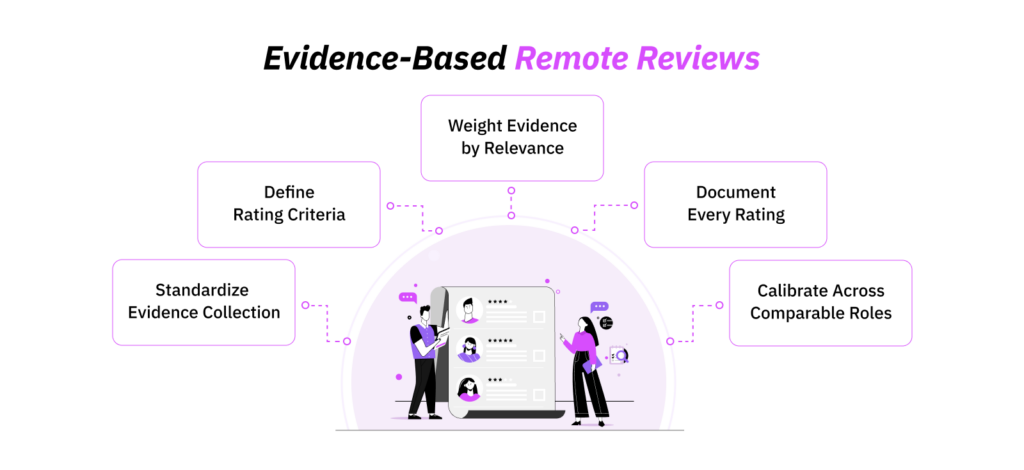
Once you know how to evaluate remote employees, the next challenge is consistency.
Without a structured approach, two remote employees can produce broadly similar performance yet receive different ratings because different evidence was noticed, remembered, or interpreted.
I use a simple principle here: the method should be repeatable enough that the rating does not depend primarily on who happens to conduct the review.
1. Use a Standard Framework for Collecting Performance Evidence
Create the same evidence structure for comparable remote roles before reviewing individual employees.
At minimum, I would capture:
- agreed expectations;
- relevant results;
- quality evidence;
- reliability evidence;
- role-specific metrics;
- material contextual factors; and
- relevant supporting observations.
A standard evidence structure gives you a consistent basis for comparing performance across similar remote roles.
If you review Employee A using project outcomes, error rates, and stakeholder evidence but assess Employee B largely from memory, the two ratings are not being produced through the same process.
A simple review record can prevent that.
| Criterion | Expected standard | Evidence reviewed | Assessment |
| Results | Defined role outcome | KPI/project evidence | Rating |
| Quality | Defined quality threshold | QA/rework evidence | Rating |
| Reliability | Agreed commitment standard | Delivery records | Rating |
| Role-specific criterion | Role requirement | Relevant evidence | Rating |
| Context | Material circumstances | Supporting records | Adjustment if justified |
The structure can be simple, as consistency matters more than complexity.
2. Define Clear Rating Criteria Before Scoring Performance
A rating such as “4/5” has very little meaning unless everyone involved understands what a 4 represents.
I personally prefer behaviorally defined ratings.
| Rating | Practical meaning |
| 5 – Exceptional | Consistently performs materially above the established role standard, with clear evidence of exceptional contribution |
| 4 – Strong | Frequently exceeds the expected standard while consistently fulfilling core responsibilities |
| 3 – Effective | Consistently performs at the established standard for the role |
| 2 – Below expectations | Material areas of expected performance are inconsistent or insufficient |
| 1 – Unsatisfactory | Performance repeatedly falls materially below established requirements |
You can adjust the terminology, but define the levels before assessing individuals.
That prevents evaluators from first deciding that someone “feels like a four” and then assembling evidence to support the impression.
3. Weight Performance Evidence According to Its Relevance and Reliability
Not every piece of evidence deserves equal influence.
I find it useful to think of performance evidence in three broad levels.
- Direct evidence is most closely connected to the employee’s expected performance. This could include completed outcomes, quality metrics, documented deliverables, and role-specific KPIs.
- Supporting evidence helps interpret those results. Relevant stakeholder feedback, documented decisions, project records, or work-pattern data may fall here.
- Weak or indirect signals have a looser relationship with actual performance. General impressions, raw message volume, or digital visibility are examples.
For instance, imagine you are assessing a remote employee whose primary responsibility is to deliver accurate weekly financial reports.
In this case, their:
- report accuracy,
- submission consistency, and
- material error rate
should all normally carry considerably more weight than how often they appear active in a communication platform.
So, I always ask myself: “If this metric changed substantially while the employee’s actual work stayed equally good, would I still change the performance rating?”
If the answer is no, it might be a supporting context rather than a core performance metric.
4. Document the Evidence Behind Each Performance Rating
A defensible rating should be explainable without relying on phrases such as:
“I feel that…”
“They seemed…”
“My impression was…”
“They weren’t very visible…”
Instead, connect the conclusion to evidence.
A more useful structure is:
Expected standard → observed evidence → relevant context → rating
For example:
The role required at least 95% of assigned reports to meet the agreed deadline. The employee delivered 47 of 48 reports on time during the evaluation period, with the one delay linked to a documented data-access issue. Reliability therefore exceeded the established standard.
That statement tells you what was expected, what happened, what relevant exception existed, and why the conclusion followed.
Specific documentation is especially useful for qualitative criteria.
5. Calibrate Final Ratings Across Comparable Remote Roles
Calibration checks whether the same performance standard is being applied consistently across remote employees performing comparable work.
For example, if one manager gives a rating of 5 whenever a remote employee meets every target, while another reserves 5 for performance materially beyond the established standard, the same numeric score represents two different things.
Calibration should surface questions such as:
- Are comparable results receiving comparable ratings?
- Is one evaluator consistently rating more harshly or generously?
- Are similar quality problems being treated similarly?
- Are role scope and seniority being accounted for consistently?
- Can unusually high or low ratings be supported with evidence?
The goal is simple: the rating should reflect performance standards rather than evaluator preference.
What to Avoid in an Employee Performance Assessment for Remote Employees
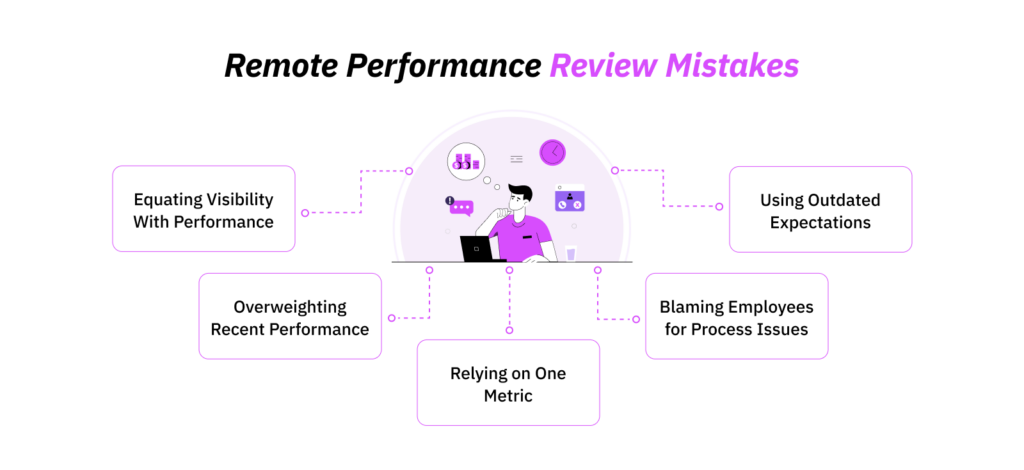
A good evaluation framework can still produce a weak conclusion if the wrong signals are allowed to influence it.
These are the errors I watch for most closely when assessing remote employees.
1. Don’t Rely on a Single Metric to Define Performance
A single metric isn’t useful on its own. A remote sales employee might exceed a revenue target while showing weaker forecast accuracy or deal quality, just as high task volume can hide poor quality or complexity differences.
I therefore prefer a small set of role-relevant measures that collectively reflect results, quality, reliability, and the actual contribution expected from the role.
2. Don’t Mistake Process Constraints for Individual Underperformance
Not every weak result points to weak employee performance. Delayed inputs, unavailable systems, shifting requirements, or other dependencies can materially affect remote work.
My operations background has taught me to separate the employee’s contribution from the process around them. The key is understanding what the employee could reasonably control, how they responded to constraints, and how much those constraints actually affected the final outcome.
3. Don’t Evaluate Employees Against Expectations That Changed Mid-Cycle
Remote responsibilities can change substantially during an evaluation period, so the original benchmark may no longer reflect the work actually performed. If priorities, workload, project scope, or responsibilities changed, I account for those changes before interpreting results.
Otherwise, an employee can appear to have missed an outdated target even though their effort was redirected toward work that became more important during the review period.
4. Don’t Let Recent Events Override the Full Evaluation Period
Recent performance is often easier to remember, but it may not represent the broader pattern. An unusually strong or weak final month should be considered alongside evidence from the rest of the review period.
I find it more reliable to look for consistency across several intervals, so the final rating reflects sustained performance rather than allowing one memorable success or setback to carry disproportionate weight.
5. Don’t Let Digital Visibility Influence the Performance Rating
Remote work creates many visible signals, including online status, message frequency, response speed, and computer activity. These can provide context, but visibility does not necessarily reflect contribution.
I distinguish between what is easy to observe and what actually matters to the role. When availability or responsiveness is an explicit requirement, it can be evaluated accordingly; otherwise, digital presence should not quietly become a substitute for performance evidence.
Conclusion
Evaluating remote employees well requires more than replacing observation with a productivity dashboard.
You need to begin with defined expectations, then examine results, quality, reliability, relevant work patterns, communication effectiveness, shared contribution, and ownership.
From there, the evaluation process should apply consistent rating definitions, weight evidence according to its relevance, account for material context, and document why the final judgment follows from the evidence.
After years of evaluating work in distributed environments, the principle I return to is straightforward: measure the contribution the role exists to produce, and use activity data only to help you understand that contribution, not to substitute for it.
When you can explain what was expected, what happened, what evidence supports it, which relevant factors affected the result, and why those facts justify the rating, you have an assessment that is much easier to defend, and much more useful than one based on perceived busyness.
FAQs
How often should remote employees receive a performance review?
Quarterly or semiannual reviews often work well, especially when responsibilities or targets change frequently. More stable roles may need less frequent formal assessments. Whatever cadence you choose, evaluate performance across the full review period rather than relying heavily on recent events. The review schedule can vary, but the evidence should consistently reflect the entire period being assessed.
Should remote employees complete a self-assessment before a performance review?
Yes. A self-assessment can surface accomplishments, context, and contributions that may not be fully visible to the evaluator. However, it should remain one source of evidence rather than determine the rating itself. I find it most useful when comparing the employee’s view with documented expectations, results, and other relevant evidence to identify any gaps in how performance is being interpreted.
How do you evaluate remote employees when their performance is difficult to quantify?
Use observable qualitative standards instead of forcing every responsibility into a numeric KPI. Depending on the role, you might assess decision quality, completeness, judgment, stakeholder acceptance, milestone achievement, or problem-solving effectiveness. The key is to define what good performance looks like in concrete terms so the evaluator can distinguish between below-standard, expected, and exceptional performance consistently.
How should time zones be considered when evaluating remote employee performance?
Evaluate the employee against the working hours and response expectations that apply to their role. A delayed reply should not count against performance if the message arrived outside the employee’s agreed working schedule. Time zones are most relevant when assessing response times, availability, handoffs, deadlines, and communication delays, so those standards should always be interpreted within the employee’s actual working window.
Can you evaluate remote employee performance without monitoring software?
Yes. Remote performance can be evaluated through results, quality, reliability, role-specific KPIs, project evidence, and relevant feedback. Monitoring software is optional. Tools such as TimeBee can add context through working time and activity patterns, but those signals should support rather than replace the core performance evidence. The aim is to understand how effectively the employee fulfilled the role, not to reconstruct every minute of the workday.
See the Work Patterns Behind Remote Performance With TimeBee
Try TimeBee


Frank Oliver
Member since July 8, 2026
Frank Oliver
Member since July 8, 2026
Frank Oliver is a Principal Consultant in Operations and Transformation, specializing in process improvement, digital transformation, operational performance, and the implementation of workplace technology.
He holds an MSc in Operations, Project and Supply Chain Management from The University of Manchester. He is also a Project Management Professional and a Prosci Certified Change Practitioner.
Overall, with more than 15 years of experience, Frank focuses on helping businesses identify the systems and workflows that influence productivity. His work further examines how processes, technology, management practices, role clarity, and data quality interact to affect organizational performance.